
Apollo landing sites
Apollo on tonight's Moon Apollo on the Moon of
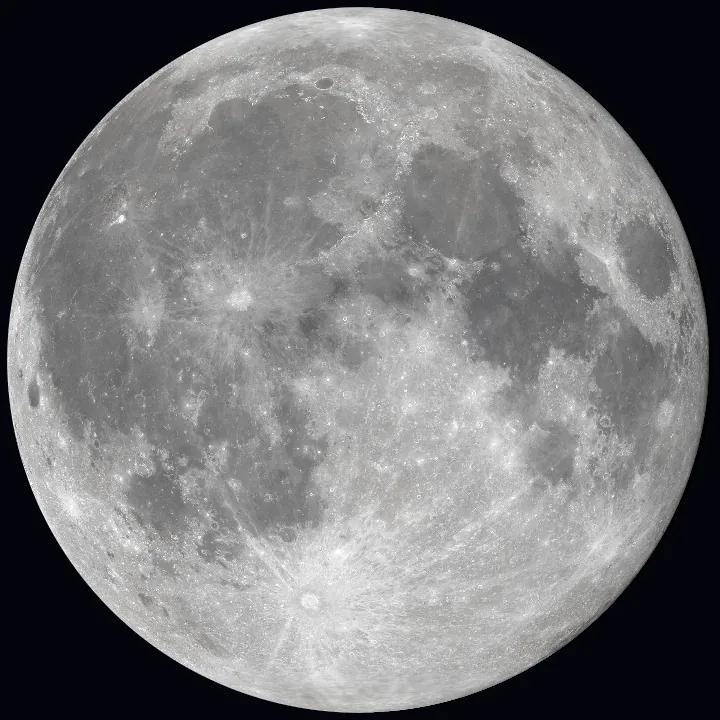
The six landing sites, and Apollo 13's planned one, placed on the Moon as it looks from where you are. Each pin is in sunlight or lunar night the way the site is right now. Pick a site for its mission dossier.
Site in sunlightSite in lunar nightPlanned, never reached
Clear-sky view: clouds and weather are not shown. Rendered from NASA Lunar Reconnaissance Orbiter maps.
The near side face on, north up, as at full Moon. With JavaScript on, this shows the Moon as it looks from your location right now.
Apollo 14
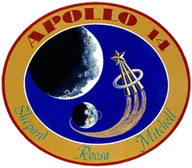
Apollo 14
Fra Mauro, near Cone crater, Fra Mauro highlands · 3.645° S, 17.471° W
- Commander
- Alan B. Shepard Jr.
- Command module pilot
- Stuart A. Roosa
- Lunar module pilot
- Edgar D. Mitchell
- Command module
- Kitty Hawk
- Lunar module
- Antares
Apollo 13's target, reached at last: a hill climb toward Cone crater, a hand-pulled cart, and two golf shots.
- Landed
- 5 February 197109:18 UTC
- Time on the Moon
- 33 h 30 minliftoff 6 February 1971
- Moonwalks
- 9 h 22 min2 moonwalks · ≈ 4 km2.5 miles with the MET cart
- Samples
- 42.28 kg93.2 lb
- Farthest from the lunar module
- ≈ 1.45 km0.9 mileson foot
- Mission
- 9 d 0 h 1 min34 lunar orbits · USS New Orleans
-
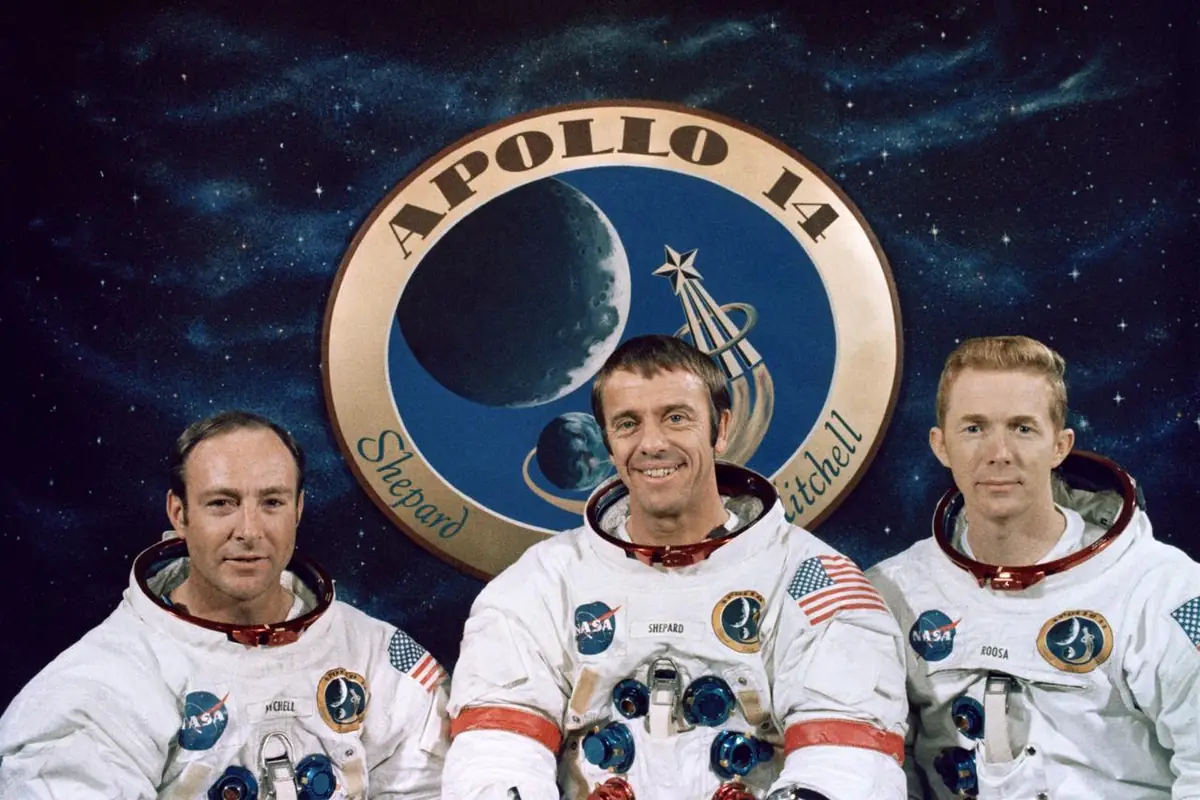
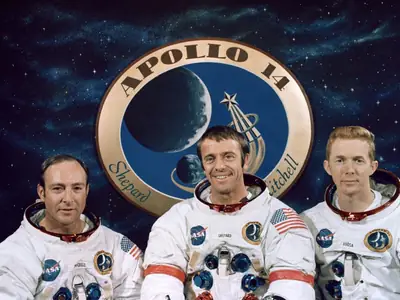 Prime crew portrait: Stuart Roosa, Alan Shepard and Edgar Mitchell.
-
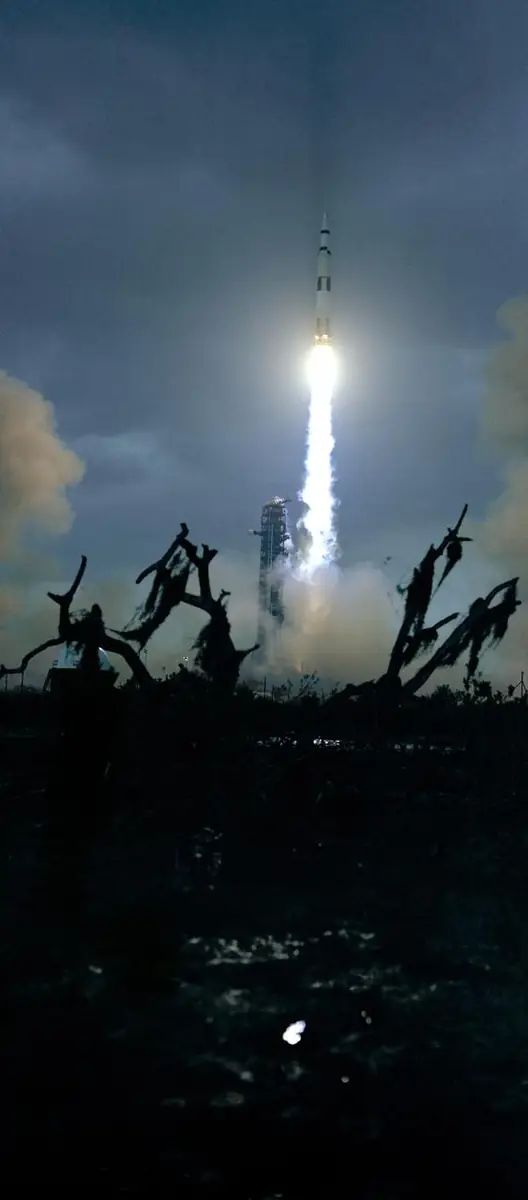
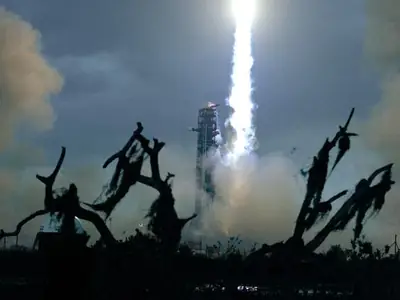 SA-509 lifts off on 31 January 1971 after a 40-minute weather hold.
-
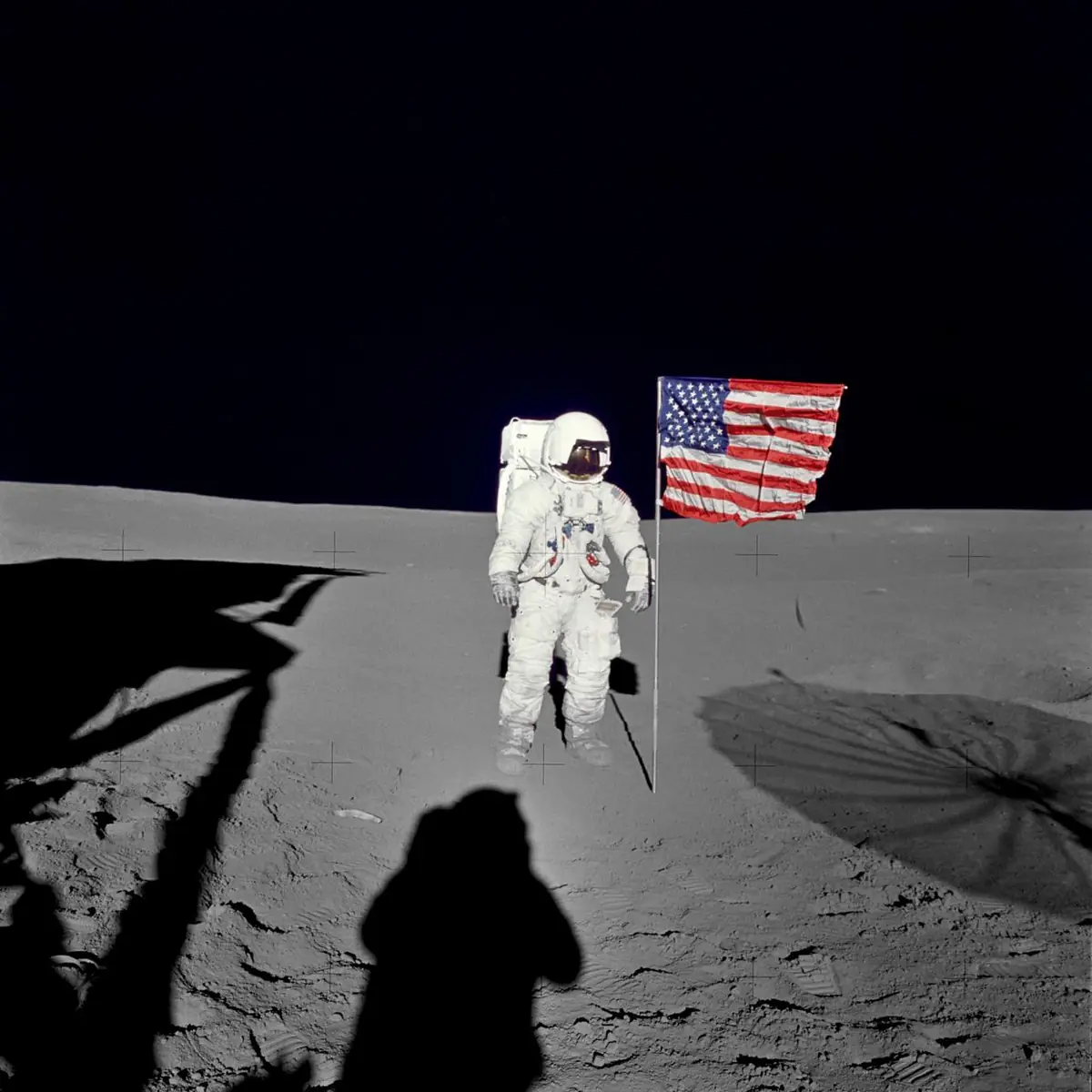
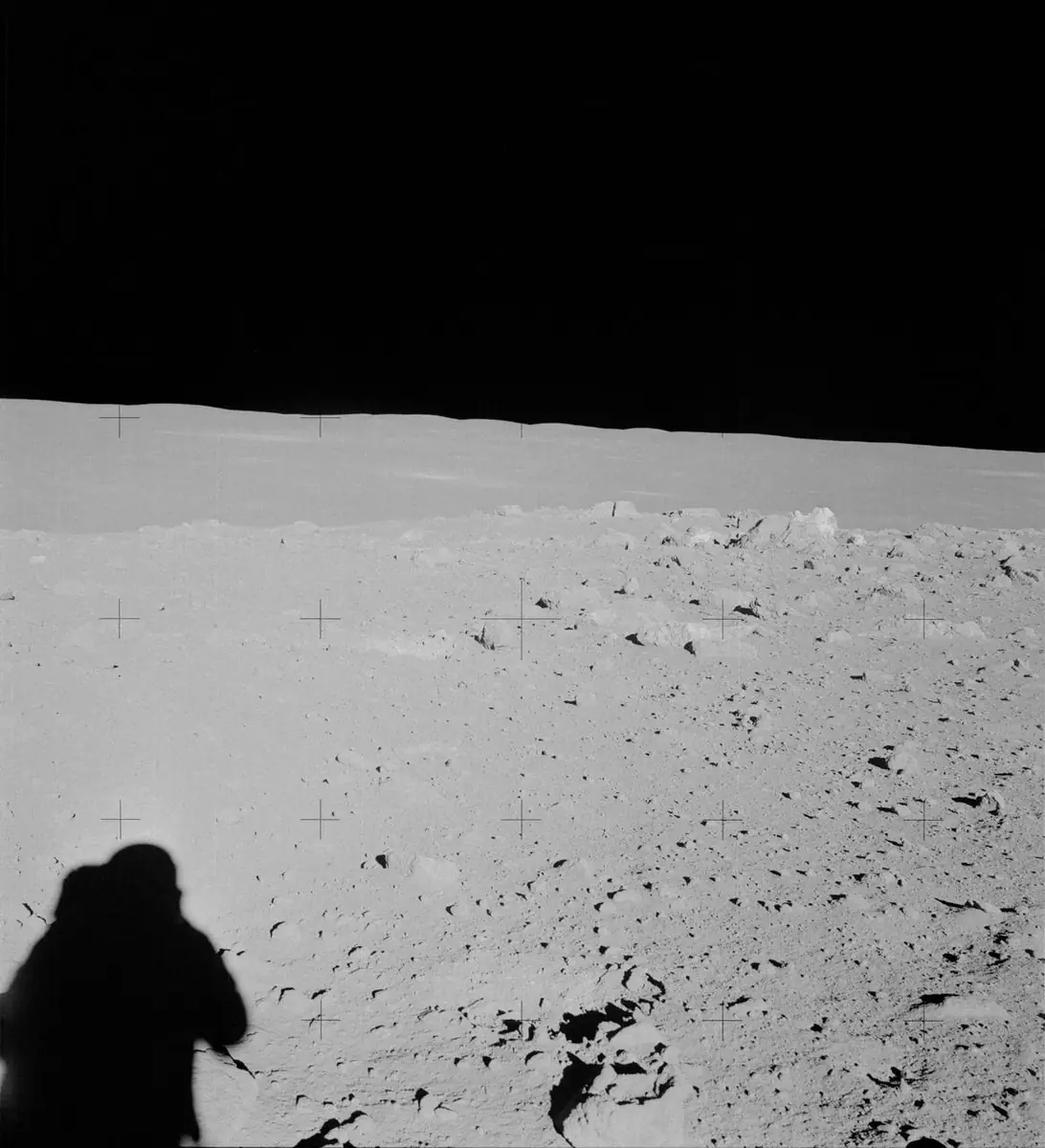
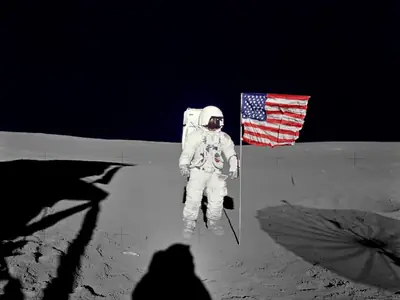 Mitchell by the flag early in EVA-1; Shepard's shadow in the foreground.
-
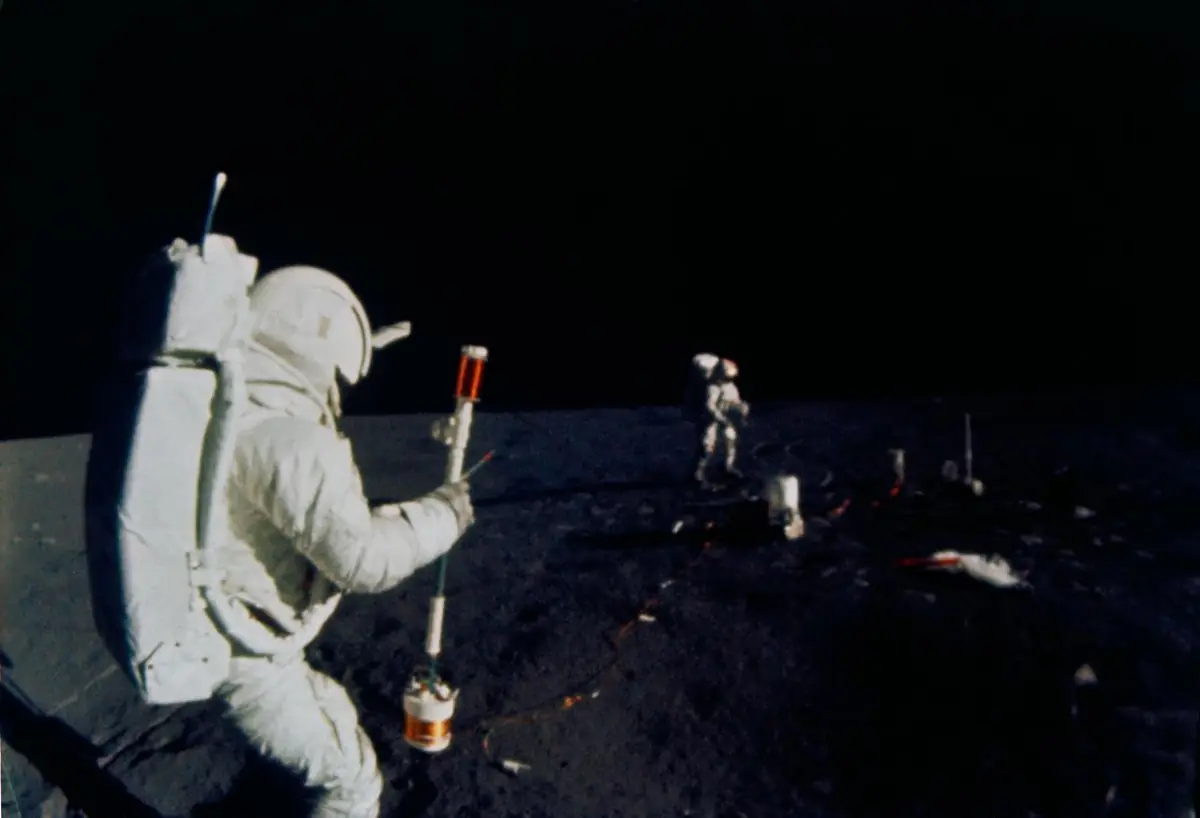
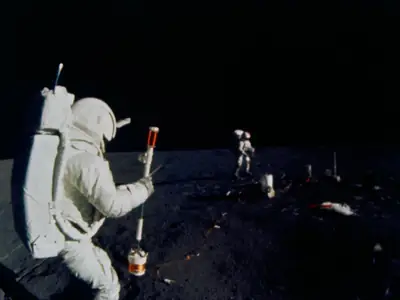 Mitchell fires the active seismic thumper; Shepard by the ALSEP (16 mm frame).
-
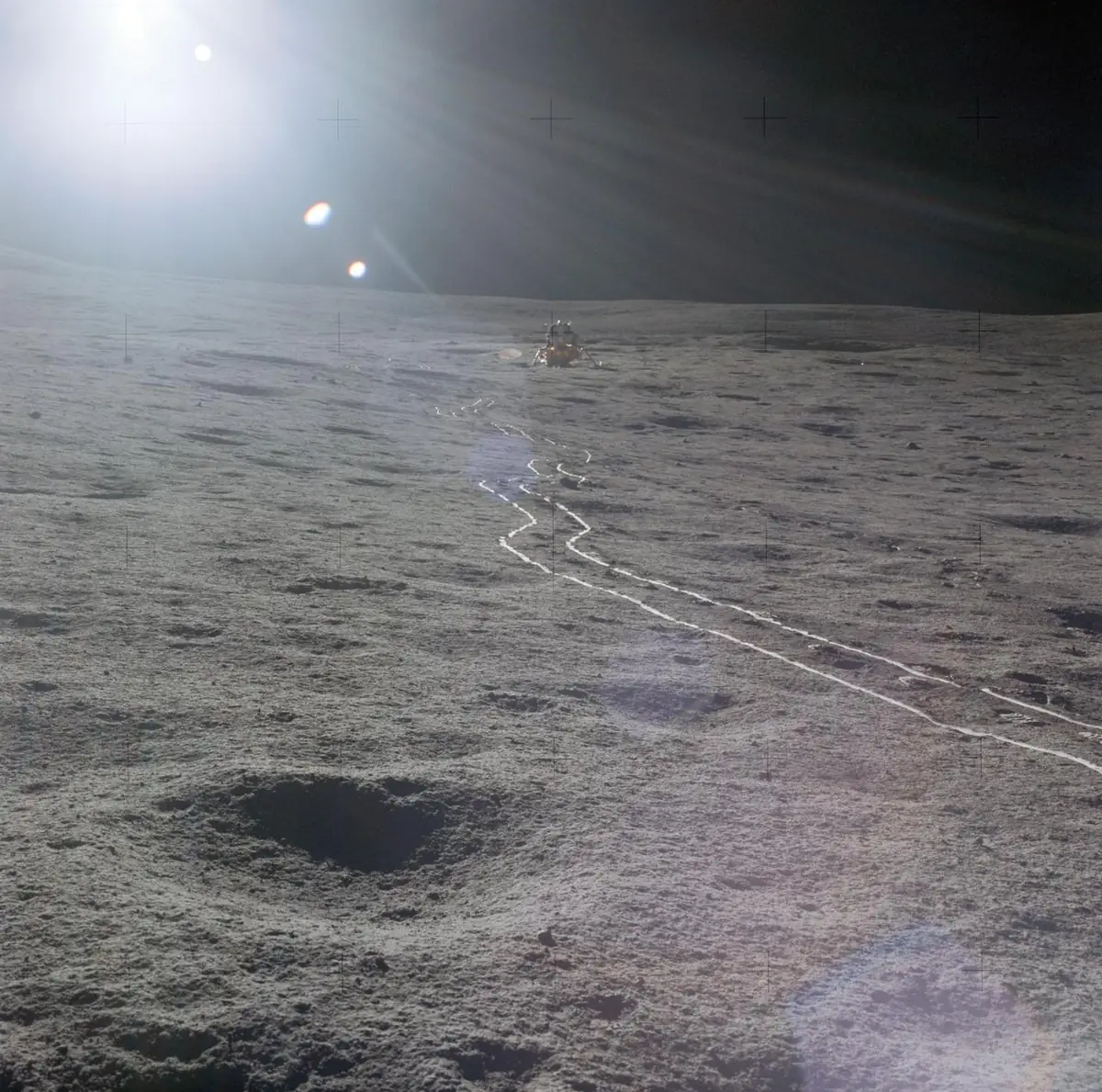
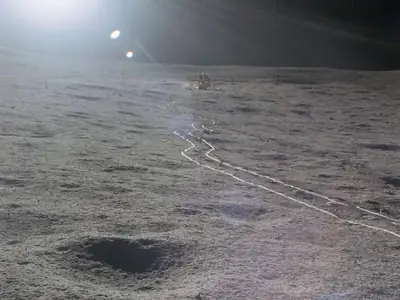 Antares against the glare, with the MET's tracks leading away.
-
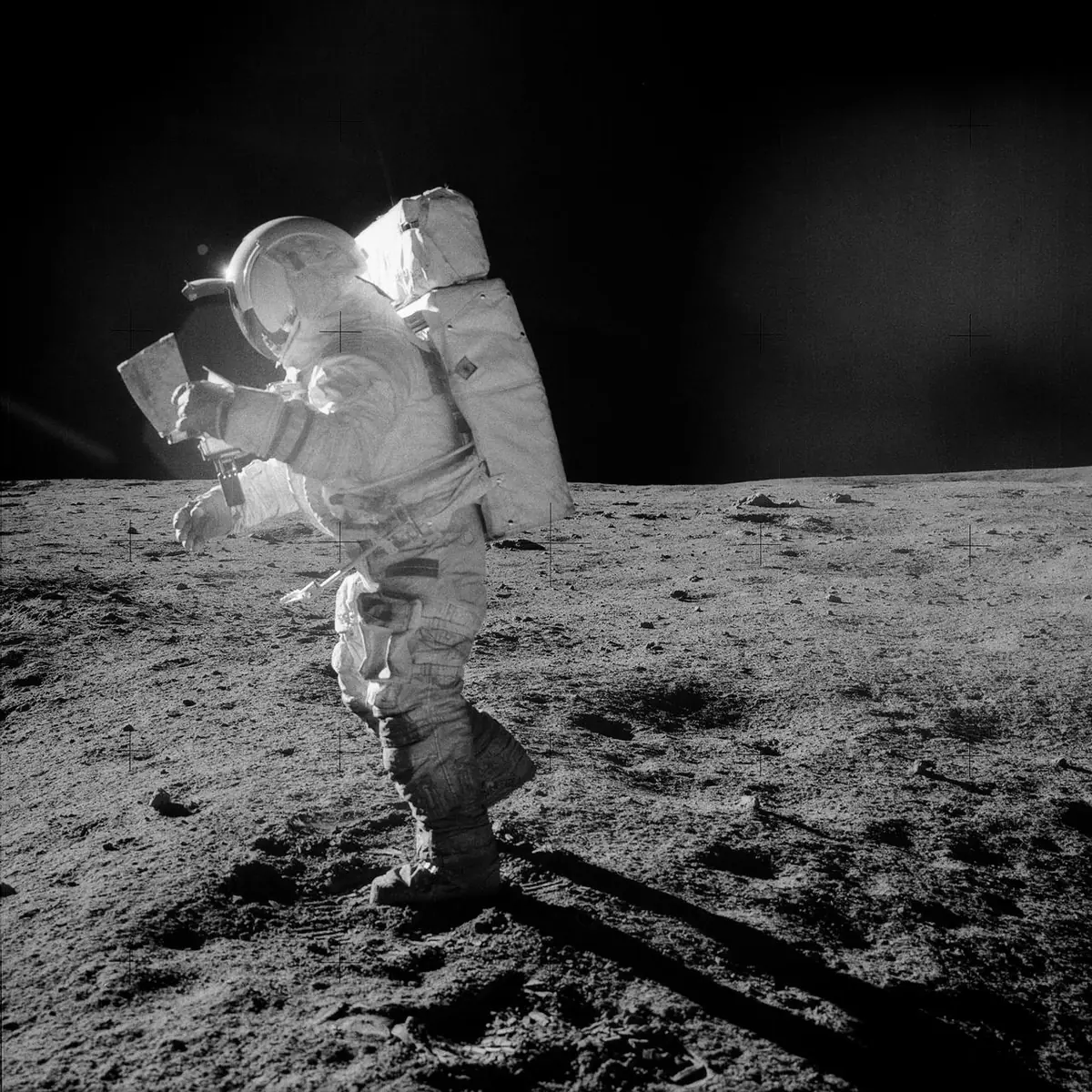
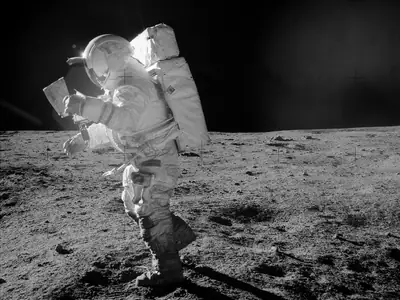 Mitchell studies the traverse map on the way to Cone crater.
-
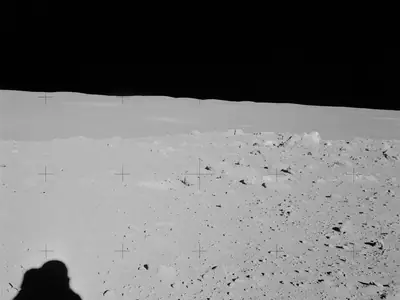 Boulder field on the flank of Cone crater.
-
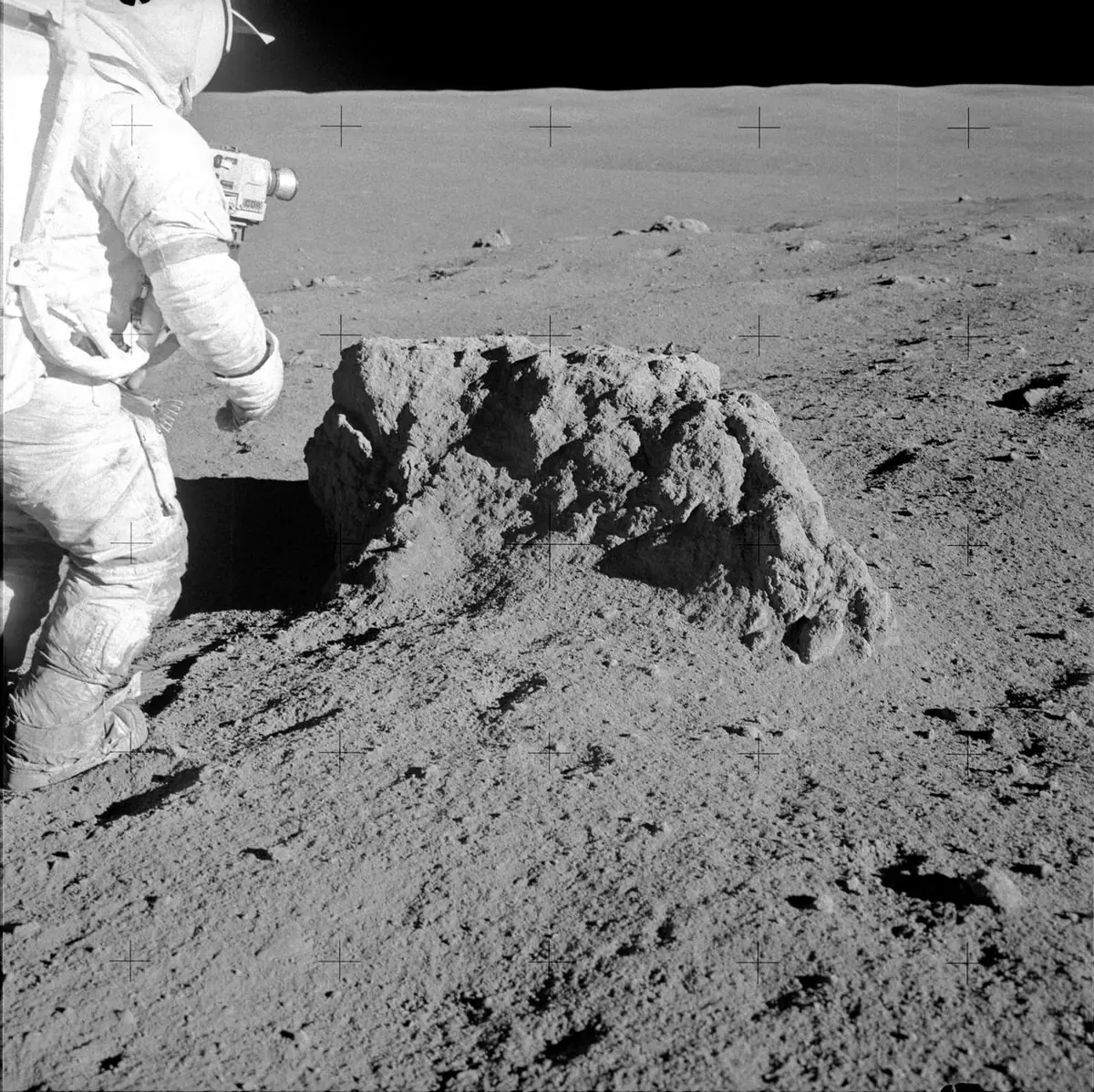
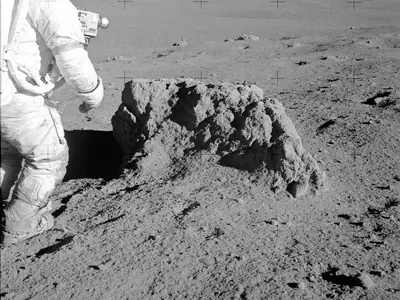 Shepard beside a large boulder on EVA-2.
-
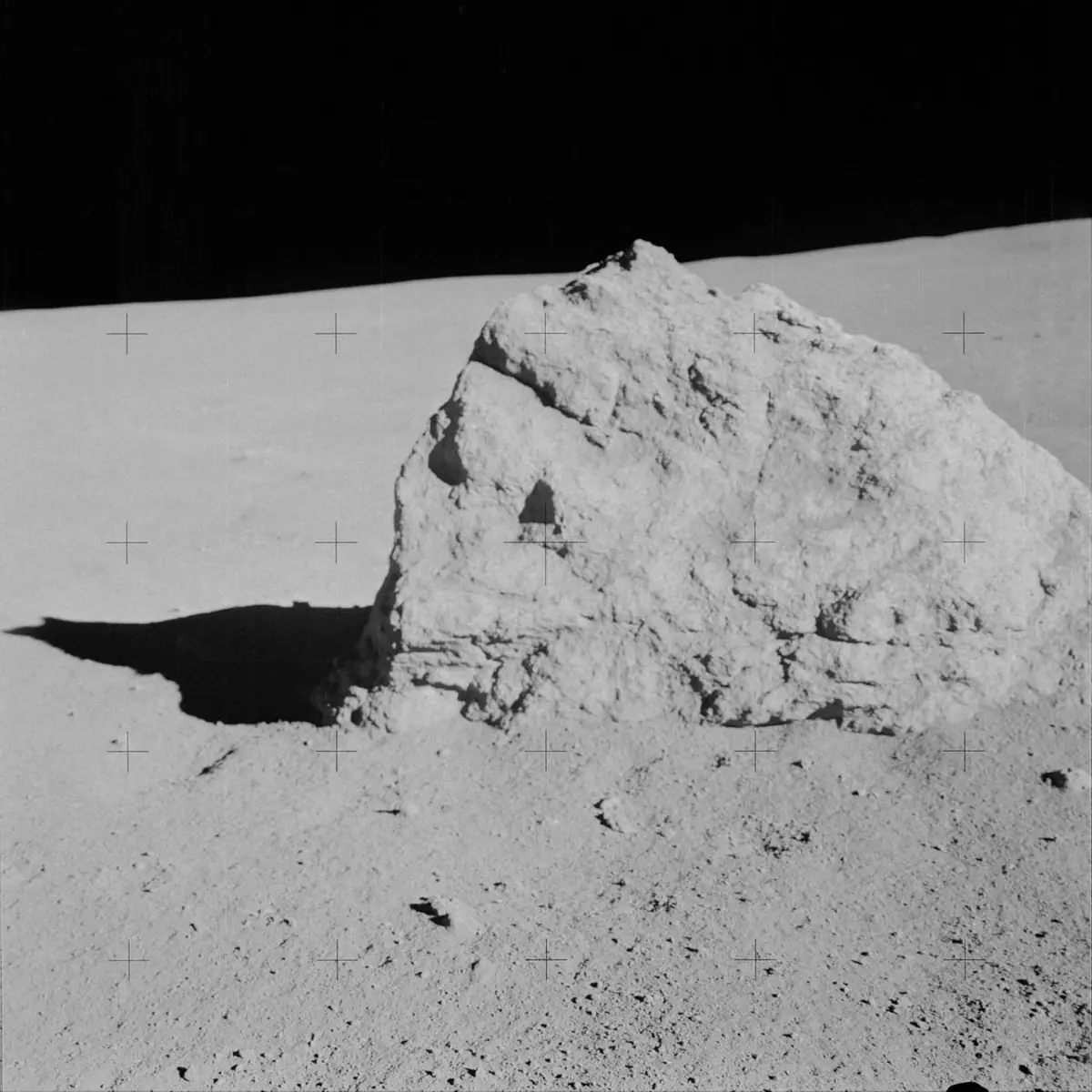
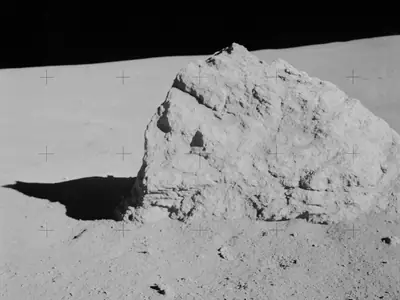 “Weird Rock”, about five feet across.
-
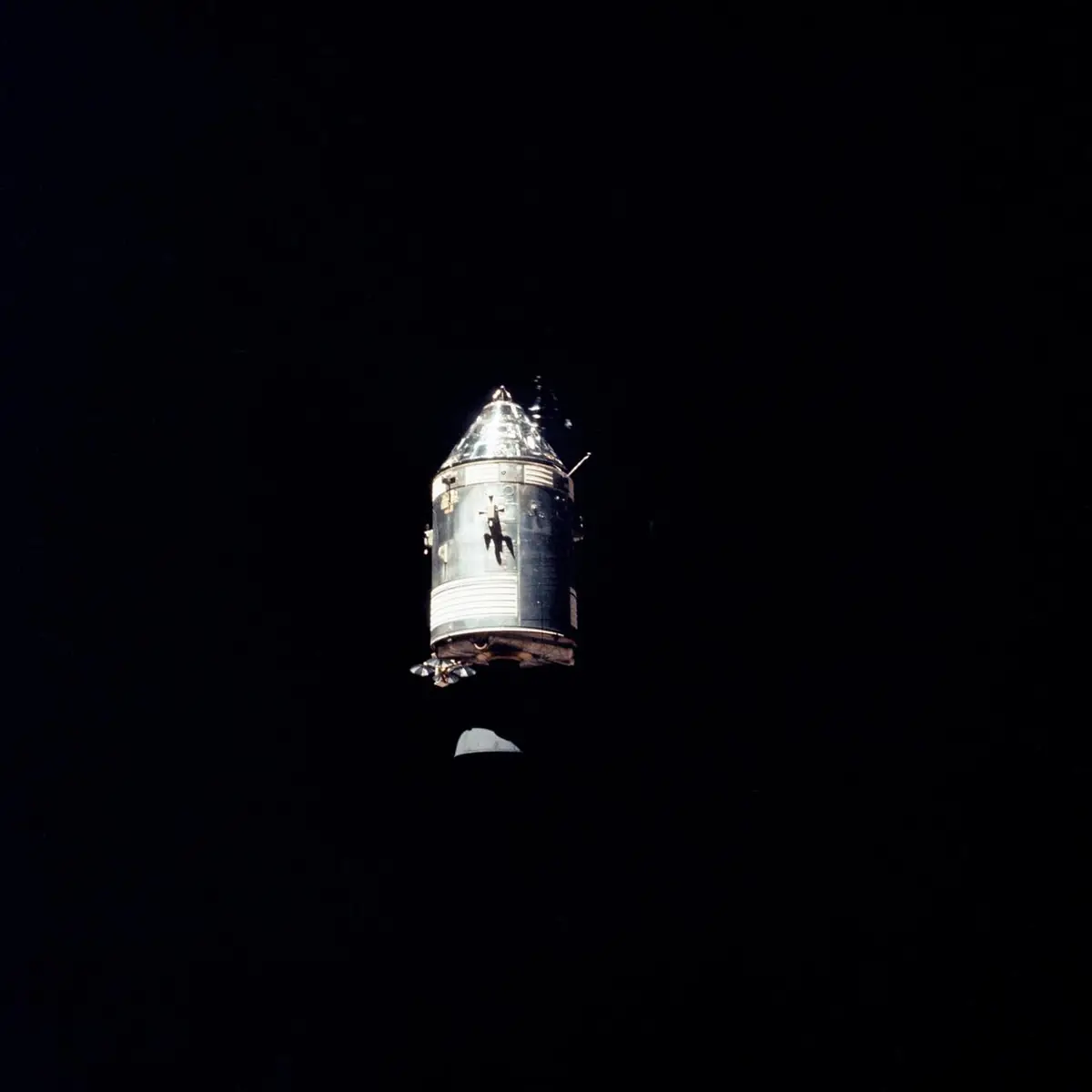
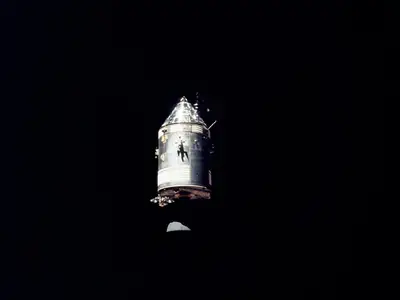 Kitty Hawk photographed from Antares in lunar orbit.
-
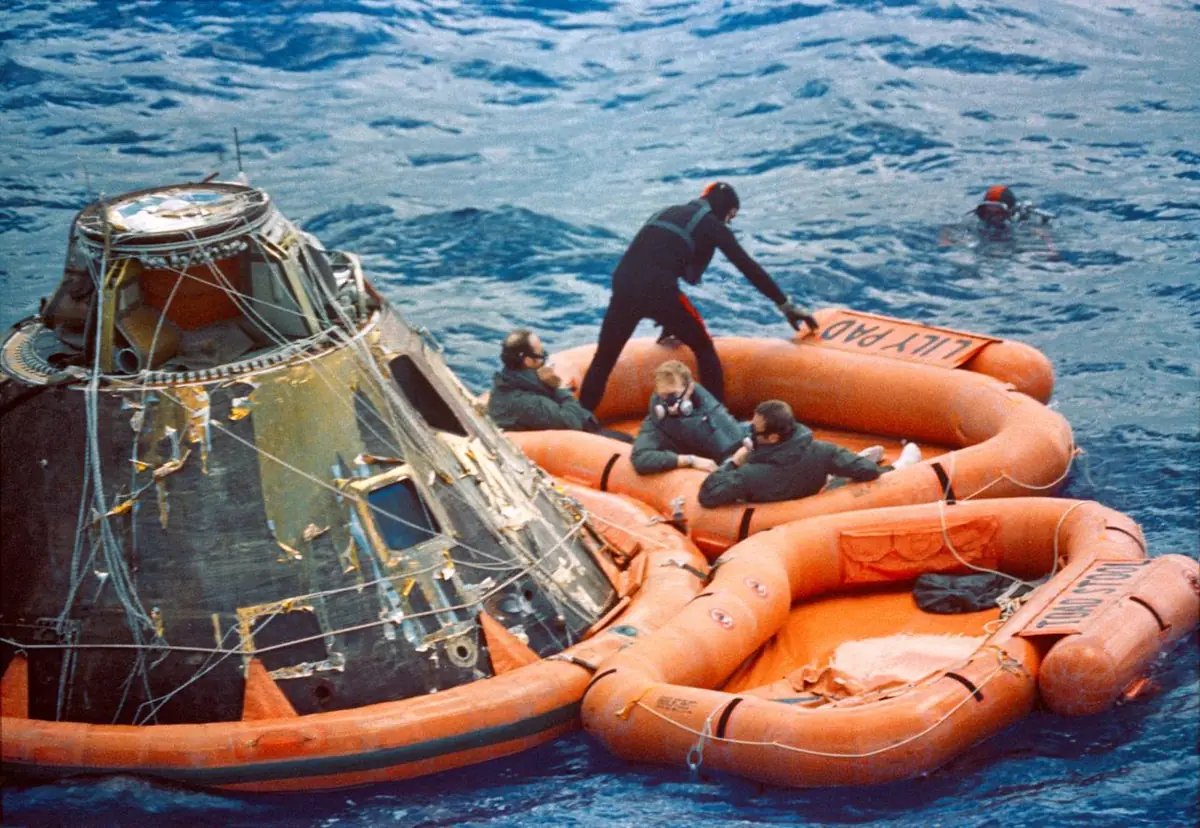
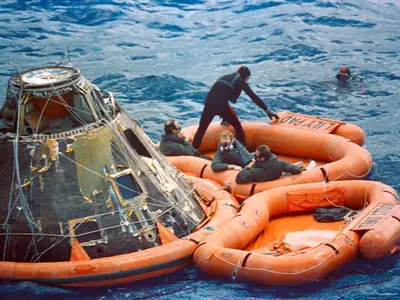 The crew in the raft beside Kitty Hawk in the South Pacific.
-
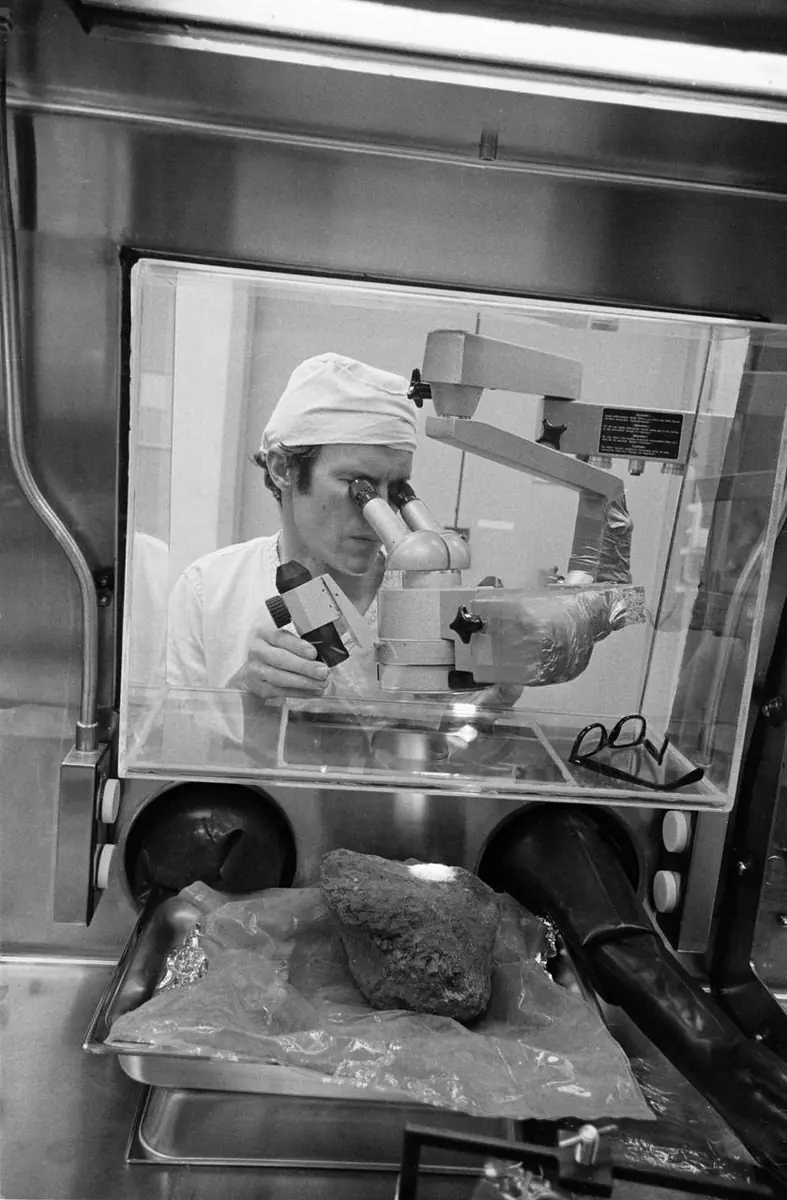
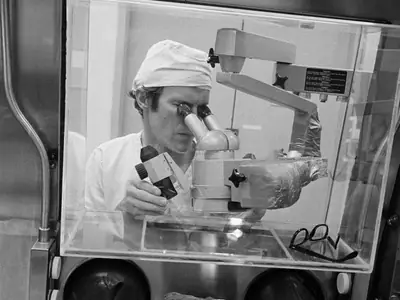 Big Bertha (14321) under the microscope at the Lunar Receiving Laboratory.
-
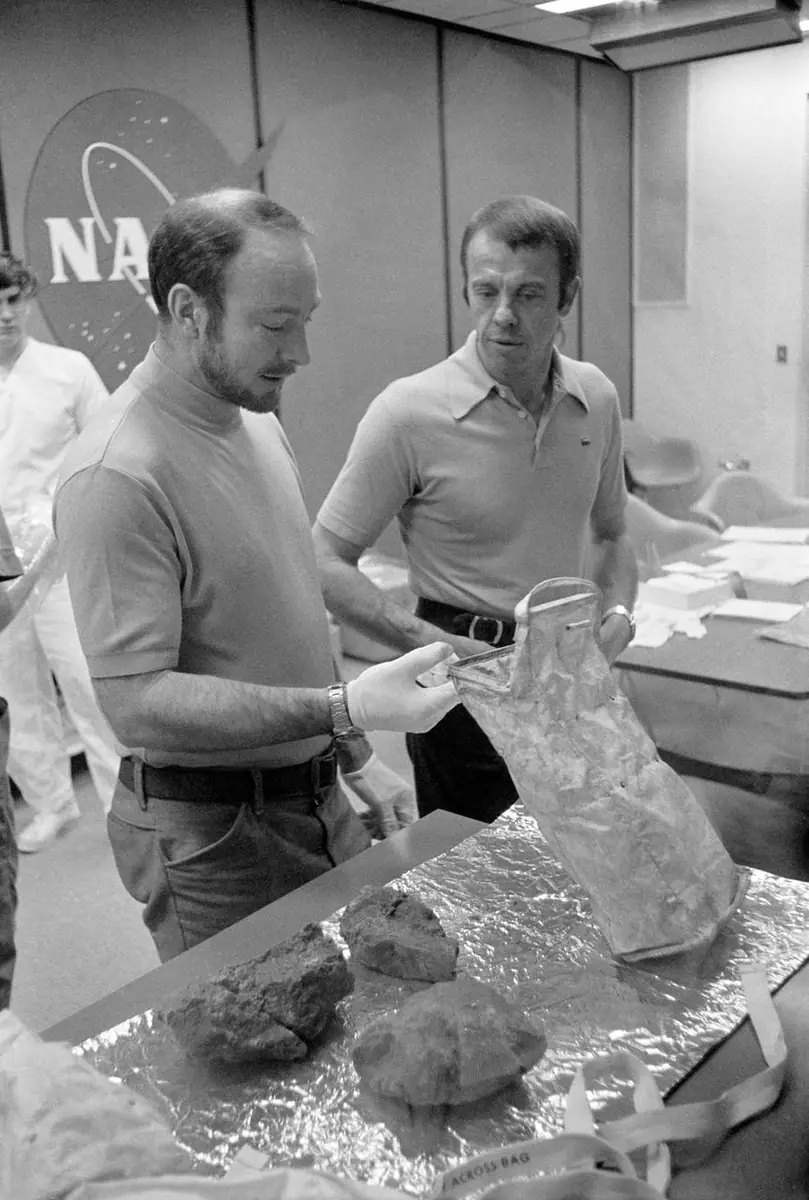
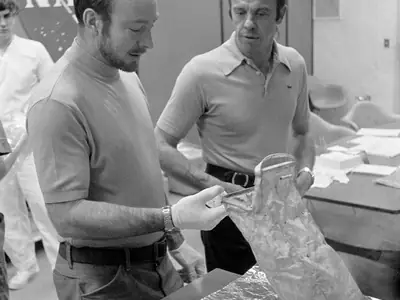 Mitchell and Shepard show reporters some of their largest rocks.
At a glance 13
-
Mission type
Type H (H-3): precision landing and two-EVA exploration; it flew Apollo 13's objectives at Apollo 13's site.
-
Dates
Launched 31 January 1971, landed 5 February, splashed down 9 February 1971.
-
Mission duration
216 h 01 min 58 s (9 days 0 h 2 min).
-
Call signs
Command module Kitty Hawk (CM-110) and lunar module Antares (LM-8).
-
Landing site
The Fra Mauro highlands, a hummocky blanket of debris thrown out by the Imbrium basin impact; Cone crater lies 1.3 km0.8 miles east-northeast.
-
Coordinates
3.64530° S, 17.47136° W.
-
Most precise landing
Antares touched down only about 53 m175 feet (17 m55 feet north, 50 m165 feet east) from its target point.
-
Time on the Moon
33 h 30 min 31 s.
-
Moonwalks
Two EVAs, totalling 9 h 22 min 31 s.
-
Samples
42.28 kg (93.2 lb).
-
Lunar orbits
34 orbits, 66 h 36 min in lunar orbit.
-
Designations
AS-509, Eastern Test Range #7194; international IDs 1971-008A to -008D.
-
Distance flown
1,000,279 n mi (about 1.85 million km1.15 million miles).
Crew & team 13
-
Alan Shepard, commander
Capt., USN, born 18 November 1923 in East Derry, New Hampshire; 47 at launch, the oldest person to walk on the Moon. U.S. Naval Academy 1944.
-
First American in space
Shepard flew Freedom 7 (Mercury-Redstone 3) in 1961 and was the only one of the original Mercury Seven to walk on the Moon.
-
Grounded and restored
Menière's syndrome grounded him for years; he ran the Astronaut Office until surgery in 1969 cured it. He was restored to flight status in May and assigned to Apollo 14 in August 1969.
-
Stuart Roosa, command module pilot
Maj., USAF, born 16 August 1933 in Durango, Colorado; 37 at launch. University of Colorado aeronautical engineering (1960), selected 1966, first flight.
-
Smokejumper
Before the Air Force, Roosa had parachuted into wildfires as a U.S. Forest Service smokejumper.
-
Edgar Mitchell, lunar module pilot
Cdr., USN, born 17 September 1930 in Hereford, Texas; 40 at launch. Sc.D. in aeronautics and astronautics from MIT (1964), selected 1966, first flight.
-
Rookie-heavy crew
Between them the crew had about 15 minutes of spaceflight before launch, Shepard's suborbital hop.
-
Backup crew
Gene Cernan, Ron Evans and Joe Engle.
-
Support crew
Bruce McCandless, Bill Pogue, Gordon Fullerton and Philip Chapman.
-
Capsule communicators
Gordon Fullerton, Bruce McCandless, Fred Haise and Ron Evans.
-
Flight directors
Pete Frank, Milt Windler, Gerry Griffin and Glynn Lunney across four shifts.
-
Gained weight
Shepard and Mitchell were the only Apollo moonwalkers recorded heavier at recovery than at launch (76.2 → 76.6 kg and 79.8 → 80.3 kg).
-
Later lives
Roosa died in 1994, Shepard in 1998 and Mitchell in 2016.
Launch & Saturn V 10
-
Liftoff
21:03:02 GMT (4:03:02 p.m. EST) on 31 January 1971 from Pad 39A.
-
Weather hold
Rain showers and the risk of lightning stopped the count at T−8 min for 40 min 2 s. Flight azimuth was changed from 72.067° to 75.558°.
-
Launch weather
21.7 °C71.1 °F, 86% humidity, cumulus 70% at 1,220 m4,000 feet; no rain at the pad at liftoff, but the vehicle flew through cloud.
-
Lightning lesson
The launch showed that flying through cumulus with tops up to 3,050 m10,000 feet was safe from triggered lightning, a rule shaped by Apollo 12.
-
Weight at ignition
6,505,548 lb for SA-509.
-
Ascent
Maximum dynamic pressure 655.8 lb/ft² at 81.0 s. Parking orbit 100.1 × 98.9 n mi (185 × 183 km115 × 114 miles) at 31.12°.
-
Translunar injection
350.84-s burn from 2:28:32, after 1.5 Earth orbits.
-
Clock change
To keep the flight plan's times, 40 min 2.9 s were added to the mission clock at 54:33:36.
-
S-IVB impact
The third stage was steered into the Moon at 82:37:52 near 8.1° S, 26.0° W. The Apollo 12 seismometer felt it 37 s later and kept ringing for more than three hours.
-
Upper winds
Strongest winds on the way up: 102.6 knots (190 km/h118 mph) at 13.2 km43,270 feet.
Spacecraft 10
-
Command & service module
CSM-110, 64,448 lb at launch; command module 12,831 lb dry.
-
Post-Apollo 13 changes
Redesigned oxygen tanks, a third oxygen tank in a separate bay and an auxiliary battery, all in response to the Apollo 13 explosion.
-
Antares
LM-8, 33,685 lb at launch.
-
Descent propellant
18,417 lb loaded, 17,623 lb burned; about 68–70 s of firing time left at touchdown.
-
Software
Colossus 2E (command module) and Luminary 1D (lunar module).
-
The MET
A two-wheeled Modular Equipment Transporter, pulled like a rickshaw, carried tools, cameras, a portable magnetometer and samples.
-
Docking trouble
It took six attempts to dock Kitty Hawk with Antares. The probe looked fine afterwards; the capture latches were thought not to have locked.
-
Phantom abort
Before descent a faulty abort switch kept sending an abort signal. MIT programmer Don Eyles wrote a workaround that Mitchell keyed in so the computer would ignore it.
-
Landing radar
The landing radar locked onto the wrong scale and gave no data until the crew cycled its circuit breaker.
-
Color TV that worked
Apollo 14 sent the first good color television pictures from the lunar surface.
Flight & orbit 10
-
Translunar coast
The S-IVB separated at 3:02:29; docking finally succeeded at 4:56:56 and the pair left the stage at 5:47:14.
-
Lunar orbit insertion
A 370.84-s burn at 81:56:41 into a 169.0 × 58.1 n mi (313 × 108 km194 × 67 miles) orbit; the coast had lasted 79 h 28 min.
-
CSM-powered descent orbit
For the first time the command module's engine, not the LM's, lowered both craft to 58.8 × 9.1 n mi (109 × 17 km68 × 10 miles) at 86:10:53, saving LM fuel.
-
Powered descent
Began at 108:02:27 at 7.8 n mi (14 km9.0 miles) altitude and lasted 764.61 s.
-
Lunar liftoff
18:48:42 GMT on 6 February; a 432-s burn reached 51.7 × 8.5 n mi (96 × 16 km59 × 9.8 miles).
-
Direct rendezvous
The first one-orbit rendezvous of Apollo: docking at 143:32:51, under two hours after liftoff and about two hours sooner than before.
-
Ascent stage impact
Steered into the Moon at 147:42:23, 36 n mi (67 km41 miles) west of the landing site.
-
Trans-Earth injection
A 149.23-s burn at 148:36:02 after 34 lunar orbits.
-
Experiments on the way home
Demonstrations of electrophoresis, liquid transfer, heat flow and composite casting in weightlessness, plus a navigation test without help from the ground.
-
Oxygen test
An oxygen flow-rate test on the way home checked the system for the longer EVAs planned on J missions.
Landing site 8
-
Touchdown
09:18:11 GMT (4:18:11 a.m. EST) on 5 February 1971.
-
Sloping ground
Antares stopped on a slope, pitched 1° down and rolled 6.9° right.
-
Sun angle
10.3°.
-
Why Fra Mauro
The formation was believed to be ejecta from the giant Imbrium impact, so its rocks could date that event and sample deep crust.
-
Apollo 13's target
Fra Mauro was Apollo 13's destination before the oxygen tank explosion in April 1970.
-
Cone crater
A young crater about 340 m1,100 feet wide on a ridge east-northeast of the LM, chosen to sample deep material it had dug up.
-
Seismic pair
The Apollo 14 seismometer stood about 181 km112 miles from Apollo 12's, forming the first two-station network on the Moon.
-
Fixes before landing
Two last-minute fixes, the abort-switch software patch and the landing radar breaker reset, saved the landing.
Moonwalks 11
-
“It's been a long way”
Shepard on stepping down: “And it's been a long way, but we're here.”
-
EVA-1
4 h 47 min 50 s, starting 49 min late because of a communications problem. ALSEP deployed about 150 m490 feet west of the LM; about 1 km0.6 miles walked and 20.5 kg collected.
-
Thumper
Mitchell walked the active seismic line firing the thumper; 13 of its 22 charges went off.
-
EVA-2
4 h 34 min 41 s. The climb toward Cone crater, about 3 km1.9 miles in all, with 22.3 kg of samples.
-
So close
Navigating in hummocky terrain and behind schedule, they turned back about 15 m50 feet from Cone's rim without knowing how near they were.
-
Hard going
Pulling the MET up the slopes and finding the way among similar-looking hummocks put the crew about 30 minutes behind schedule.
-
Moon golf
Shepard attached a 6-iron head to a sample-scoop handle and hit two golf balls with one hand. Image analysis in 2021 put them at about 22 and 37 m24 and 40 yards.
-
Javelin
Mitchell answered the golf by throwing a scoop handle like a javelin.
-
Trench and cores
They dug a trench about 45 cm1.5 feet deep. One attempt at a triple core tube failed.
-
Magnetometer stops
Portable magnetometer readings were taken at two sites on the traverse.
-
Totals
9 h 22 min 31 s outside, about 4 km2.5 miles covered, farthest point 1.45 km0.9 miles from Antares.
Surface science 9
-
ALSEP
Passive and active seismic experiments, suprathermal ion detector, cold cathode gauge, charged particle environment experiment and a dust detector.
-
Deployment glitches
A sticky bolt, a stiff cable that toppled the cold cathode gauge, a weak central station signal and noisy ion-detector data.
-
Mortar never fired
The active seismic mortar, with four grenades, was left to be fired by command later. It never was; uplink to the station was lost in 1975.
-
Laser reflector
A second 100-corner-cube reflector was set about 30 m100 feet west of the ALSEP.
-
Charged particles
The Charged Particle Lunar Environment Experiment flew only on Apollo 14. It measured electrons and ions from 50 to 50,000 eV.
-
Solar wind sail
Exposed for 21 h.
-
Station lifetime
The Apollo 14 central station failed in January 1976.
-
Gravity from the LM
Lunar gravity was measured with the LM's own guidance system as an operational test.
-
Portable magnetometer
Apollo 14 carried the first portable magnetometer, taking readings at stops along the traverse.
Rocks & discoveries 8
-
What came home
42.28 kg, mostly breccias, rocks of broken fragments welded by impacts, as expected of basin ejecta.
-
Dating Imbrium
Many breccias give ages near 3.9 billion years, interpreted as the age of the Imbrium impact.
-
Big Bertha
Sample 14321, a 9 kg breccia from near Cone crater, was the largest rock collected up to then and the third largest of Apollo.
-
A piece of Earth?
In 2019 researchers reported a granite fragment in Big Bertha whose zircons formed in Earth-like conditions about 4.0–4.1 billion years ago. It may be a meteorite from Earth.
-
KREEP country
Fra Mauro rocks are rich in KREEP, the potassium-rare-earth-phosphorus component first named from Apollo 12 samples.
-
Sample numbers
Apollo 14 samples are numbered 14xxx.
-
“Weird Rock”
Shepard photographed a large boulder about 1.5 m5 feet across on EVA-2, later nicknamed Weird Rock.
-
Contingency sample
Mitchell collected the contingency sample as his first task on the surface.
Alone in orbit 6
-
Roosa solo
Stu Roosa flew Kitty Hawk alone for 39 h 45 min.
-
Scouting Descartes
He photographed Descartes, the future Apollo 16 site. The lunar topographic camera failed, so a Hasselblad with a 500 mm lens stood in.
-
Faint light
He photographed the Gegenschein and Moulton point regions and other dim astronomical sources.
-
Moon trees
Roosa carried about 500 tree seeds for the Forest Service. After return they were grown into “Moon trees” and planted around the U.S. and abroad.
-
Bistatic radar
Kitty Hawk's S-band signal, bounced off the Moon to Earth, probed the surface's radar properties.
-
High-sun photography
He photographed the surface under high Sun to test how visible features would be for landing crews.
Return & recovery 8
-
Entry
Entry at 36,170 ft/s; peak 6.76 g.
-
Splashdown
21:05:00 GMT on 9 February 1971 at 27.02° S, 172.67° W, about 0.6 n mi (1.1 km0.7 miles) from target and 3.8 n mi (7.0 km4.4 miles) from USS New Orleans (LPH-11).
-
Upright
Kitty Hawk floated apex-up; crew aboard ship in 48 minutes.
-
Last quarantine
The crew was released on 26 February. No lunar microorganisms had been found at any of the three sites, so quarantine ended with this flight.
-
Radiation
The crew's average skin dose of 1.14 rad was the highest of any Apollo flight.
-
Recovery force
5 ships and 19 aircraft.
-
Where Kitty Hawk is
Displayed at Kennedy Space Center's Apollo/Saturn V Center in Florida.
-
Two quarantine trailers
The crew flew from the ship to Pago Pago, transferred to a second quarantine trailer on a C-141 and reached Houston on 12 February.
Moments & legacy 6
-
Back on track
The flight restored confidence after Apollo 13 and showed the redesigned spacecraft was safe.
-
The patch
The astronaut pin trails a comet tail from Earth to the Moon.
-
The golf club
Shepard's makeshift club is in the USGA Museum in New Jersey.
-
Dust control
New procedures cut the dust carried back into both spacecraft.
-
Mitchell's later path
Mitchell ran an unofficial ESP card test during the flight and later founded the Institute of Noetic Sciences.
-
From orbit today
LRO images show Antares's descent stage and the MET's wheel tracks heading toward Cone crater.
Seven missions side by side
Figures from NASA's Apollo by the Numbers. Select a mission to open its dossier.
| Measure | Apollo 11 | Apollo 12 | Apollo 13 | Apollo 14 | Apollo 15 | Apollo 16 | Apollo 17 |
|---|---|---|---|---|---|---|---|
| Landing (UTC) | 20 July 1969 | 19 November 1969 | did not land | 5 February 1971 | 30 July 1971 | 21 April 1972 | 11 December 1972 |
| Landing site | Mare Tranquillitatis | Oceanus Procellarum | Fra Mauro highlands (planned) | Fra Mauro highlands | Hadley–Apennine | Descartes Highlands | Taurus–Littrow valley |
| Lunar module | Eagle (LM-5) | Intrepid (LM-6) | Aquarius (LM-7) | Antares (LM-8) | Falcon (LM-10) | Orion (LM-11) | Challenger (LM-12) |
| Command module | Columbia (CM-107) | Yankee Clipper (CM-108) | Odyssey (CM-109) | Kitty Hawk (CM-110) | Endeavour (CM-112) | Casper (CM-113) | America (CM-114) |
| Commander | Neil Armstrong | Pete Conrad | Jim Lovell | Alan Shepard | David Scott | John Young | Gene Cernan |
| Lunar module pilot | Buzz Aldrin | Alan Bean | Fred Haise | Edgar Mitchell | Jim Irwin | Charlie Duke | Harrison Schmitt |
| Command module pilot | Michael Collins | Dick Gordon | Jack Swigert | Stuart Roosa | Al Worden | Ken Mattingly | Ron Evans |
| Mission type | G | H-1 | H-2 | H-3 | J-1 | J-2 | J-3 |
| Time on the Moon | 21 h 36 min | 31 h 31 min | none | 33 h 30 min | 66 h 54 min | 71 h 2 min | 74 h 59 min |
| Moonwalks | 1 · 2 h 31 min | 2 · 7 h 45 min | none | 2 · 9 h 22 min | 3 · 18 h 34 min | 3 · 20 h 14 min | 3 · 22 h 3 min |
| Samples | 21.55 kg | 34.35 kg | none | 42.28 kg | 77.31 kg | 95.71 kg | 110.52 kg |
| Farthest from the lunar module | 60 m200 feet | ≈ 410 m1,350 feet | none | ≈ 1.45 km0.9 miles | ≈ 5.0 km3.1 miles | ≈ 4.6 km2.9 miles | ≈ 7.6 km4.7 miles |
| Rover distance | none | none | none | none | 27.9 km17.3 miles | 26.9 km16.7 miles | 35.7 km22.2 miles |
| Sun at landing | 10.8° | 5.1° | none | 10.3° | 12.2° | 14.8° | 13.0° |
| Lunar orbits | 30 | 45 | none (flyby) | 34 | 74 | 64 | 75 |
| Mission length | 8 d 3 h 18 min | 10 d 4 h 36 min | 5 d 22 h 54 min | 9 d 0 h 1 min | 12 d 7 h 11 min | 11 d 1 h 51 min | 12 d 13 h 51 min |
| Recovery ship | USS Hornet | USS Hornet | USS Iwo Jima | USS New Orleans | USS Okinawa | USS Ticonderoga | USS Ticonderoga |
| Sourced facts | 130 | 113 | 134 | 112 | 110 | 111 | 112 |
Sources and method
27 sources, how the Moon is drawn, and photo credits
Mission facts
- R. W. Orloff, Apollo by the Numbers: A Statistical Reference, NASA SP-2000-4029
- E. M. Jones & K. Glover, Apollo Lunar Surface Journal (NASA History)
- Apollo Preliminary Science Reports, NASA SP-214, SP-235, SP-272, SP-289, SP-315, SP-330
- C. Meyer, Lunar Sample Compendium, NASA Astromaterials Curation
- NASA NSSDCA, Apollo: Where are they now?
- NASA Science, Moonwalkers (living status checked Nov 2026)
- NASA Science, Apollo 11 Seismic Experiment
- H. Lindsay, ALSEP essay, Apollo Lunar Surface Journal
- Active Seismic Experiment (Apollo 14 and 16 results)
- A. Saunders, The Mystery Behind Alan Shepard's 'Moon Shot' Revealed, USGA, Feb 2021
- K. Cartier, Apollo may have found an Earth meteorite on the Moon, Eos (on Bellucci et al. 2019, EPSL)
- Langseth, Keihm & Peters, Revised lunar heat-flow values (1976)
- Apollo 16 Preliminary Science Report, Lunar Portable Magnetometer
- LROC, Orion, Up Close (Apollo 16 site), NASA/GSFC/ASU
- Haymaker et al., The Apollo 17 Pocket Mouse Experiment (BIOCORE), NASA SP-368
- NASA/JPL, First Confirmed Capture into Earth Orbit Is Likely Apollo Rocket (2002)
- NASA Science, Genesis Rock
- NASA History, Apollo 13: Mission Details
- NASA History, 50 Years Ago: Apollo 13 Preps for 3rd Moon Landing
- NASA History, 50 Years Ago: Apollo 13 Review Board Report (on the Cortright report, June 1970)
- NASA, Apollo 13: The Successful Failure
- LROC, Rocket impacts recorded by the Apollo seismic network, NASA/GSFC/ASU
- NASA, Acting NASA Administrator Reflects on Legacy of Astronaut Jim Lovell, Aug 2025
- Associated Press, Artemis II makes trip around the Moon after breaking Apollo 13's distance record, Apr 2026
- collectSPACE, NASA's SpaceX Crew-13 pays homage to Apollo 13 on mission patch, Apr 2026
- NASA Image and Video Library (photo captions)
- General Apollo reference (mission reports, press kits, crew biographies)
How the Moon is drawn
Positions of the Moon and Sun come from Astronomy Engine (Don Cross, MIT license). The Moon's orientation uses the IAU/WGCCRE 2009 rotation model, giving the libration seen from your location. Spot checks against NASA's Dial-a-Moon agree to within 0.02° for the sub-Earth and sub-solar points.
Surface map: NASA Scientific Visualization Studio CGI Moon Kit (Ernie Wright), from Lunar Reconnaissance Orbiter camera data. Shading follows the Lommel-Seeliger law with faint earthshine.
Landing coordinates are in the IAU mean Earth/polar axis frame, as tabulated in Apollo by the Numbers; Apollo 13's is its planned target. Feature-name positions are approximate.
Photographs
All photographs and mission emblems are NASA images from the NASA Image and Video Library; each photo links to its original record. NASA does not endorse this site.
Crew living status was checked in November 2026. Mission times are UTC.
Source
Apollo Preliminary Science Reports, NASA SP-214, SP-235, SP-272, SP-289, SP-315, SP-330
All sourcesSource
A. Saunders, The Mystery Behind Alan Shepard's 'Moon Shot' Revealed, USGA, Feb 2021
All sourcesSource
All sourcesSource
NASA/JPL, First Confirmed Capture into Earth Orbit Is Likely Apollo Rocket (2002)
All sourcesSource
NASA History, 50 Years Ago: Apollo 13 Review Board Report (on the Cortright report, June 1970)
All sourcesSource
NASA, Acting NASA Administrator Reflects on Legacy of Astronaut Jim Lovell, Aug 2025
All sourcesSource
All sources