
Apollo landing sites
Apollo on tonight's Moon Apollo on the Moon of
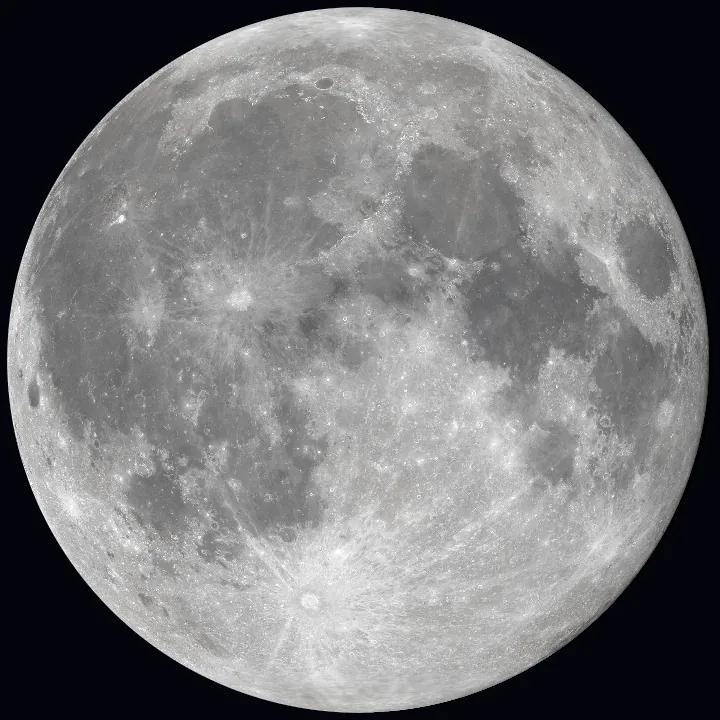
The six landing sites, and Apollo 13's planned one, placed on the Moon as it looks from where you are. Each pin is in sunlight or lunar night the way the site is right now. Pick a site for its mission dossier.
Site in sunlightSite in lunar nightPlanned, never reached
Clear-sky view: clouds and weather are not shown. Rendered from NASA Lunar Reconnaissance Orbiter maps.
The near side face on, north up, as at full Moon. With JavaScript on, this shows the Moon as it looks from your location right now.
Apollo 15
Apollo 15
Hadley Rille, at the foot of the Apennines, Hadley–Apennine · 26.132° N, 3.634° E
- Commander
- David R. Scott
- Command module pilot
- Alfred M. Worden
- Lunar module pilot
- James B. Irwin
- Command module
- Endeavour
- Lunar module
- Falcon
The first J mission: the first rover, three long traverses beneath mountains 4 km2.5 miles high, and the Genesis Rock.
- Landed
- 30 July 197122:16 UTC
- Time on the Moon
- 66 h 54 minliftoff 2 August 1971
- Moonwalks
- 18 h 34 min3 moonwalks · 27.9 km17.3 miles by rover
- Samples
- 77.31 kg170.4 lb
- Farthest from the lunar module
- ≈ 5.0 km3.1 milesby Lunar Roving Vehicle
- Mission
- 12 d 7 h 11 min74 lunar orbits · USS Okinawa
-
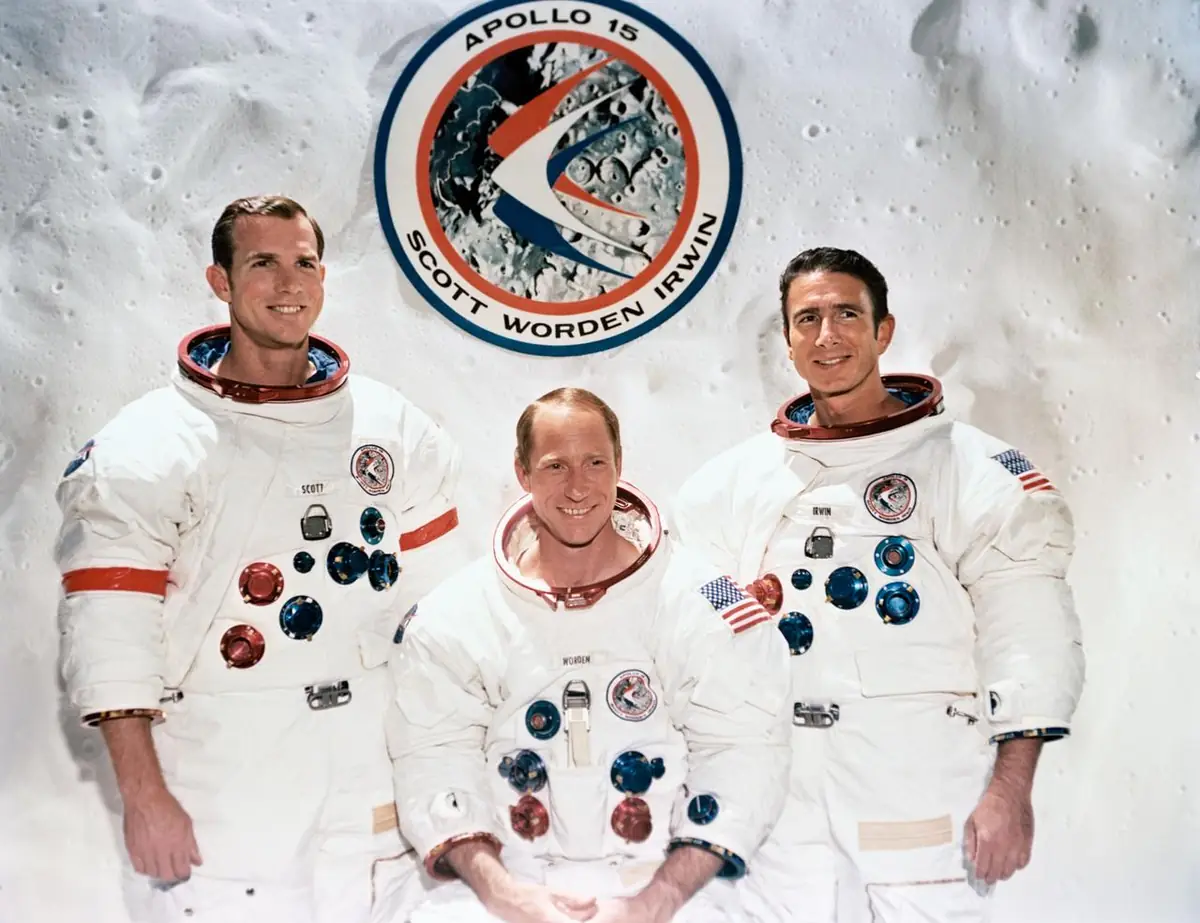
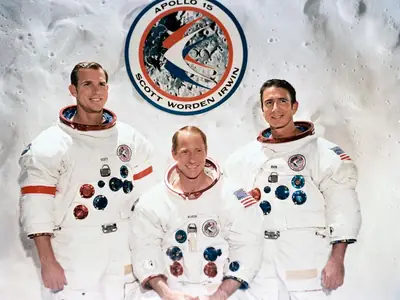 Prime crew portrait: David Scott, Al Worden and Jim Irwin.
-
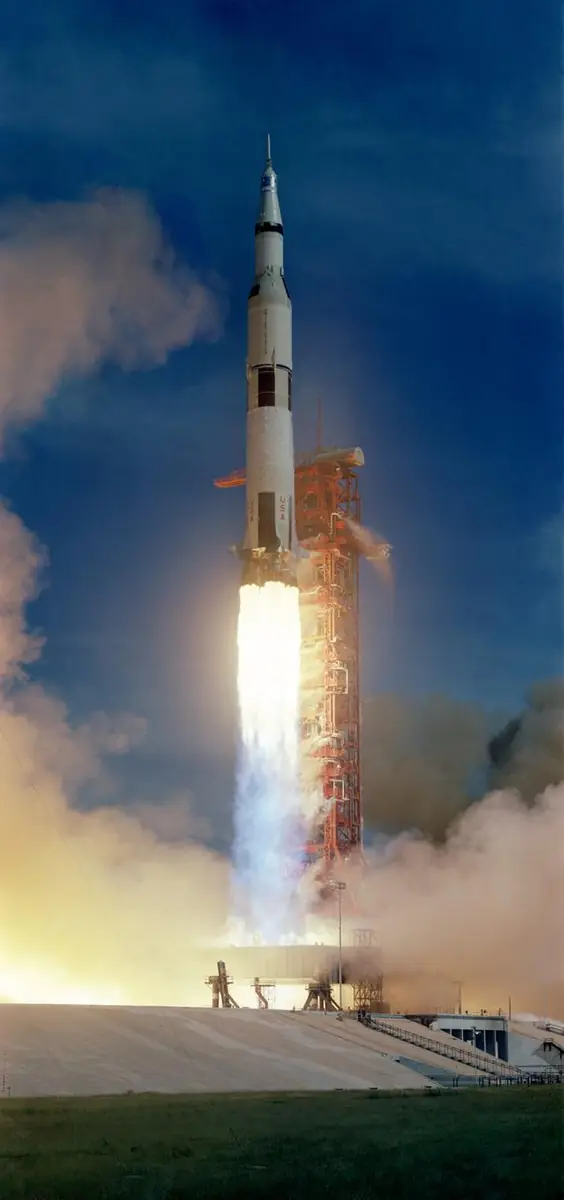
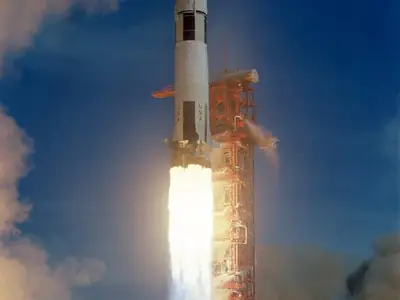 SA-510 lifts off from Pad 39A, 26 July 1971.
-
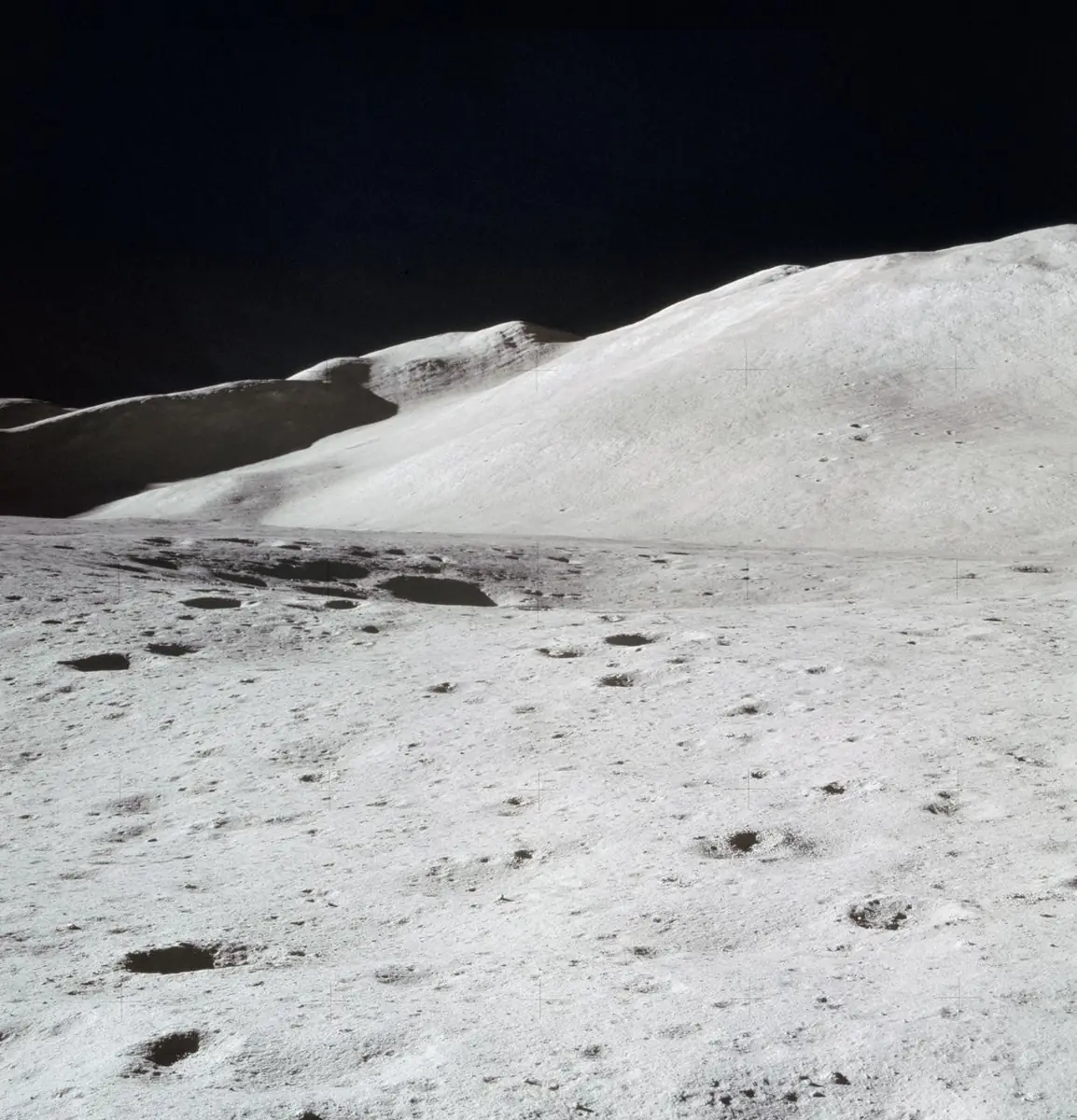
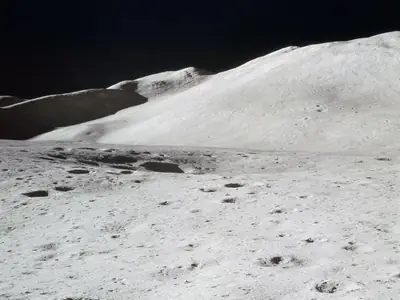 Hadley Delta from Falcon's top hatch during the stand-up EVA.
-
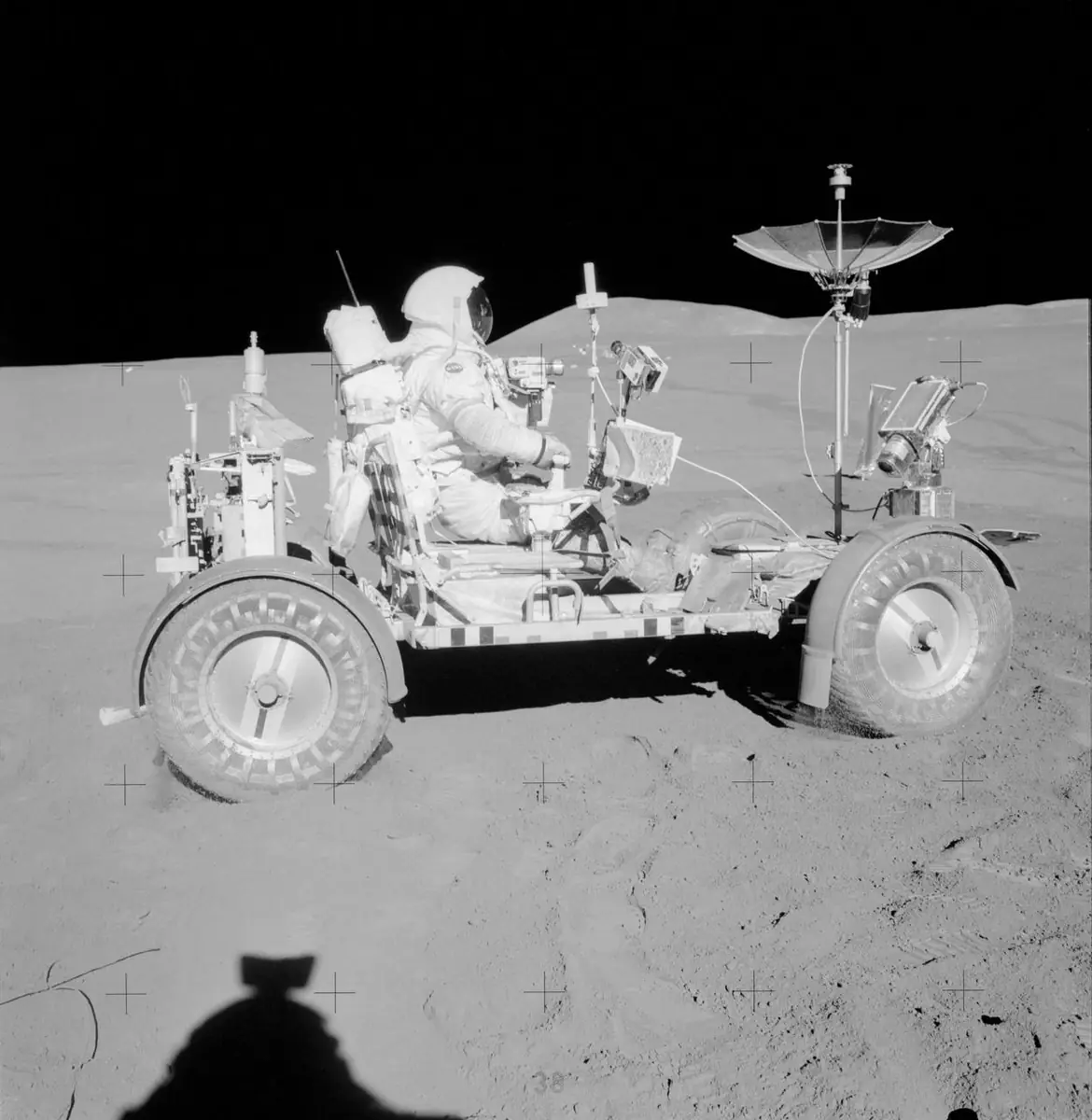
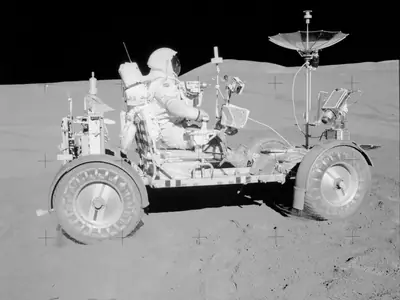 Scott in the first Lunar Roving Vehicle on EVA-1.
-
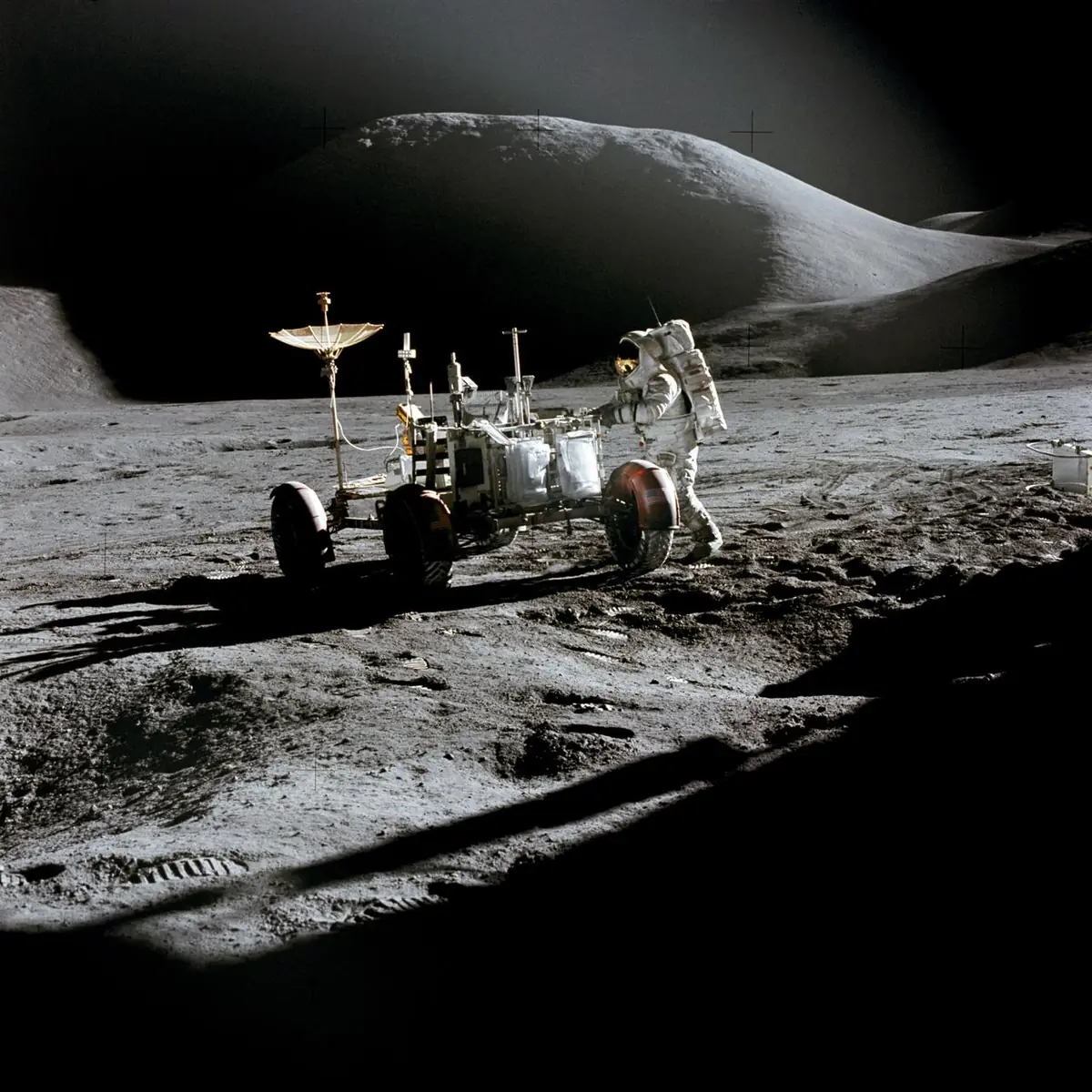
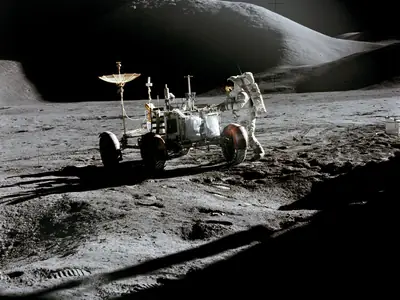 Irwin at the rover at the end of EVA-1, Mount Hadley behind.
-
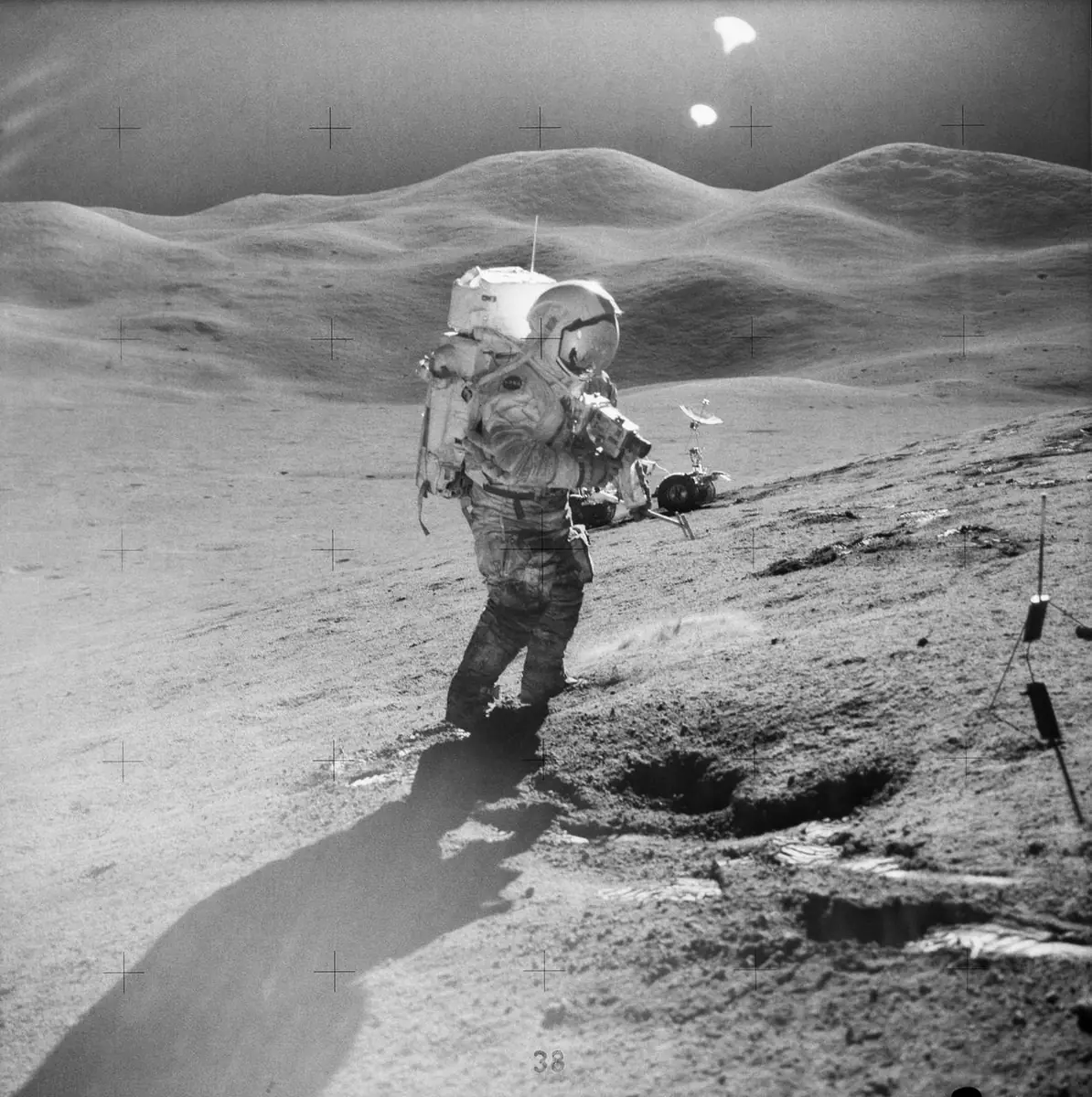
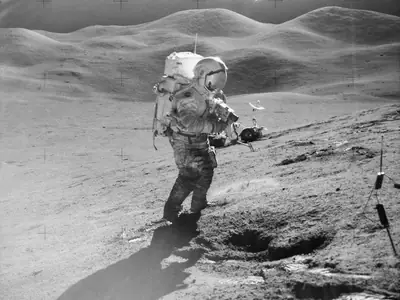 Scott on the slope of Hadley Delta with the rover beyond.
-
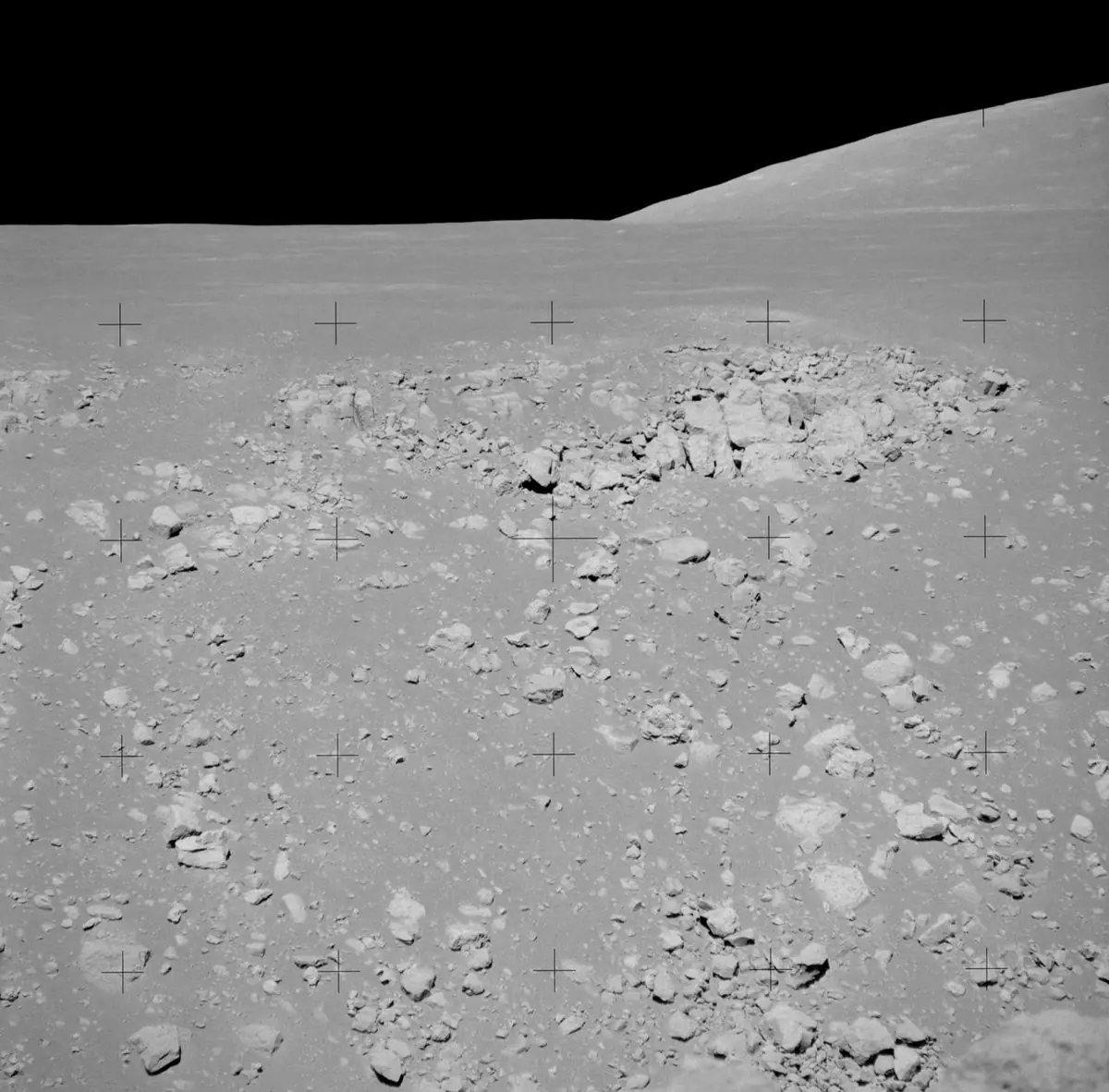
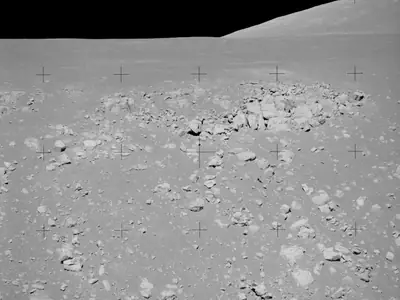 Telephoto view across Hadley Rille; the outcrop is about 1.9 km1.2 miles away.
-
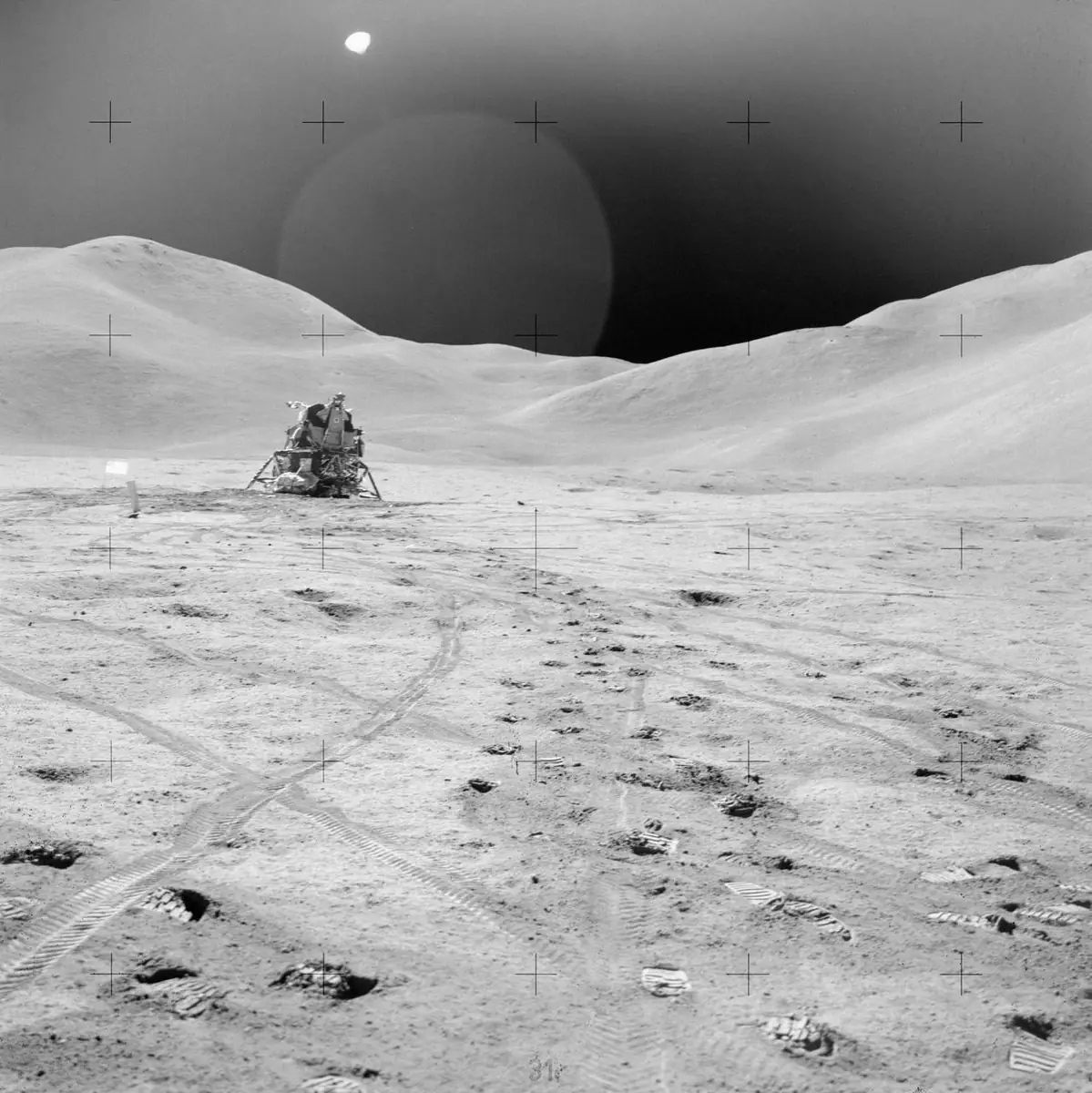
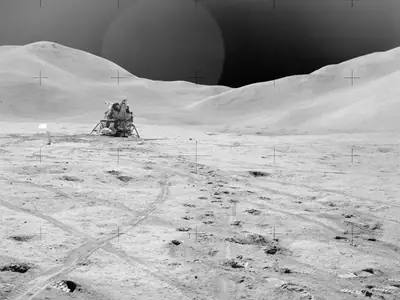 Falcon against the Apennine Front and Hadley Delta.
-
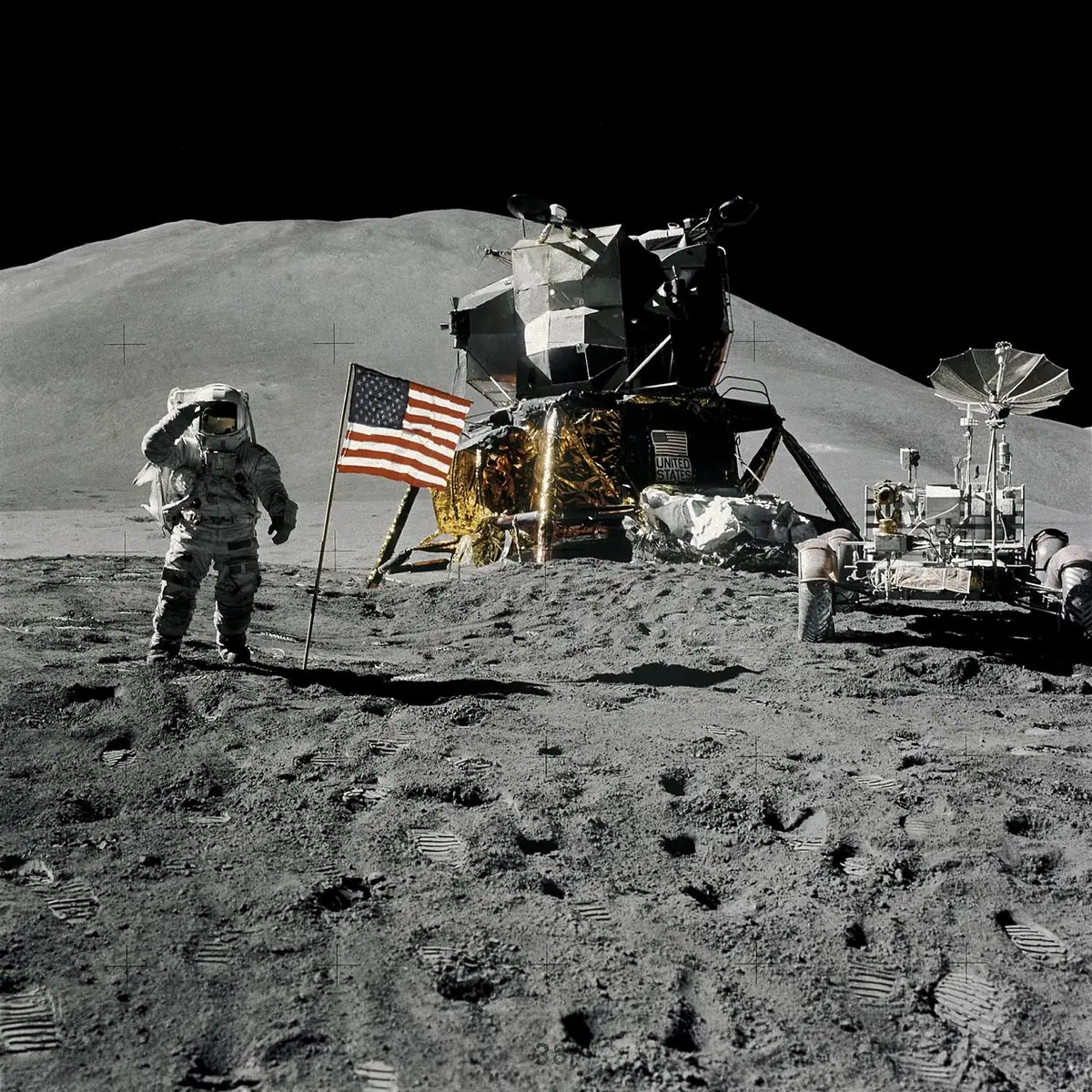
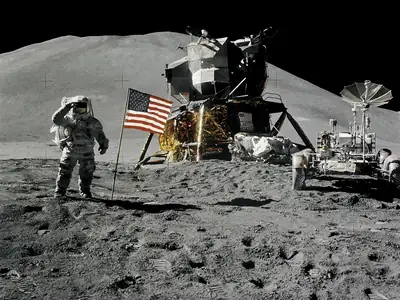 Irwin salutes the flag; Falcon and the rover behind him.
-
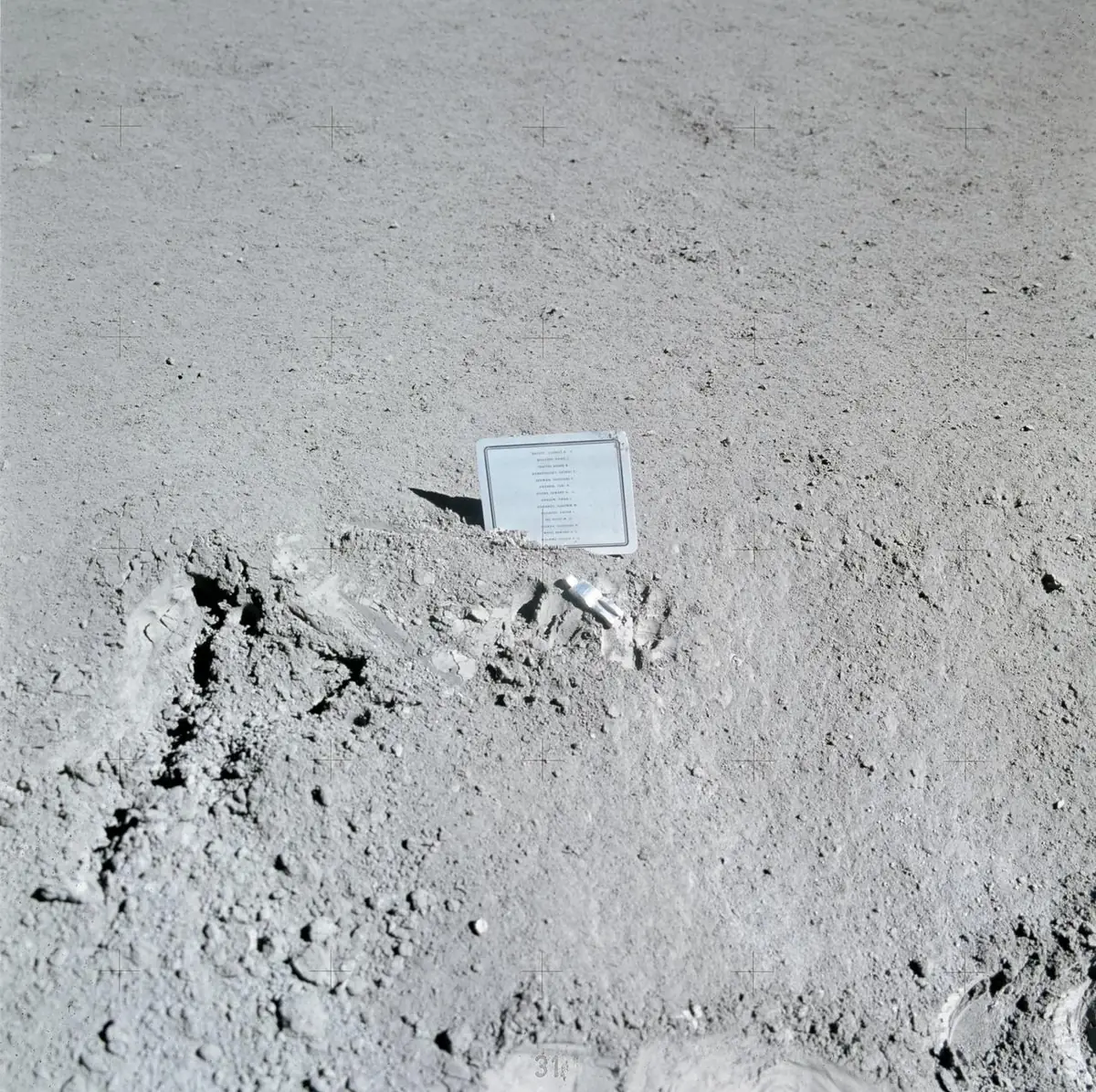
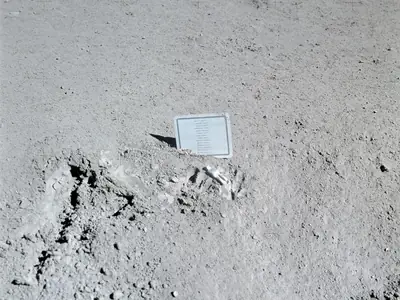 The plaque and Fallen Astronaut memorial left at Hadley.
-
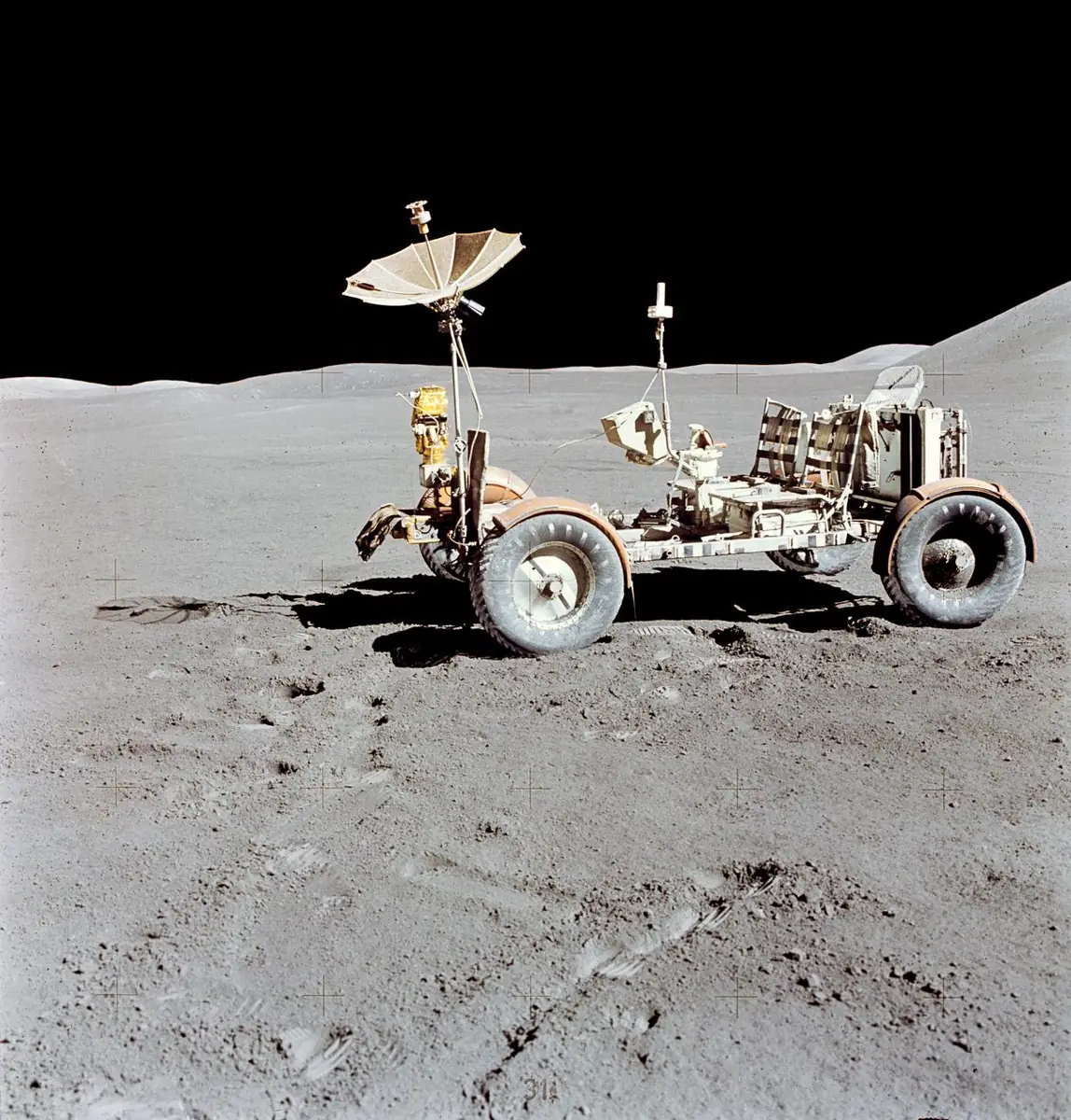
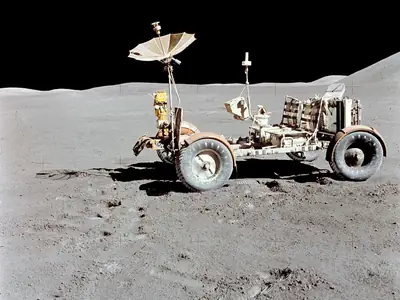 The rover parked at its final spot to televise liftoff.
-
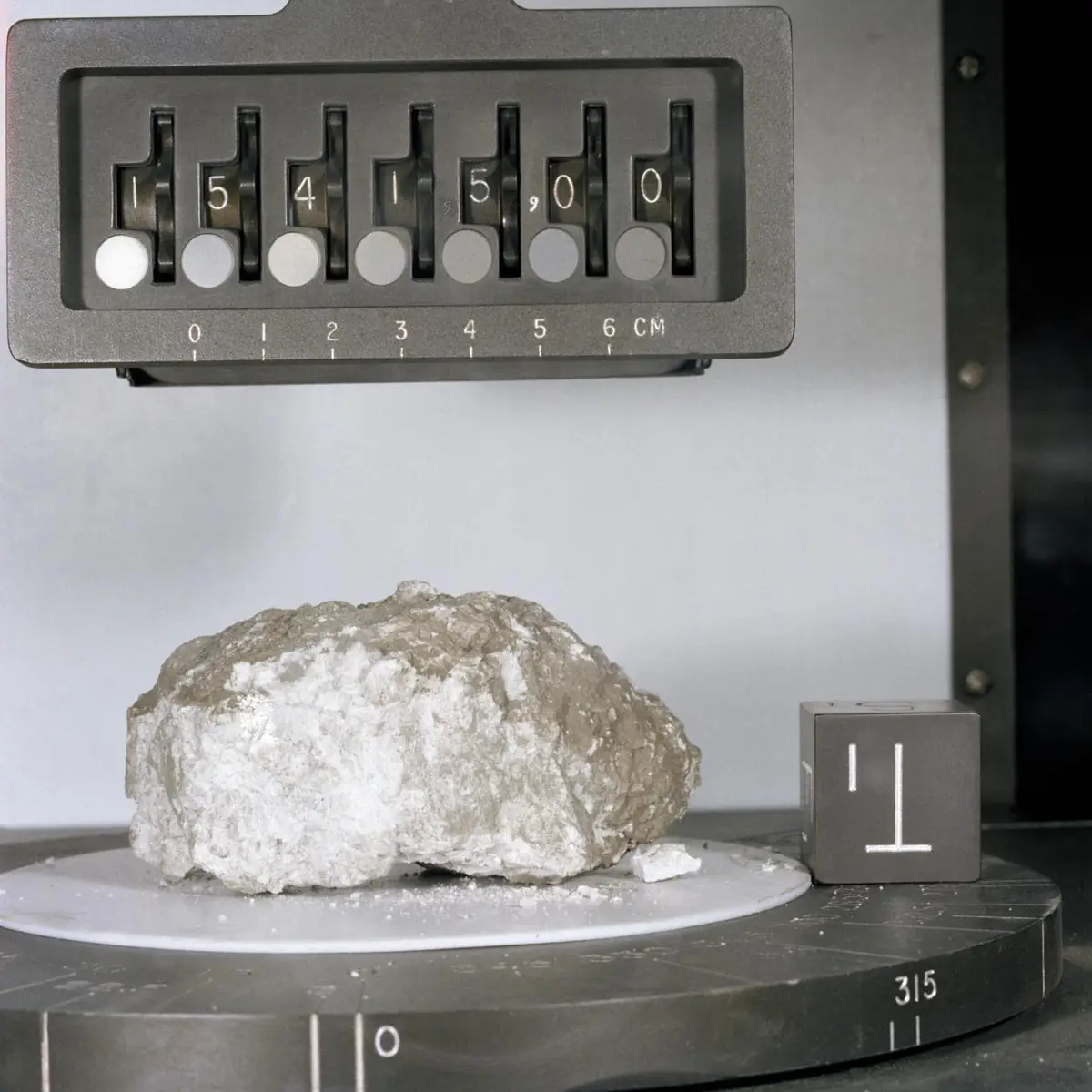
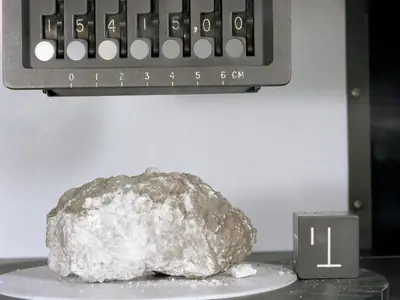 The Genesis Rock, sample 15415, in the Lunar Receiving Laboratory.
-
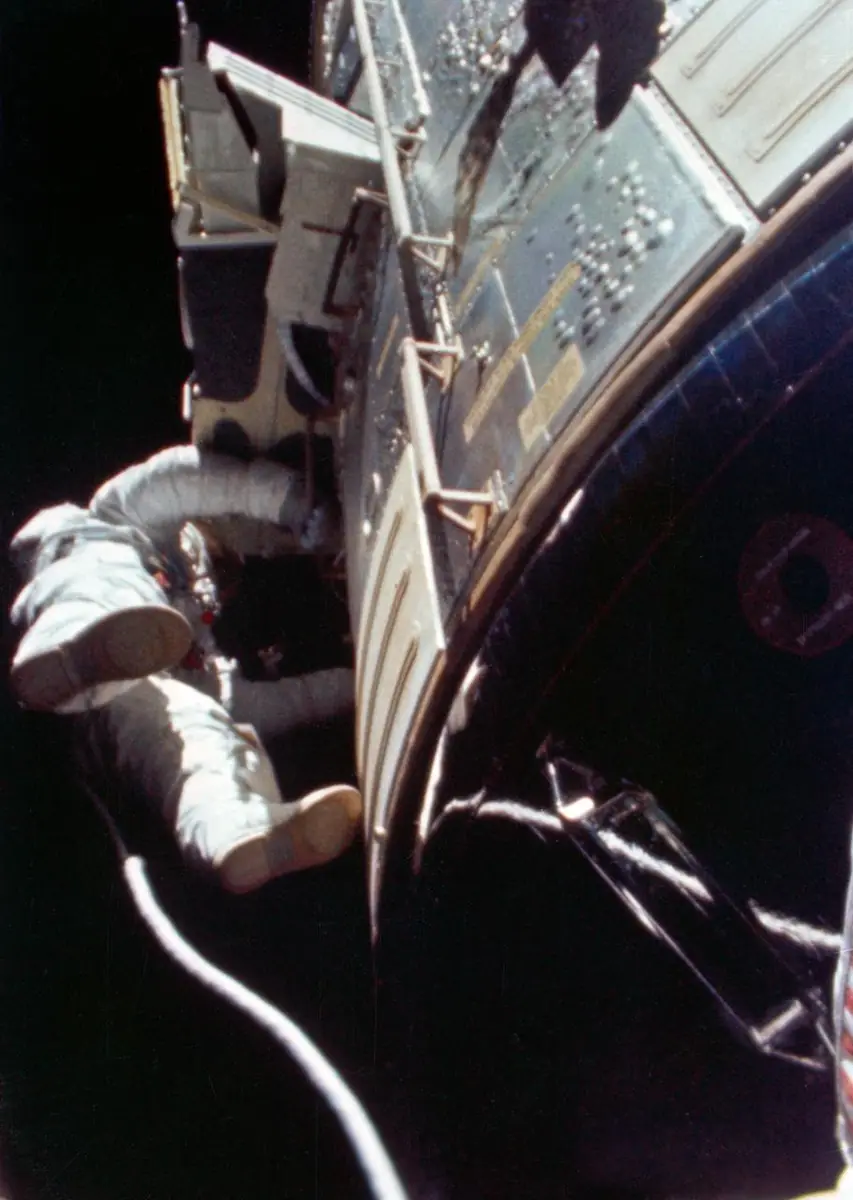
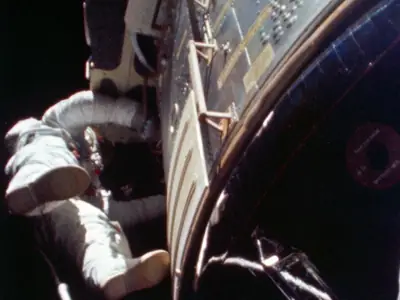 Worden outside Endeavour retrieving film on the way home.
-
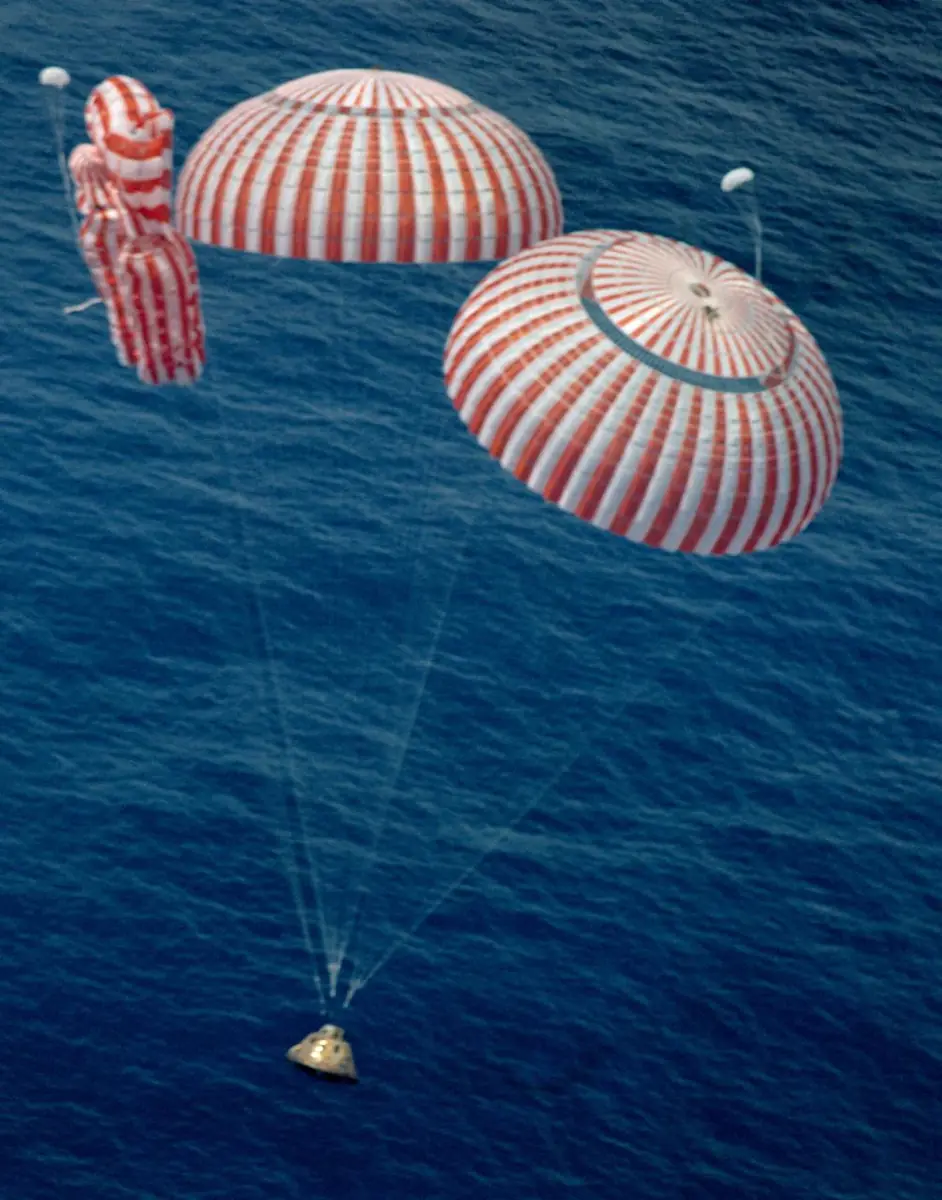
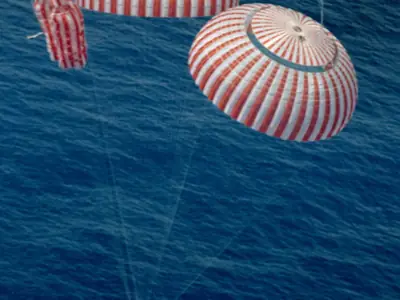 Splashdown with one of three main parachutes collapsed.
At a glance 13
-
Mission type
Type J-1: the first of three extended science missions, with a rover, a longer-stay LM and a science bay in the service module.
-
Dates
Launched 26 July 1971, landed 30 July, splashed down 7 August 1971.
-
Mission duration
295 h 11 min 53 s (12 days 7 h 12 min).
-
Call signs
Command module Endeavour (CM-112), named for Captain Cook's ship, and lunar module Falcon (LM-10), for the U.S. Air Force Academy mascot.
-
Landing site
Palus Putredinis at the foot of the Apennine Mountains, beside the winding Hadley Rille.
-
Coordinates
26.13222° N, 3.63386° E, the farthest north of the Apollo landings.
-
Time on the Moon
66 h 54 min 54 s, about twice as long as any earlier stay.
-
Moonwalks
A 33-min stand-up EVA plus three surface EVAs totalling 18 h 34 min 46 s.
-
Samples
77.31 kg (170.4 lb).
-
Rover
27.9 km17.3 miles driven in the first Lunar Roving Vehicle.
-
Lunar orbits
74 orbits, 145 h 13 min in lunar orbit.
-
Designations
AS-510, Eastern Test Range #7744; CSM 1971-063A, subsatellite 1971-063D.
-
All Air Force
Scott, Worden and Irwin were all U.S. Air Force officers.
Crew & team 11
-
David Scott, commander
Col., USAF, born 6 June 1932 in San Antonio, Texas; 39 at launch. West Point 1954; M.S., MIT (1962). Pilot of Gemini 8 and command module pilot of Apollo 9.
-
Al Worden, command module pilot
Maj., USAF, born 7 February 1932 in Jackson, Michigan; 39 at launch. West Point 1955; two M.S. degrees from Michigan (1963). First flight.
-
Jim Irwin, lunar module pilot
Lt. Col., USAF, born 17 March 1930 in Pittsburgh; 41 at launch. U.S. Naval Academy 1951; two M.S. degrees from Michigan (1957). First flight.
-
Backup crew
Dick Gordon, Vance Brand and Jack Schmitt.
-
Support crew
Karl Henize, Joe Allen and Bob Parker, three scientist-astronauts.
-
Capsule communicators
Joe Allen (moonwalk CAPCOM), Gordon Fullerton, Karl Henize, Edgar Mitchell, Bob Parker, Jack Schmitt, Alan Shepard, Dick Gordon and Vance Brand.
-
Flight directors
Gerry Griffin, Milt Windler, and Glynn Lunney with Gene Kranz.
-
Geology school
Caltech geologist Lee Silver led the crew on field trips to train them as observers. Scott and Irwin showed it at the Apennine front.
-
Irwin's heart
Irwin had irregular heartbeats during the EVAs, linked to potassium loss. Later crews drank potassium-enriched juice.
-
Weights
Launch-day weights 80.2 kg (Scott), 73.5 kg (Worden) and 73.2 kg (Irwin).
-
Where they are now
Irwin died in 1991 and Worden in 2020. Scott is one of four living moonwalkers.
Launch & Saturn V 8
-
Liftoff
13:34:00 GMT (9:34 a.m. EDT) on 26 July 1971 from Pad 39A.
-
Weather
Fair: 29.8 °C85.6 °F, 68% humidity, high cirrus covering 70% of the sky.
-
Weight at ignition
6,494,415 lb for SA-510.
-
Heavier payload
A lower 91.5 × 89.6 n mi (169 × 166 km105 × 103 miles) parking orbit and an 80.088° flight azimuth helped lift the heavier J-mission spacecraft.
-
Max Q
768.58 lb/ft² at 82.0 s.
-
Translunar injection
350.79-s burn from 2:50:03, after 1.5 orbits.
-
S-IVB impact
Steered into the Moon at 79:24:42 near 1° S, 11.8° W, 83 n mi (154 km96 miles) from target. The Apollo 12 and 14 seismometers recorded it.
-
Launch window
Planned for a 12.0° Sun elevation at Hadley, open until 16:11 GMT.
Spacecraft 10
-
Command & service module
CSM-112, 66,925 lb at launch; the service module carried a Scientific Instrument Module (SIM) bay.
-
SIM bay
Panoramic camera, mapping and stellar cameras, laser altimeter, gamma-ray, X-ray fluorescence and alpha-particle spectrometers, a mass spectrometer and a subsatellite.
-
Extended LM
Falcon (LM-10), 36,238 lb at launch, had bigger descent tanks and more consumables for a three-day stay.
-
Descent propellant
19,561 lb loaded, 18,373 lb burned; about 103 s of hover time left.
-
Lunar Roving Vehicle
Built by Boeing: 3.1 m10 feet 2 inches long with a wheelbase of 2.3 m7.5 feet, 462 lb on Earth, carrying up to 1,080 lb. Two 36-V batteries and four wheel motors.
-
Folded for flight
The rover rode folded in a bay of Falcon's descent stage and was unfolded by pulling tapes.
-
Rover limits
Designed for 78 hours of operation, 65 km40 miles cumulative (35 nautical miles) and a radius of 8 km5 miles from the LM, set by how far the crew could walk back.
-
TV on wheels
A ground-controlled color TV camera on the rover let Houston pan and zoom while the crew worked.
-
New suits
A7LB suits with waist and neck joints made sitting on the rover and bending easier.
-
Software
Colossus 3 (command module) and Luminary 1E (lunar module).
Flight & orbit 13
-
Docking
Separated from the S-IVB at 3:22:27 and docked at 3:33:50 on TV.
-
SPS short
A short in the main engine's bank A valve circuit appeared; later burns used bank B, with dual-bank burns started on B.
-
Broken glass
A cracked meter cover in Falcon left glass floating in the cabin; the crew vacuumed it up.
-
Door off
The SIM bay door was blown off at 74:06:47; Irwin watched it tumble away.
-
Lunar orbit insertion
A 398.36-s burn at 78:31:47 into 170.1 × 57.7 n mi (315 × 107 km196 × 66 miles); the coast had lasted 75 h 42 min.
-
Low descent orbit
The CSM's engine lowered both craft to 58.5 × 9.6 n mi (108 × 18 km67 × 11 miles), later trimmed to 60.3 × 8.8 n mi (112 × 16 km69 × 10 miles).
-
Stuck undocking
The first undocking try failed; Worden found a loose umbilical plug in the tunnel. They separated 25 min late at 100:39:16.
-
Steeper approach
Falcon came in on a steeper descent path to clear the mountains and improve visibility.
-
Liftoff on TV
The rover camera televised Falcon's liftoff at 17:11:23 GMT on 2 August, the first lunar liftoff seen live.
-
Rendezvous
Docked at 173:36:26 after 72 h 57 min apart.
-
Ascent stage impact
Crashed at 26°21' N, 0°15' E, 93 km58 miles west of the landing site; recorded by three seismometers.
-
Subsatellite
A 78.5-lb particles-and-fields subsatellite was spring-ejected from the SIM bay into a 76.3 × 55.1 n mi (141 × 102 km88 × 63 miles) orbit.
-
Trans-Earth injection
A 140.9-s burn at 223:48:46 after 74 orbits.
Landing site 8
-
Touchdown
22:16:29 GMT (6:16:29 p.m. EDT) on 30 July 1971.
-
Tilted
One footpad came down in a small crater; Falcon sat pitched 6.9° up and rolled 8.6°, about 11° from level.
-
Off target
About 550 m1,800 feet northwest of the planned point.
-
Margins
About 103 s of hover time remained; the Sun was 12.2° high.
-
Mountains
Hadley Delta rises about 4 km2.5 miles above the plain to the south; Mons Hadley stands to the northeast.
-
Hadley Rille
A sinuous channel more than a kilometre wide and hundreds of metres deep, winding past the site.
-
Why here
Three targets in one: mare basalt, the rille, and the Apennine front, raised by the Imbrium impact and likely to hold ancient crust.
-
Names
The crew used names such as Elbow, St. George, Spur and Dune for craters, and the Swann Range for hills named after geologist Gordon Swann.
Moonwalks 10
-
Stand-up EVA
Two hours after landing Scott stood in the top hatch for 33 min 7 s, photographing and describing the site. It was the only stand-up EVA of Apollo.
-
“Man must explore”
Scott's first words outside: “As I stand out here in the wonders of the unknown at Hadley, I sort of realize there's a fundamental truth to our nature: Man must explore.”
-
EVA-1
6 h 32 min 42 s, cut short by Scott's higher oxygen use. The rover's front steering was dead, so they drove on rear steering to Elbow and St. George craters: 10.3 km6.4 miles, 14.5 kg.
-
EVA-2
7 h 12 min 14 s along the Apennine front to Spur and Dune craters: 12.5 km7.8 miles, 34.9 kg. Front steering worked again after a breaker reset.
-
EVA-3
4 h 49 min 50 s to the rim of Hadley Rille at Scarp, Rim and The Terrace: 5.1 km3.2 miles, 27.3 kg. A planned trip to the North Complex was dropped.
-
Hammer and feather
Scott dropped a geologic hammer and a falcon feather together on live TV. They hit the ground at the same moment, as Galileo predicted.
-
Fallen Astronaut
A small aluminium figure by Belgian artist Paul Van Hoeydonck and a plaque listing 14 astronauts and cosmonauts who had died were left beside the rover.
-
Seatbelt Rock
Scott grabbed vesicular basalt 15016 on the rover's last stop while telling Houston he was fixing his seatbelt.
-
A stumble
Scott tripped over a rock and fell while sampling, then got up without trouble.
-
Totals
18 h 34 min 46 s outside, 27.9 km17.3 miles by rover (3 h 0 min driving), farthest point 5.0 km3.1 miles from Falcon.
Surface science 8
-
ALSEP
Passive seismometer, lunar surface magnetometer, solar wind spectrometer, suprathermal ion detector, cold cathode gauge, heat flow experiment and a dust detector.
-
Biggest laser target
A 300-corner-cube retroreflector, three times larger than those of Apollo 11 and 14.
-
Heat flow
Two probes, after hard drilling, gave the first direct heat-flow measurement from the Moon's interior, later revised to about 21 mW/m².
-
Deep core
Scott drilled a core about 2.4 m8 feet deep on EVA-2; it stuck fast and was only wrestled out of the ground on EVA-3.
-
A seismic triangle
With Apollo 12 and 14, the station formed a triangle, letting seismologists locate moonquakes, including deep ones about 1,000 km620 miles down.
-
Solar wind sail
Exposed for 41 h 8 min.
-
Soil mechanics
Irwin measured soil strength with a penetrometer and dug a trench.
-
Station lifetime
The Apollo 15 ALSEP worked until the stations were switched off on 30 September 1977.
Rocks & discoveries 9
-
What came home
77.31 kg, including the first long drill core and rocks from the mountain front, the rille and the mare.
-
Genesis Rock
Sample 15415, a 269 g anorthosite found on the rim of Spur crater. Scott: “Guess what we just found! I think we found what we came for.”
-
How old
Genesis Rock is a piece of early crust, around 4 billion years old, old, but not the original crust it was once hoped to be.
-
Green glass
Tiny green glass beads, sprayed out in volcanic fire fountains, were found in the Apennine front soils.
-
Water in the glass
In 2008, analysis of Apollo volcanic glass beads found traces of water, overturning the picture of a completely dry Moon interior.
-
Great Scott
Sample 15555, an olivine basalt of about 9.6 kg, the second largest Apollo rock.
-
Mare basalts
Basalts from the plain crystallized about 3.3 billion years ago.
-
Rille walls
Layering seen in the rille wall showed a stack of separate lava flows.
-
Lunar soil gardening
Lettuce, tomato and citrus plants were later grown in Apollo 15 soil in germ-free plant experiments.
Alone in orbit 7
-
Worden solo
Al Worden flew Endeavour alone for 72 h 57 min and completed 34 lunar orbits while Falcon was on the surface.
-
Mapping the Moon
He ran the SIM bay: panoramic and mapping photography, laser altimetry, and gamma-ray and X-ray surveys of surface chemistry.
-
Chemical maps
The orbital spectrometers mapped aluminium, magnesium and radioactive thorium, showing how highlands and maria differ.
-
Volcanoes spotted
Worden reported what looked like cinder cones near Littrow, a clue that helped send Apollo 17 to Taurus-Littrow.
-
Deep-space EVA
On the way home Worden spent 39 min outside retrieving film cassettes from the SIM bay, the first spacewalk in deep space.
-
Most isolated human
On the far side he was more than 3,500 km2,200 miles from his crewmates and out of contact with everyone else.
-
Camera faults
The mapping camera's extend mechanism stuck out and the panoramic camera's velocity sensor failed; Worden saw no cause on his EVA.
Return & recovery 7
-
Entry
Entry at 36,096 ft/s; peak 6.23 g.
-
Two of three
One of the three main parachutes collapsed. The CM hit the water a little harder, but the crew was unhurt.
-
Fastest descent
With one chute out, it took only 778 s from entry to splashdown, the fastest of Apollo.
-
Splashdown
20:45:53 GMT on 7 August 1971 at 26.13° N, 158.13° W north of Hawaii, about 1 n mi (1.9 km1.2 miles) from target and 5 n mi (9.3 km5.8 miles) from USS Okinawa (LPH-3).
-
No quarantine
The first lunar crew not quarantined after return; they were aboard ship in 39 minutes.
-
Recovery force
4 ships and 17 aircraft.
-
Where Endeavour is
Displayed at the National Museum of the U.S. Air Force in Dayton, Ohio.
Moments & legacy 6
-
The patch
Three stylized birds fly over Hadley Rille; the crater pattern below spells XV. It was designed with Italian fashion designer Emilio Pucci.
-
Postal covers
The crew carried about 400 unauthorized postal covers, some of which were sold. NASA reprimanded them and none flew again.
-
Irwin's mission
Irwin left NASA in 1972, founded the High Flight Foundation and led expeditions looking for Noah's Ark on Mount Ararat.
-
Science comes first
Apollo 15 showed the crew could work as field scientists, with geologists in a back room joining in real time.
-
From orbit today
LRO images show Falcon's descent stage, the parked rover and its tracks.
-
Feather and hammer
The feather drop remains one of the most replayed physics demonstrations ever filmed.
Seven missions side by side
Figures from NASA's Apollo by the Numbers. Select a mission to open its dossier.
| Measure | Apollo 11 | Apollo 12 | Apollo 13 | Apollo 14 | Apollo 15 | Apollo 16 | Apollo 17 |
|---|---|---|---|---|---|---|---|
| Landing (UTC) | 20 July 1969 | 19 November 1969 | did not land | 5 February 1971 | 30 July 1971 | 21 April 1972 | 11 December 1972 |
| Landing site | Mare Tranquillitatis | Oceanus Procellarum | Fra Mauro highlands (planned) | Fra Mauro highlands | Hadley–Apennine | Descartes Highlands | Taurus–Littrow valley |
| Lunar module | Eagle (LM-5) | Intrepid (LM-6) | Aquarius (LM-7) | Antares (LM-8) | Falcon (LM-10) | Orion (LM-11) | Challenger (LM-12) |
| Command module | Columbia (CM-107) | Yankee Clipper (CM-108) | Odyssey (CM-109) | Kitty Hawk (CM-110) | Endeavour (CM-112) | Casper (CM-113) | America (CM-114) |
| Commander | Neil Armstrong | Pete Conrad | Jim Lovell | Alan Shepard | David Scott | John Young | Gene Cernan |
| Lunar module pilot | Buzz Aldrin | Alan Bean | Fred Haise | Edgar Mitchell | Jim Irwin | Charlie Duke | Harrison Schmitt |
| Command module pilot | Michael Collins | Dick Gordon | Jack Swigert | Stuart Roosa | Al Worden | Ken Mattingly | Ron Evans |
| Mission type | G | H-1 | H-2 | H-3 | J-1 | J-2 | J-3 |
| Time on the Moon | 21 h 36 min | 31 h 31 min | none | 33 h 30 min | 66 h 54 min | 71 h 2 min | 74 h 59 min |
| Moonwalks | 1 · 2 h 31 min | 2 · 7 h 45 min | none | 2 · 9 h 22 min | 3 · 18 h 34 min | 3 · 20 h 14 min | 3 · 22 h 3 min |
| Samples | 21.55 kg | 34.35 kg | none | 42.28 kg | 77.31 kg | 95.71 kg | 110.52 kg |
| Farthest from the lunar module | 60 m200 feet | ≈ 410 m1,350 feet | none | ≈ 1.45 km0.9 miles | ≈ 5.0 km3.1 miles | ≈ 4.6 km2.9 miles | ≈ 7.6 km4.7 miles |
| Rover distance | none | none | none | none | 27.9 km17.3 miles | 26.9 km16.7 miles | 35.7 km22.2 miles |
| Sun at landing | 10.8° | 5.1° | none | 10.3° | 12.2° | 14.8° | 13.0° |
| Lunar orbits | 30 | 45 | none (flyby) | 34 | 74 | 64 | 75 |
| Mission length | 8 d 3 h 18 min | 10 d 4 h 36 min | 5 d 22 h 54 min | 9 d 0 h 1 min | 12 d 7 h 11 min | 11 d 1 h 51 min | 12 d 13 h 51 min |
| Recovery ship | USS Hornet | USS Hornet | USS Iwo Jima | USS New Orleans | USS Okinawa | USS Ticonderoga | USS Ticonderoga |
| Sourced facts | 130 | 113 | 134 | 112 | 110 | 111 | 112 |
Sources and method
27 sources, how the Moon is drawn, and photo credits
Mission facts
- R. W. Orloff, Apollo by the Numbers: A Statistical Reference, NASA SP-2000-4029
- E. M. Jones & K. Glover, Apollo Lunar Surface Journal (NASA History)
- Apollo Preliminary Science Reports, NASA SP-214, SP-235, SP-272, SP-289, SP-315, SP-330
- C. Meyer, Lunar Sample Compendium, NASA Astromaterials Curation
- NASA NSSDCA, Apollo: Where are they now?
- NASA Science, Moonwalkers (living status checked Nov 2026)
- NASA Science, Apollo 11 Seismic Experiment
- H. Lindsay, ALSEP essay, Apollo Lunar Surface Journal
- Active Seismic Experiment (Apollo 14 and 16 results)
- A. Saunders, The Mystery Behind Alan Shepard's 'Moon Shot' Revealed, USGA, Feb 2021
- K. Cartier, Apollo may have found an Earth meteorite on the Moon, Eos (on Bellucci et al. 2019, EPSL)
- Langseth, Keihm & Peters, Revised lunar heat-flow values (1976)
- Apollo 16 Preliminary Science Report, Lunar Portable Magnetometer
- LROC, Orion, Up Close (Apollo 16 site), NASA/GSFC/ASU
- Haymaker et al., The Apollo 17 Pocket Mouse Experiment (BIOCORE), NASA SP-368
- NASA/JPL, First Confirmed Capture into Earth Orbit Is Likely Apollo Rocket (2002)
- NASA Science, Genesis Rock
- NASA History, Apollo 13: Mission Details
- NASA History, 50 Years Ago: Apollo 13 Preps for 3rd Moon Landing
- NASA History, 50 Years Ago: Apollo 13 Review Board Report (on the Cortright report, June 1970)
- NASA, Apollo 13: The Successful Failure
- LROC, Rocket impacts recorded by the Apollo seismic network, NASA/GSFC/ASU
- NASA, Acting NASA Administrator Reflects on Legacy of Astronaut Jim Lovell, Aug 2025
- Associated Press, Artemis II makes trip around the Moon after breaking Apollo 13's distance record, Apr 2026
- collectSPACE, NASA's SpaceX Crew-13 pays homage to Apollo 13 on mission patch, Apr 2026
- NASA Image and Video Library (photo captions)
- General Apollo reference (mission reports, press kits, crew biographies)
How the Moon is drawn
Positions of the Moon and Sun come from Astronomy Engine (Don Cross, MIT license). The Moon's orientation uses the IAU/WGCCRE 2009 rotation model, giving the libration seen from your location. Spot checks against NASA's Dial-a-Moon agree to within 0.02° for the sub-Earth and sub-solar points.
Surface map: NASA Scientific Visualization Studio CGI Moon Kit (Ernie Wright), from Lunar Reconnaissance Orbiter camera data. Shading follows the Lommel-Seeliger law with faint earthshine.
Landing coordinates are in the IAU mean Earth/polar axis frame, as tabulated in Apollo by the Numbers; Apollo 13's is its planned target. Feature-name positions are approximate.
Photographs
All photographs and mission emblems are NASA images from the NASA Image and Video Library; each photo links to its original record. NASA does not endorse this site.
Crew living status was checked in November 2026. Mission times are UTC.
Source
Apollo Preliminary Science Reports, NASA SP-214, SP-235, SP-272, SP-289, SP-315, SP-330
All sourcesSource
A. Saunders, The Mystery Behind Alan Shepard's 'Moon Shot' Revealed, USGA, Feb 2021
All sourcesSource
All sourcesSource
NASA/JPL, First Confirmed Capture into Earth Orbit Is Likely Apollo Rocket (2002)
All sourcesSource
NASA History, 50 Years Ago: Apollo 13 Review Board Report (on the Cortright report, June 1970)
All sourcesSource
NASA, Acting NASA Administrator Reflects on Legacy of Astronaut Jim Lovell, Aug 2025
All sourcesSource
All sources