
Apollo landing sites
Apollo on tonight's Moon Apollo on the Moon of
The six landing sites, and Apollo 13's planned one, placed on the Moon as it looks from where you are. Each pin is in sunlight or lunar night the way the site is right now. Pick a site for its mission dossier.
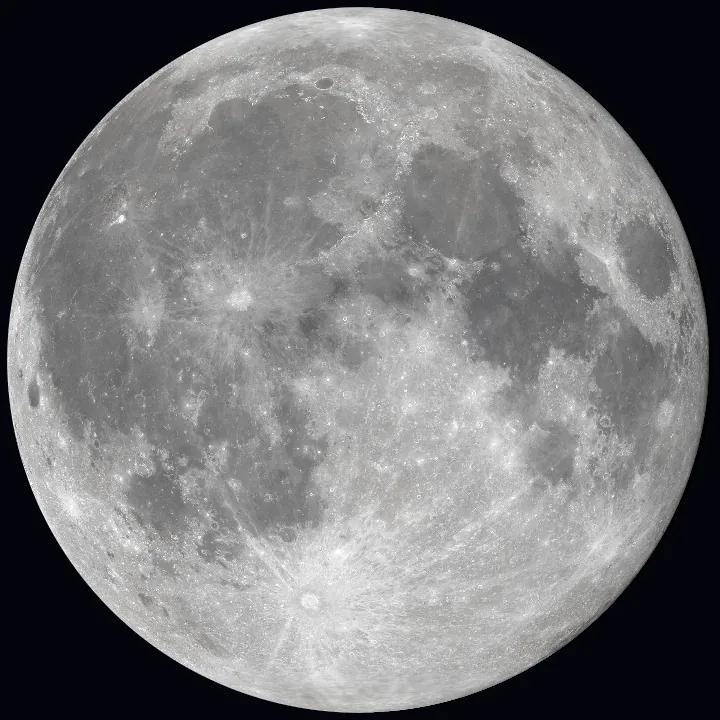
Site in sunlightSite in lunar nightPlanned, never reached
Clear-sky view: clouds and weather are not shown. Rendered from NASA Lunar Reconnaissance Orbiter maps.
The near side face on, north up, as at full Moon. With JavaScript on, this shows the Moon as it looks from your location right now.
Apollo 17
Apollo 17
Taurus–Littrow valley, edge of Mare Serenitatis, Taurus–Littrow valley · 20.191° N, 30.772° E
- Commander
- Eugene A. Cernan
- Command module pilot
- Ronald E. Evans
- Lunar module pilot
- Harrison H. “Jack” Schmitt
- Command module
- America
- Lunar module
- Challenger
The last and longest: a geologist on the Moon, orange volcanic soil, and records that still stand.
- Landed
- 11 December 197219:54 UTC
- Time on the Moon
- 74 h 59 minliftoff 14 December 1972
- Moonwalks
- 22 h 3 min3 moonwalks · 35.7 km22.2 miles by rover
- Samples
- 110.52 kg243.7 lb
- Farthest from the lunar module
- ≈ 7.6 km4.7 milesby Lunar Roving Vehicle
- Mission
- 12 d 13 h 51 min75 lunar orbits · USS Ticonderoga
-
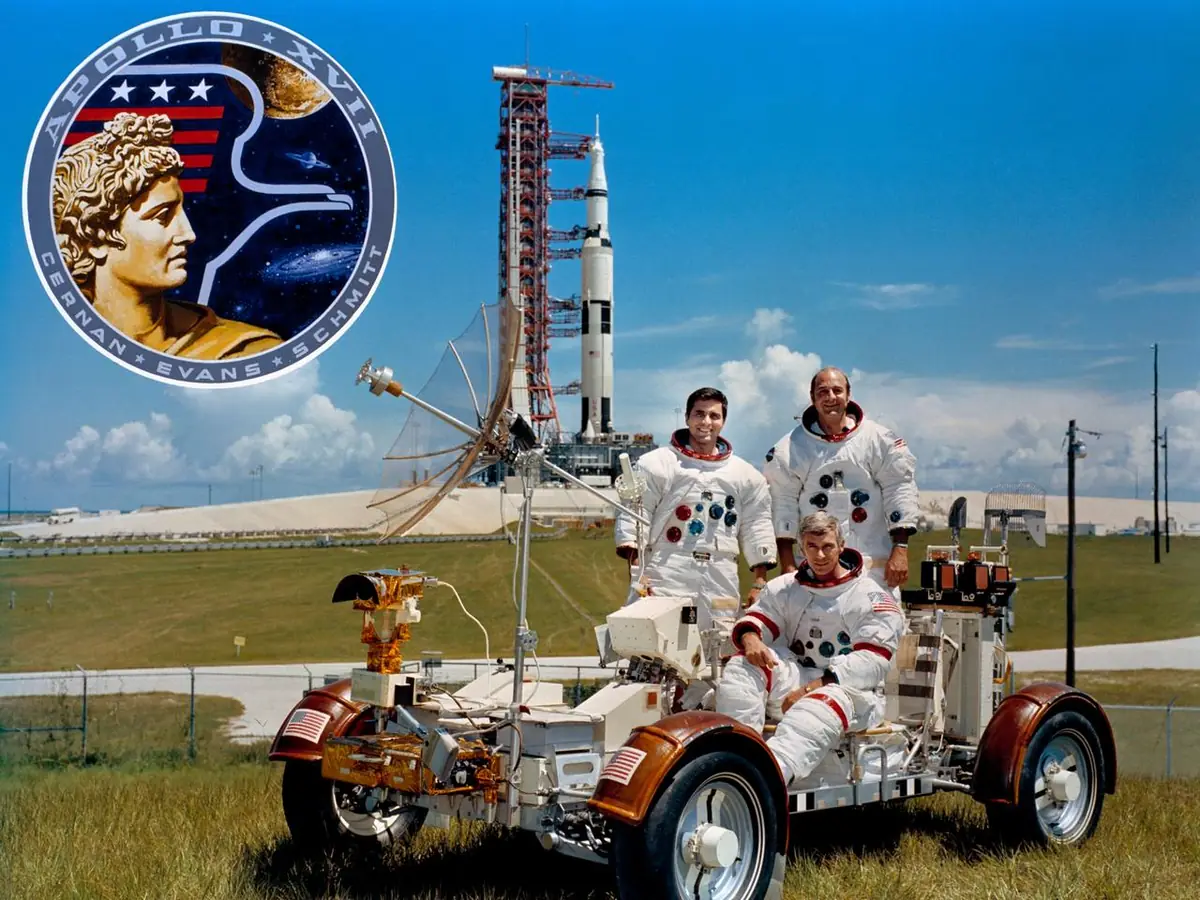
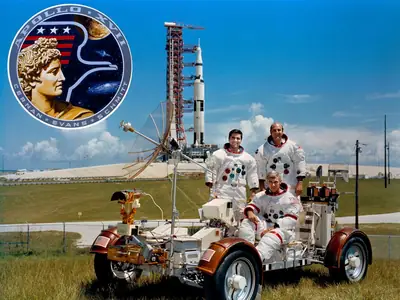 Prime crew with the rover trainer: Schmitt, Cernan (seated) and Evans.
-
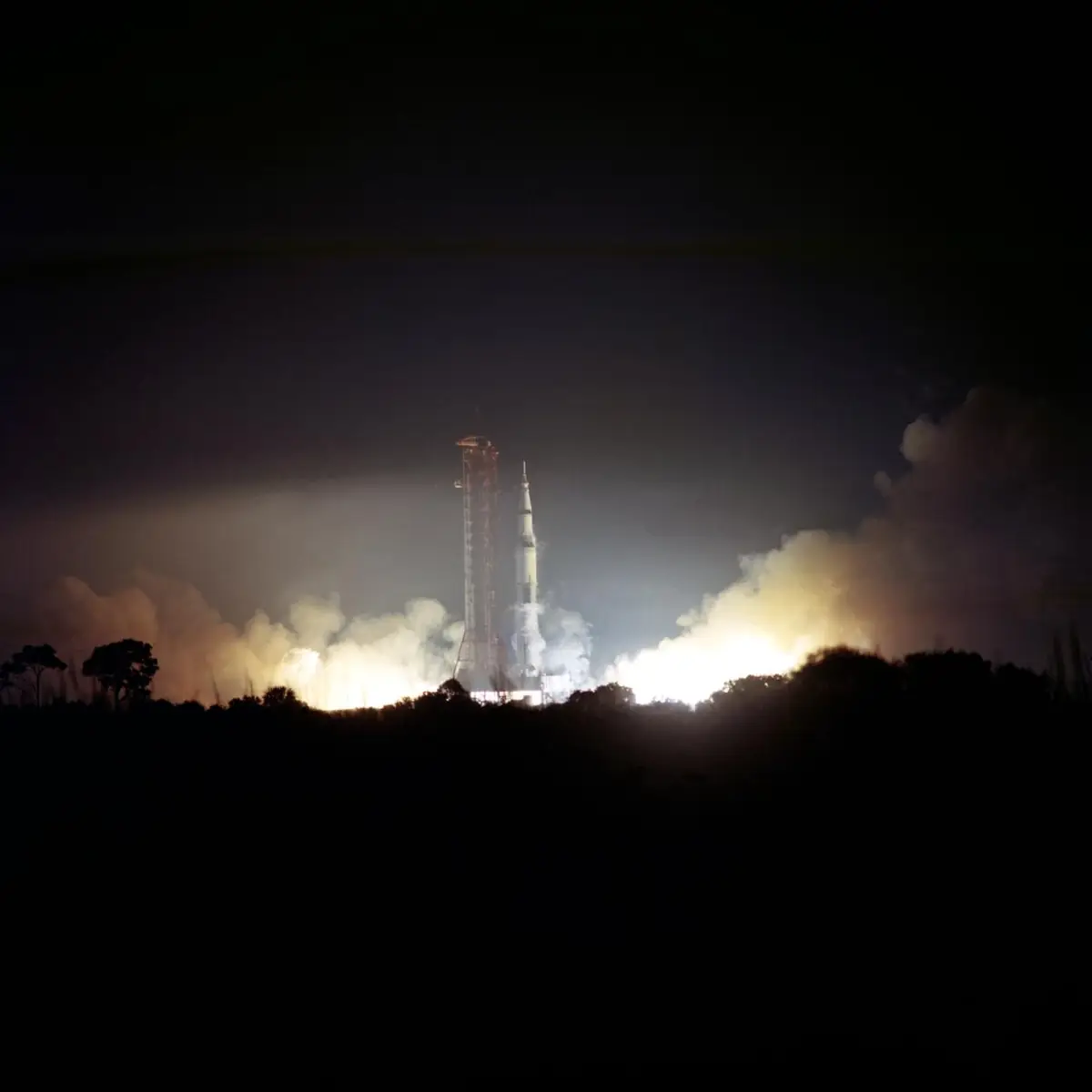
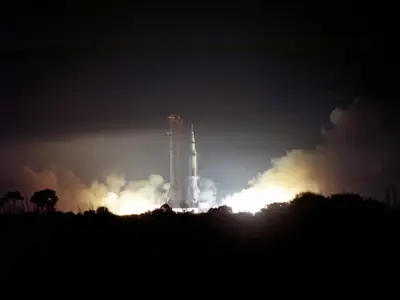 The only night launch of a crewed Saturn V, 7 December 1972.
-
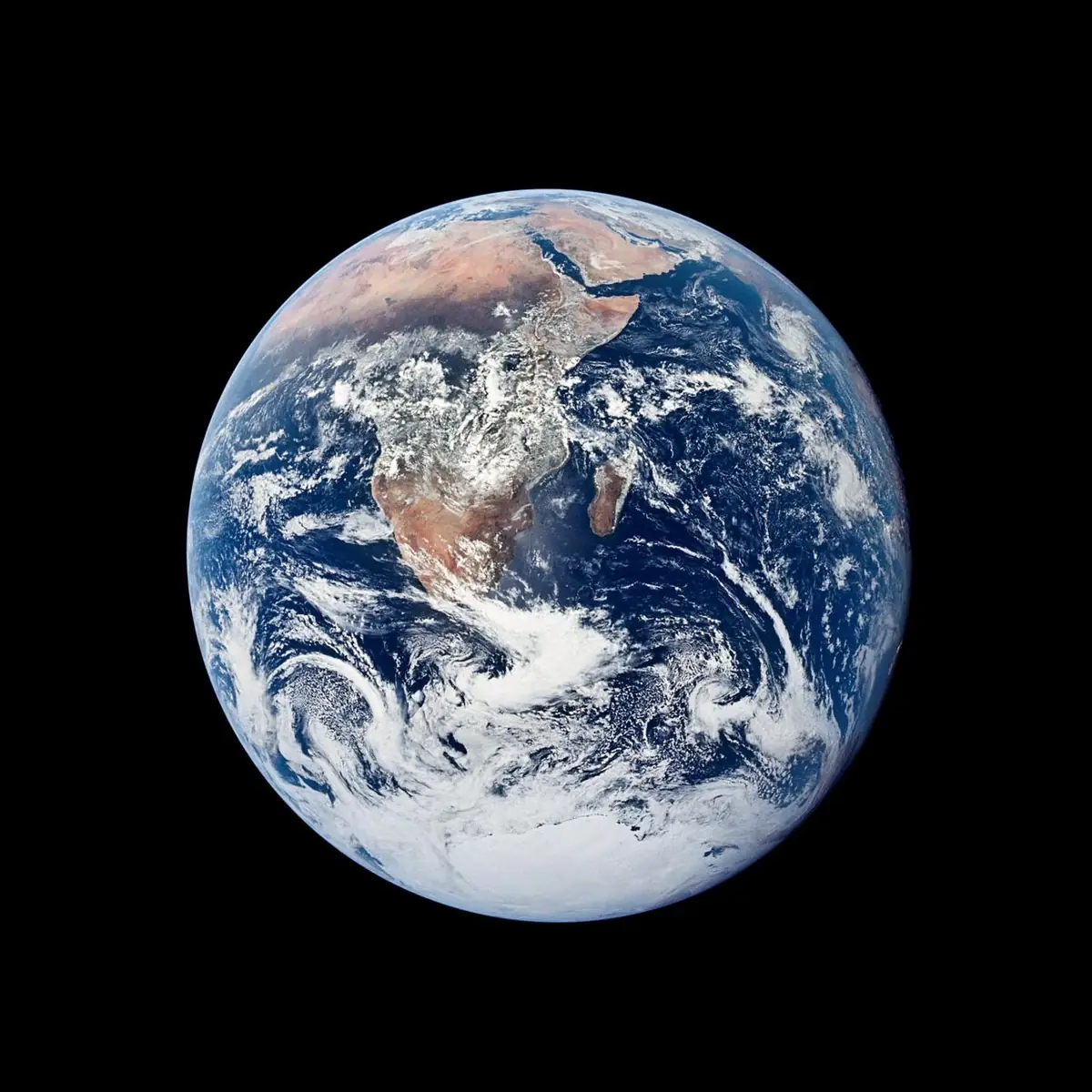
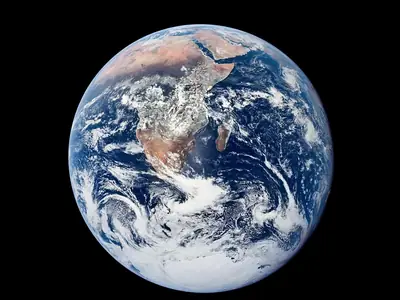 The Blue Marble: a full Earth with Africa, Arabia and the south polar cap.
-
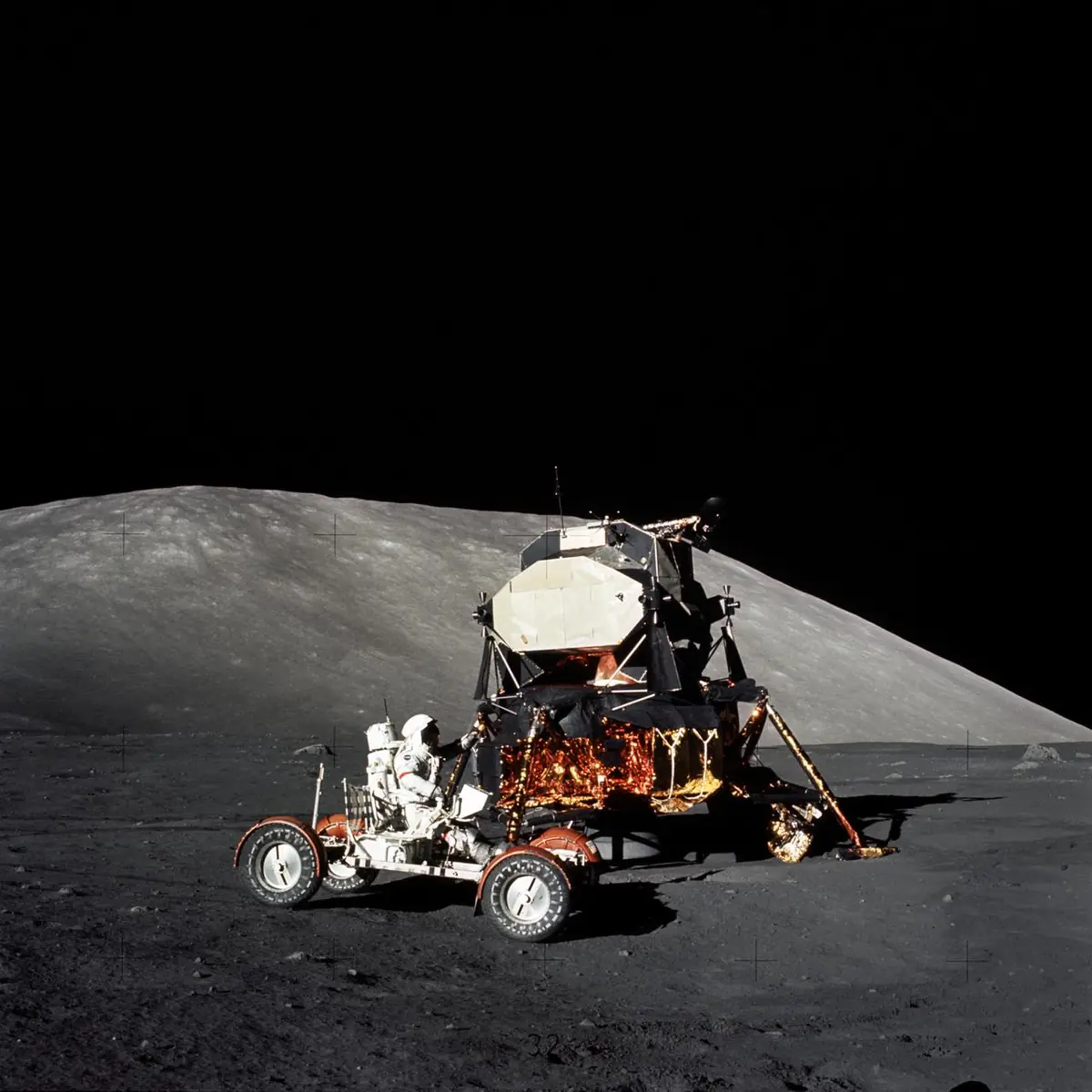
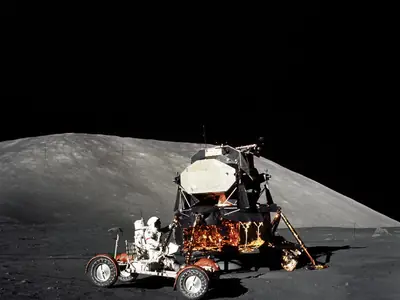 Cernan takes the rover on a checkout drive during EVA-1.
-
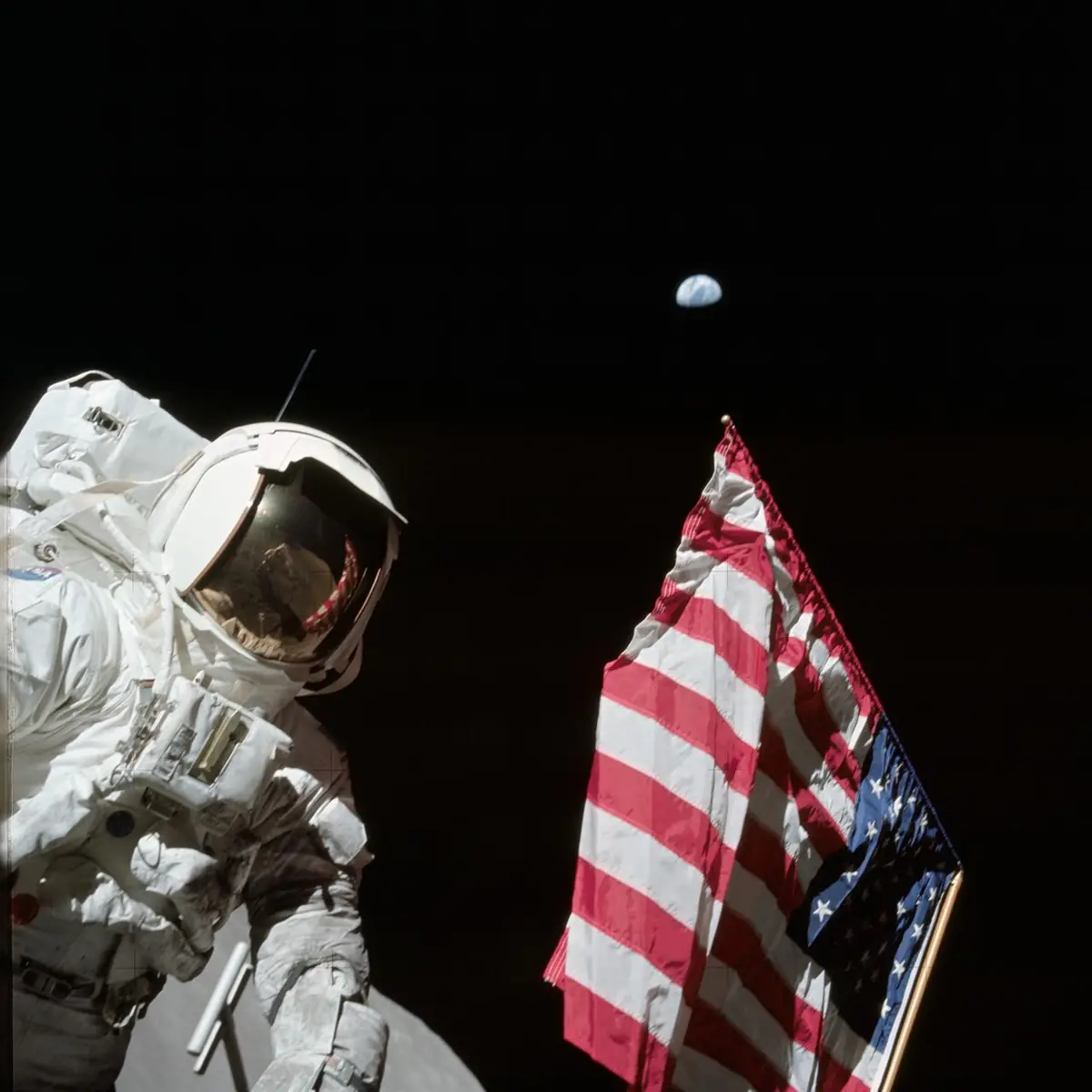
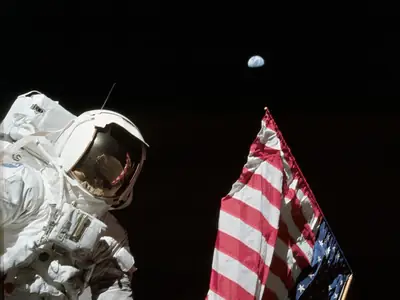 Schmitt beside the flag, with Earth above.
-
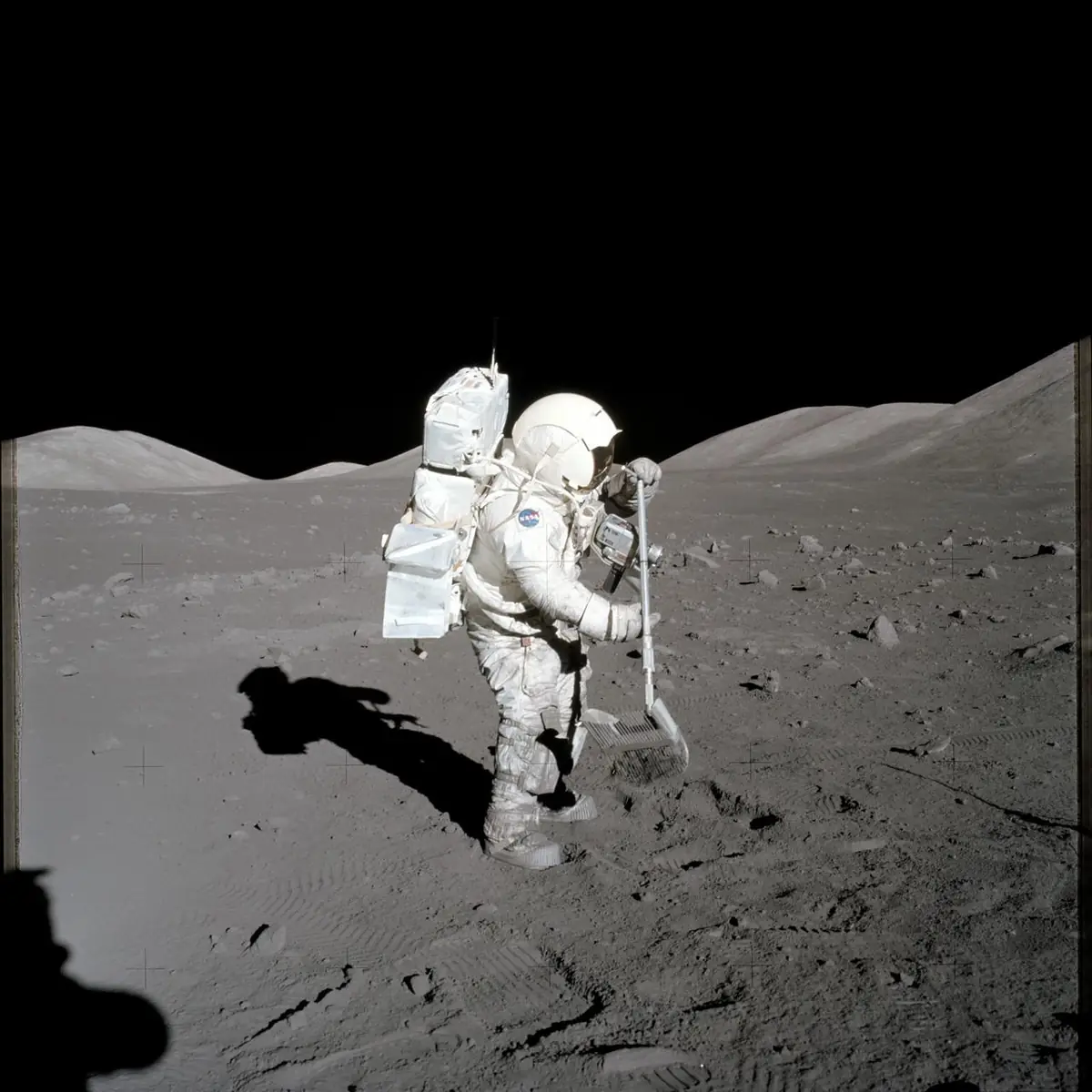
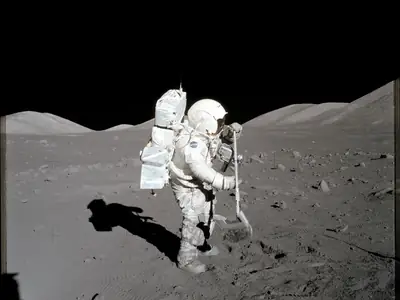 Schmitt collects rake samples at Station 1.
-
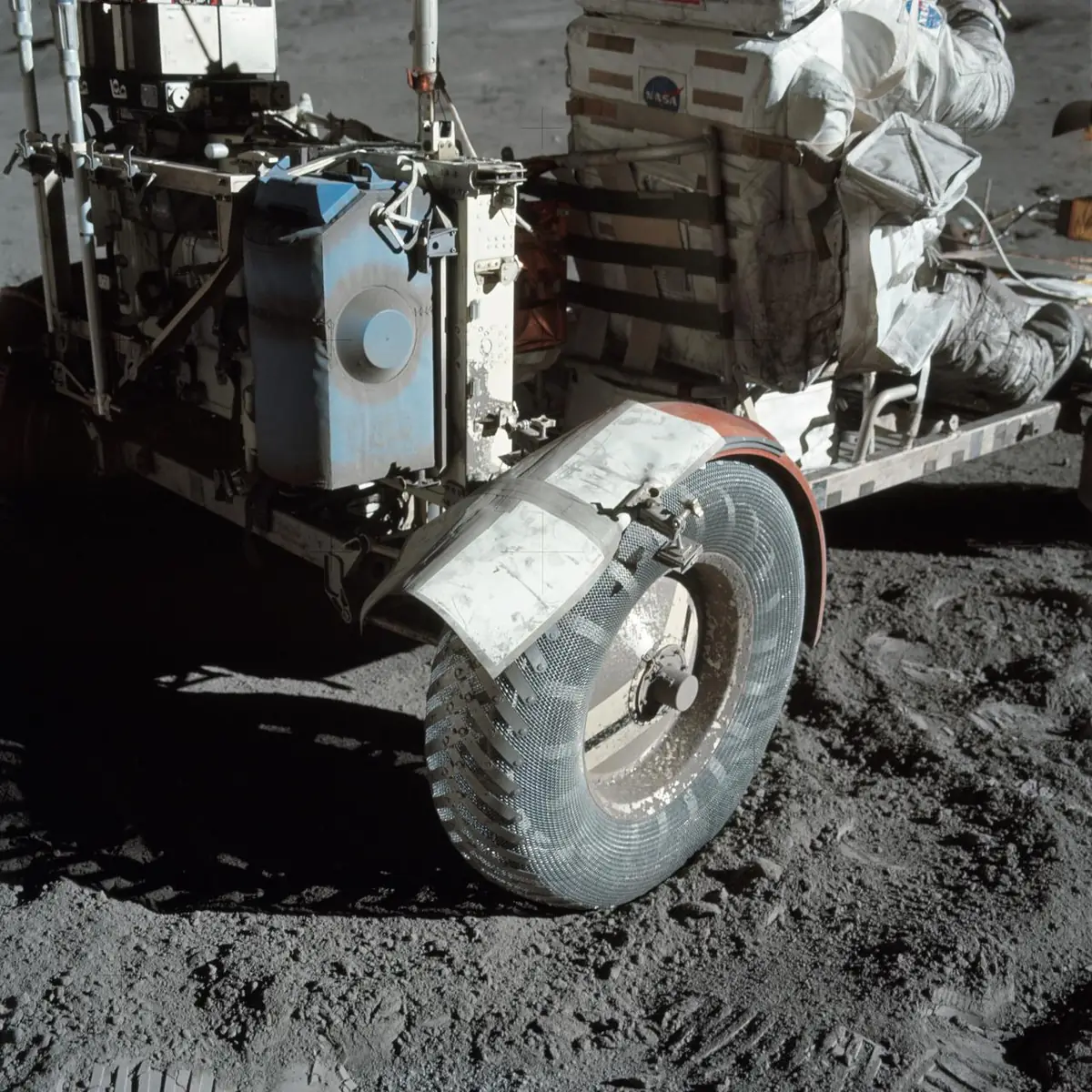
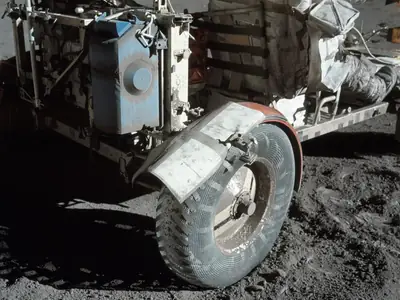 The rover with its map-and-clamp fender repair.
-
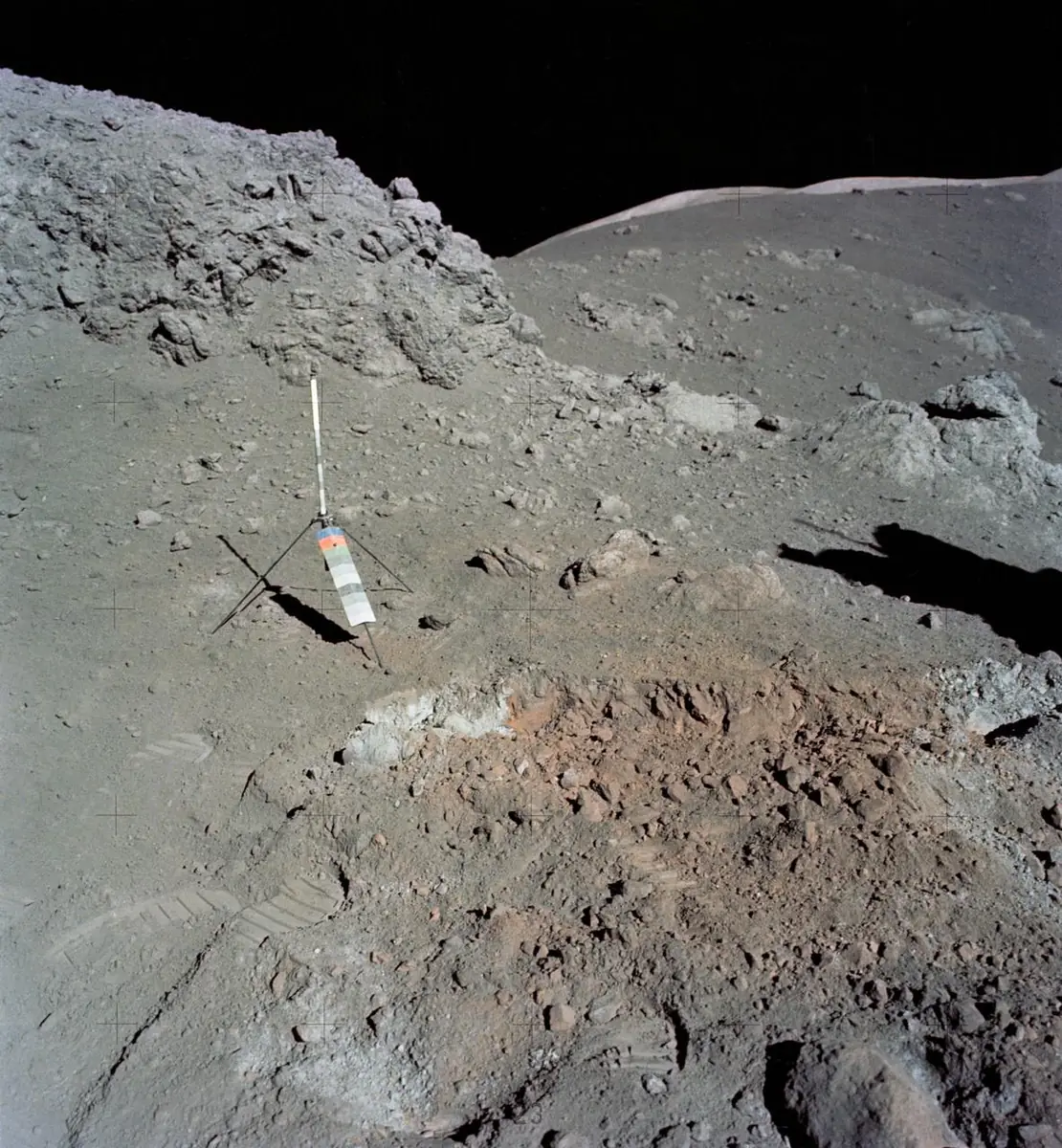
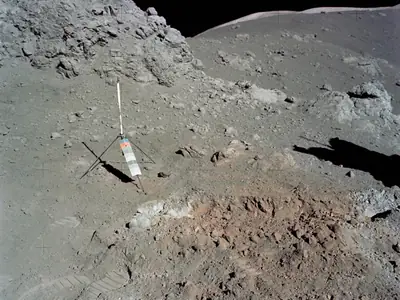 The orange soil at Shorty crater, Station 4.
-
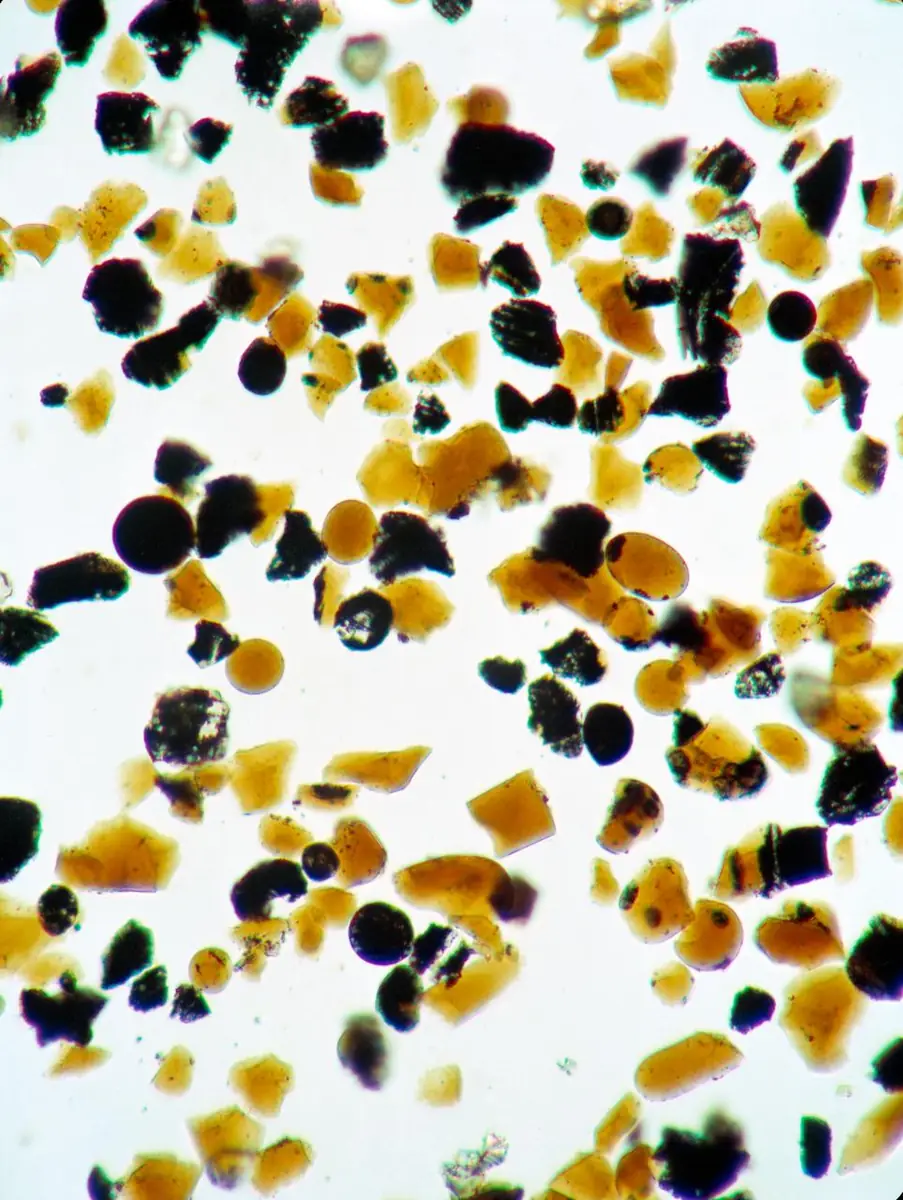
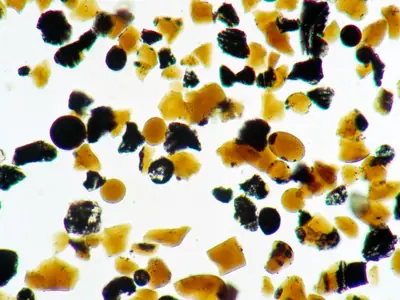 Orange glass spheres and fragments from the Shorty crater soil, under a microscope.
-
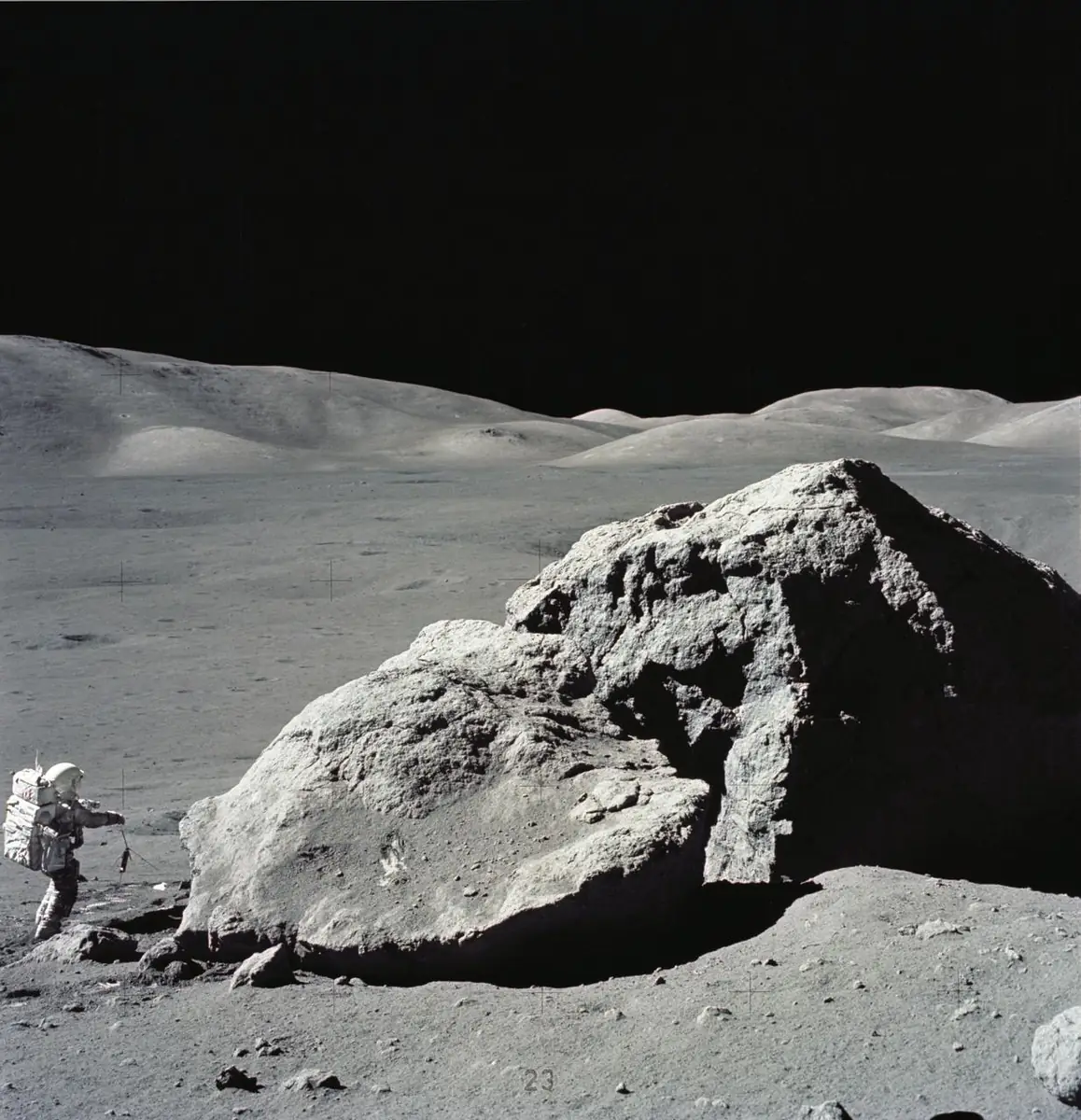
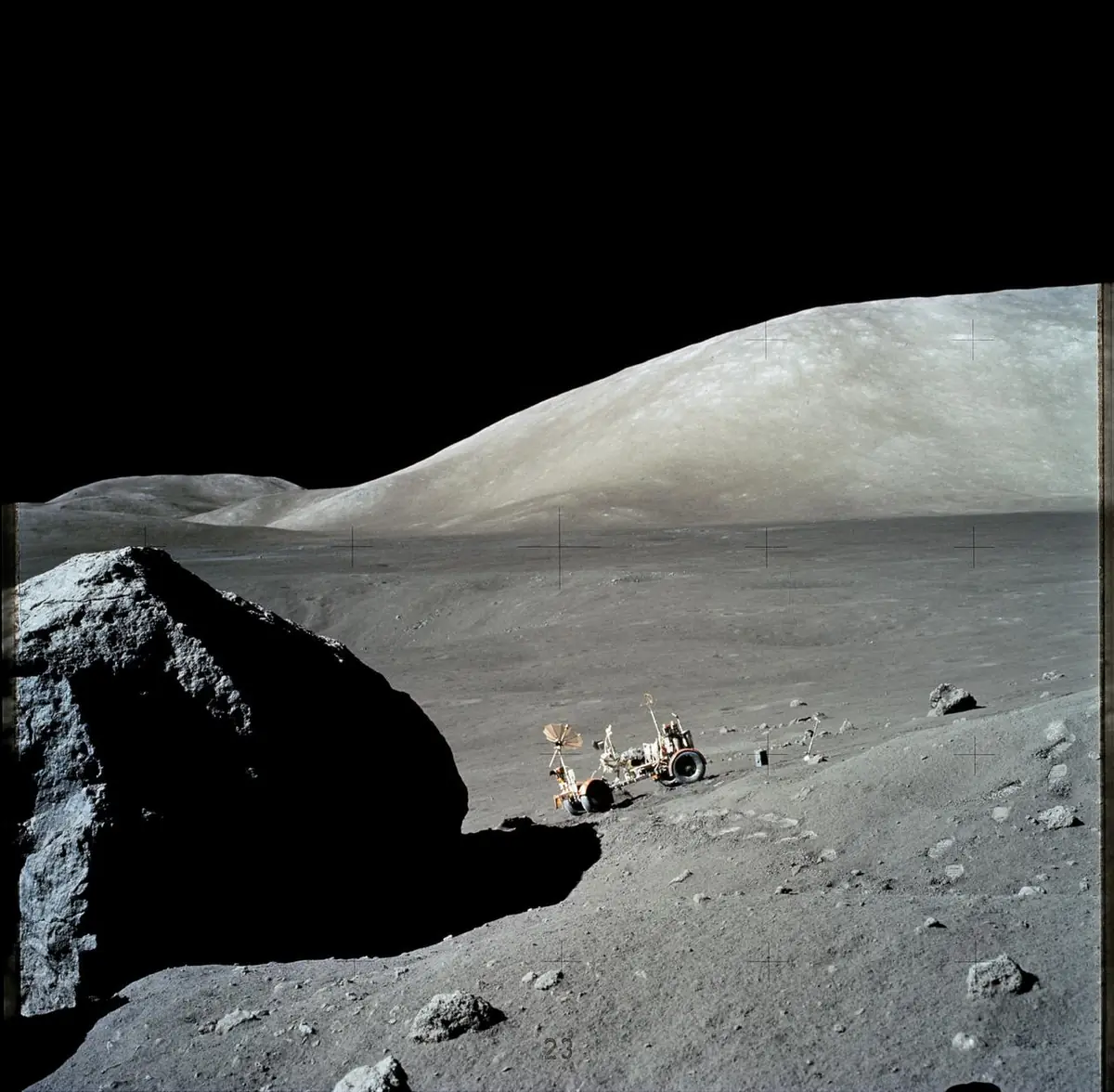
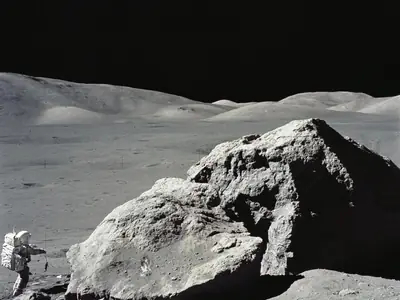 Schmitt beside Tracy's Rock, the huge split boulder at Station 6.
-
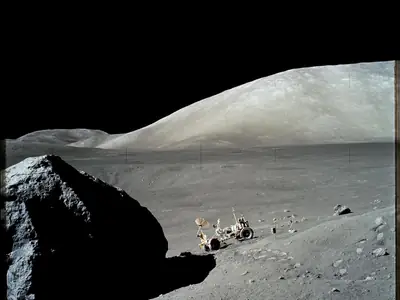 The rover beside the Station 6 boulder.
-
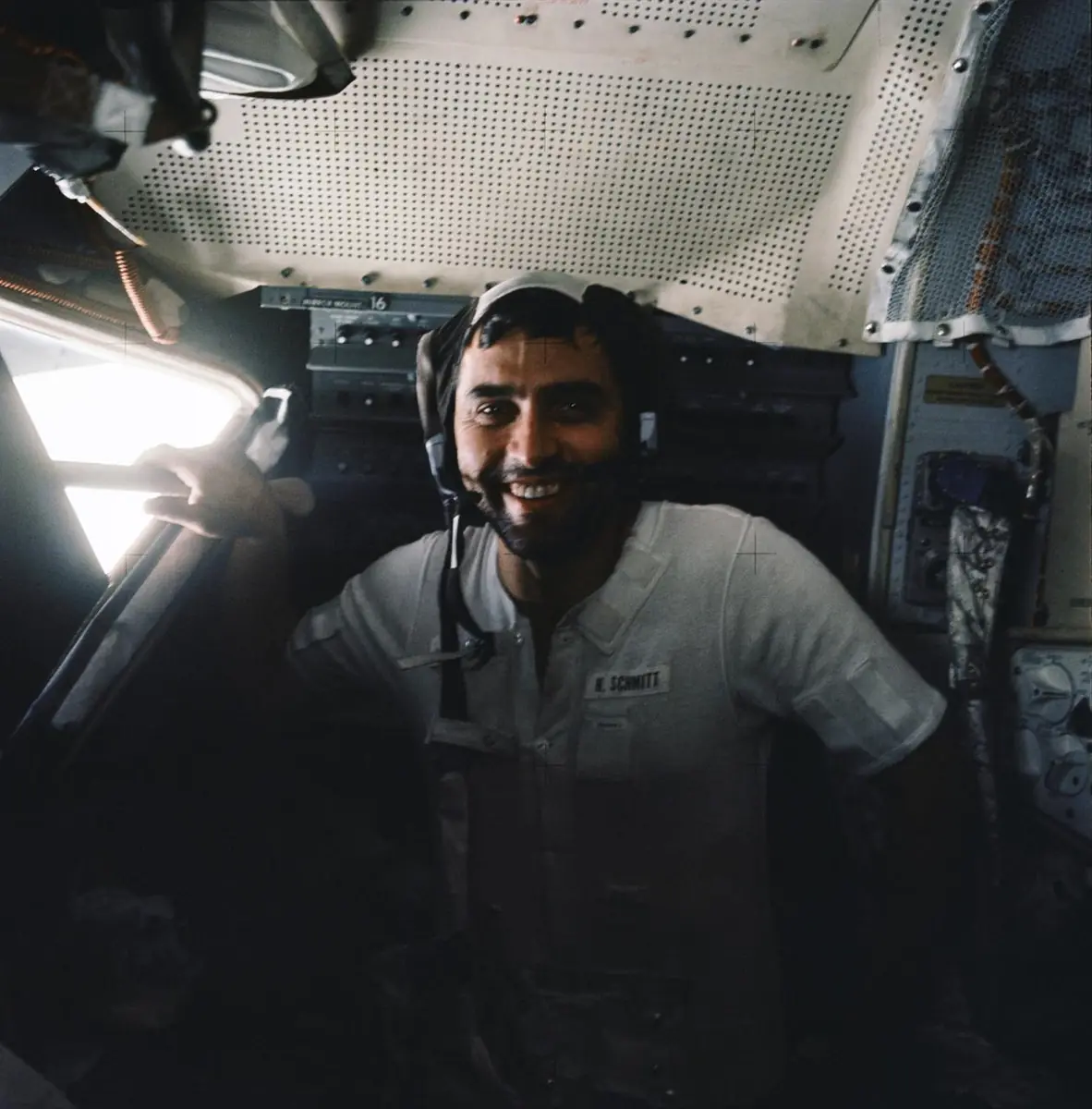
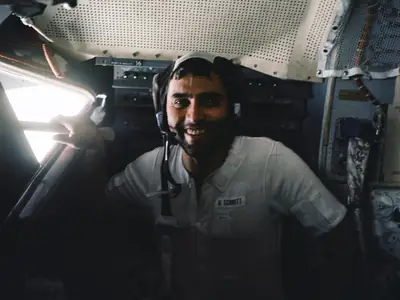 Schmitt inside Challenger after an EVA.
-
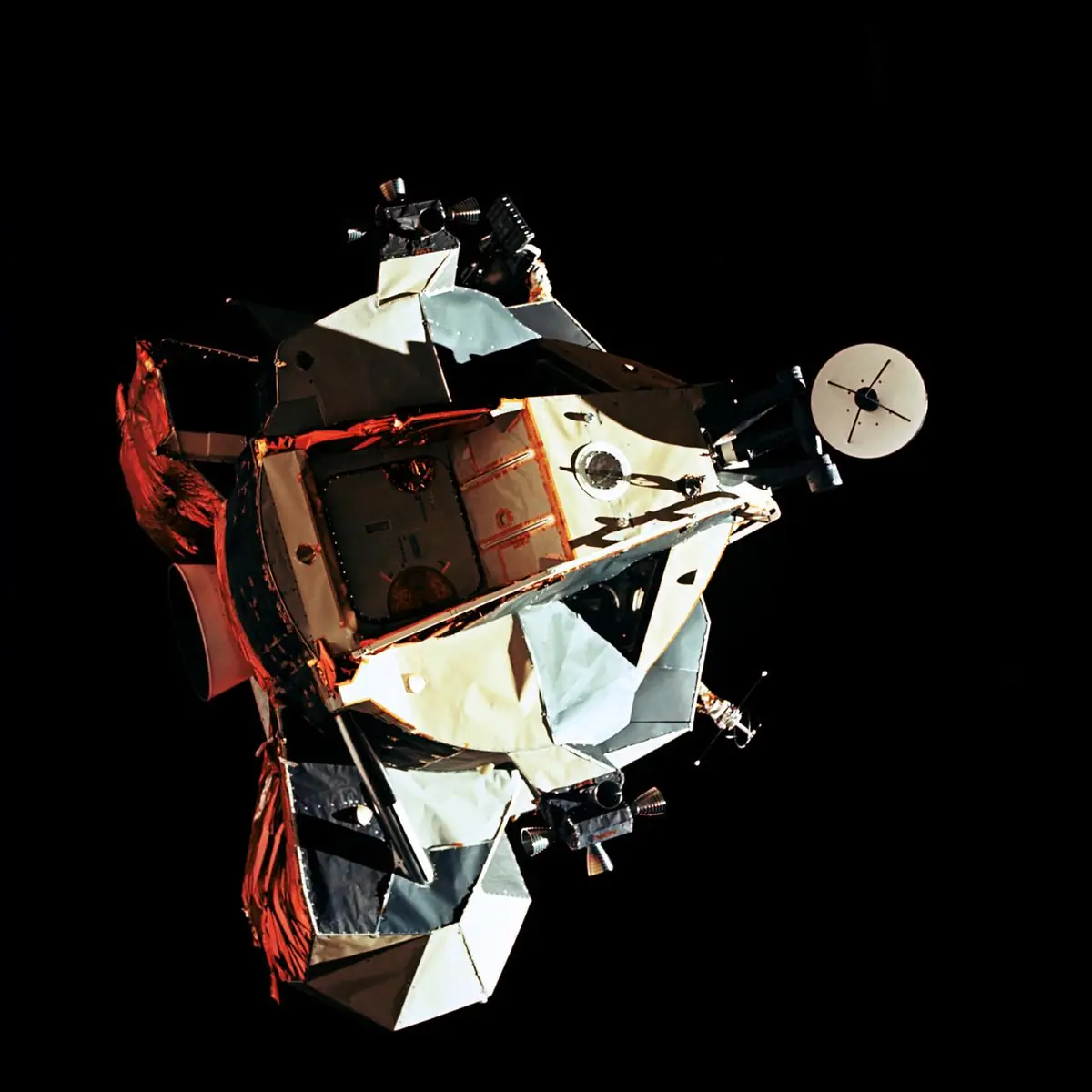
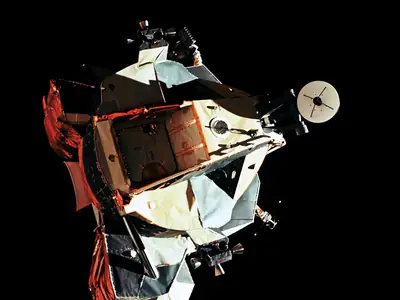 Challenger's ascent stage approaches America in lunar orbit.
-
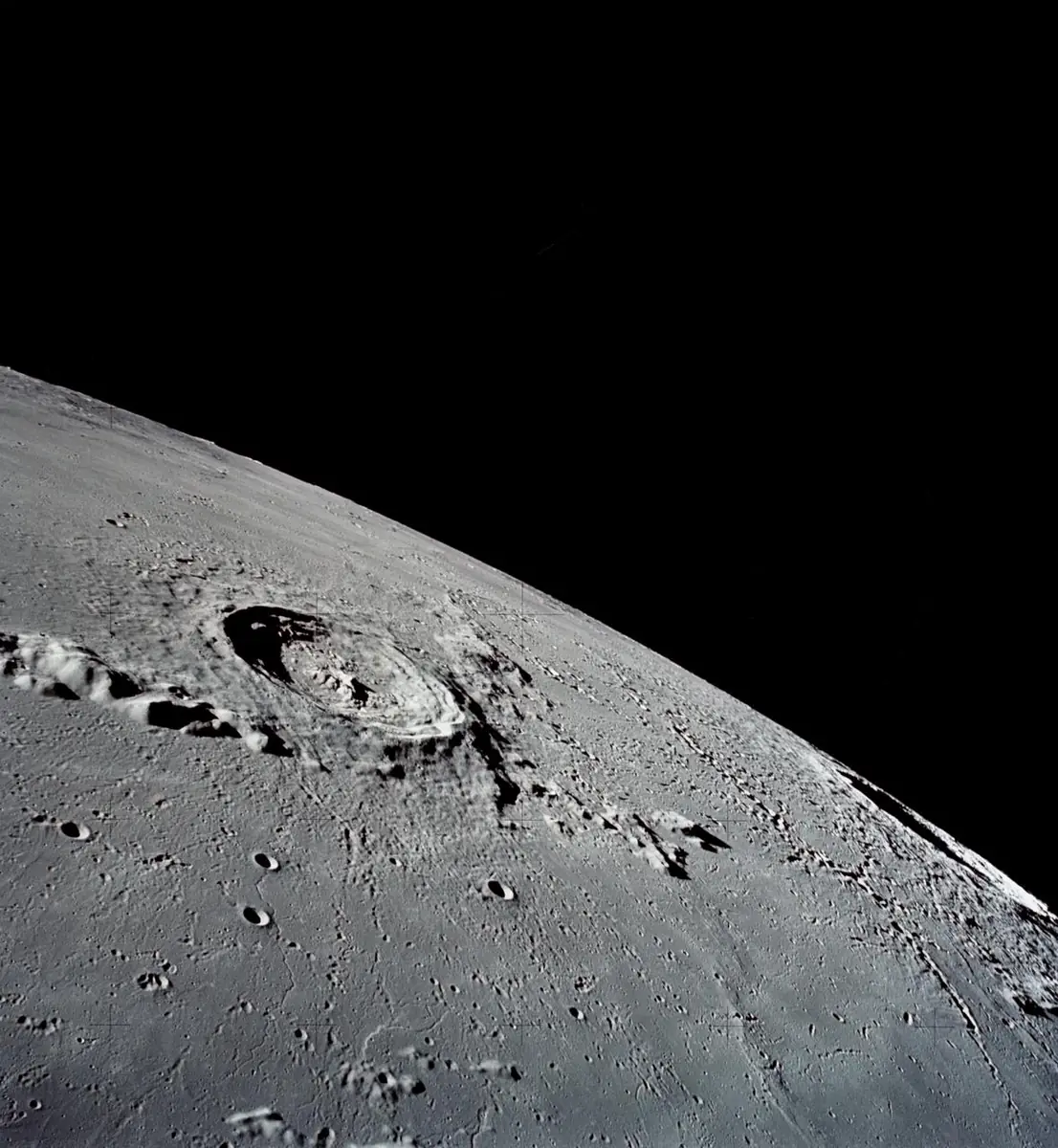
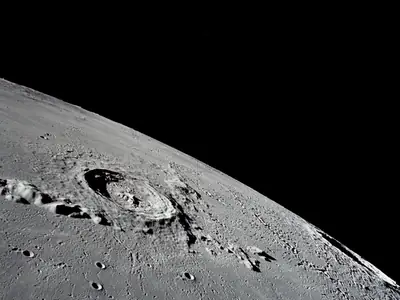 Eratosthenes, with Copernicus on the horizon, from lunar orbit.
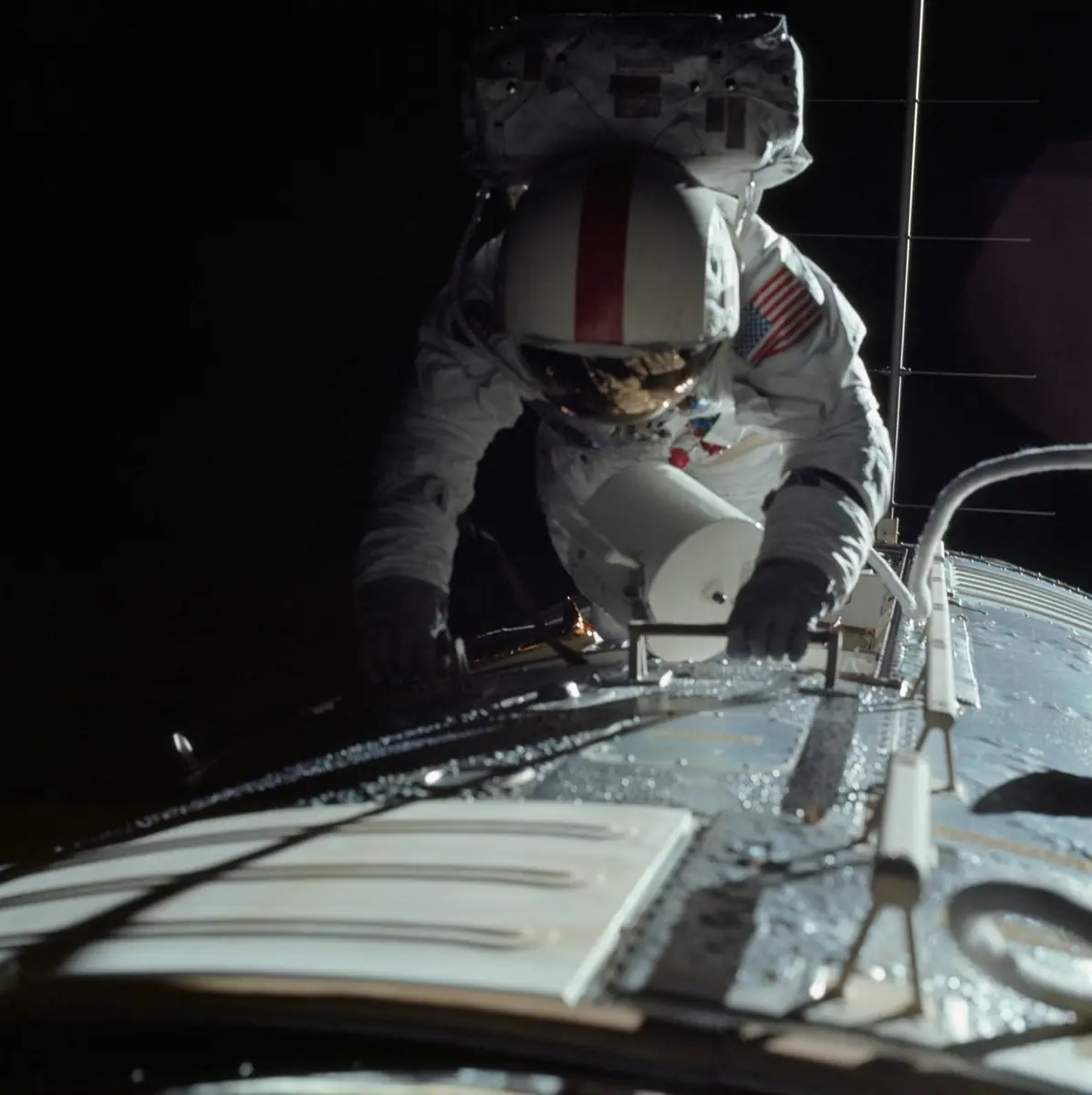
-
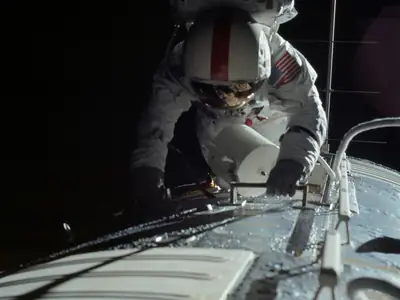 Evans outside America on the trans-Earth EVA.
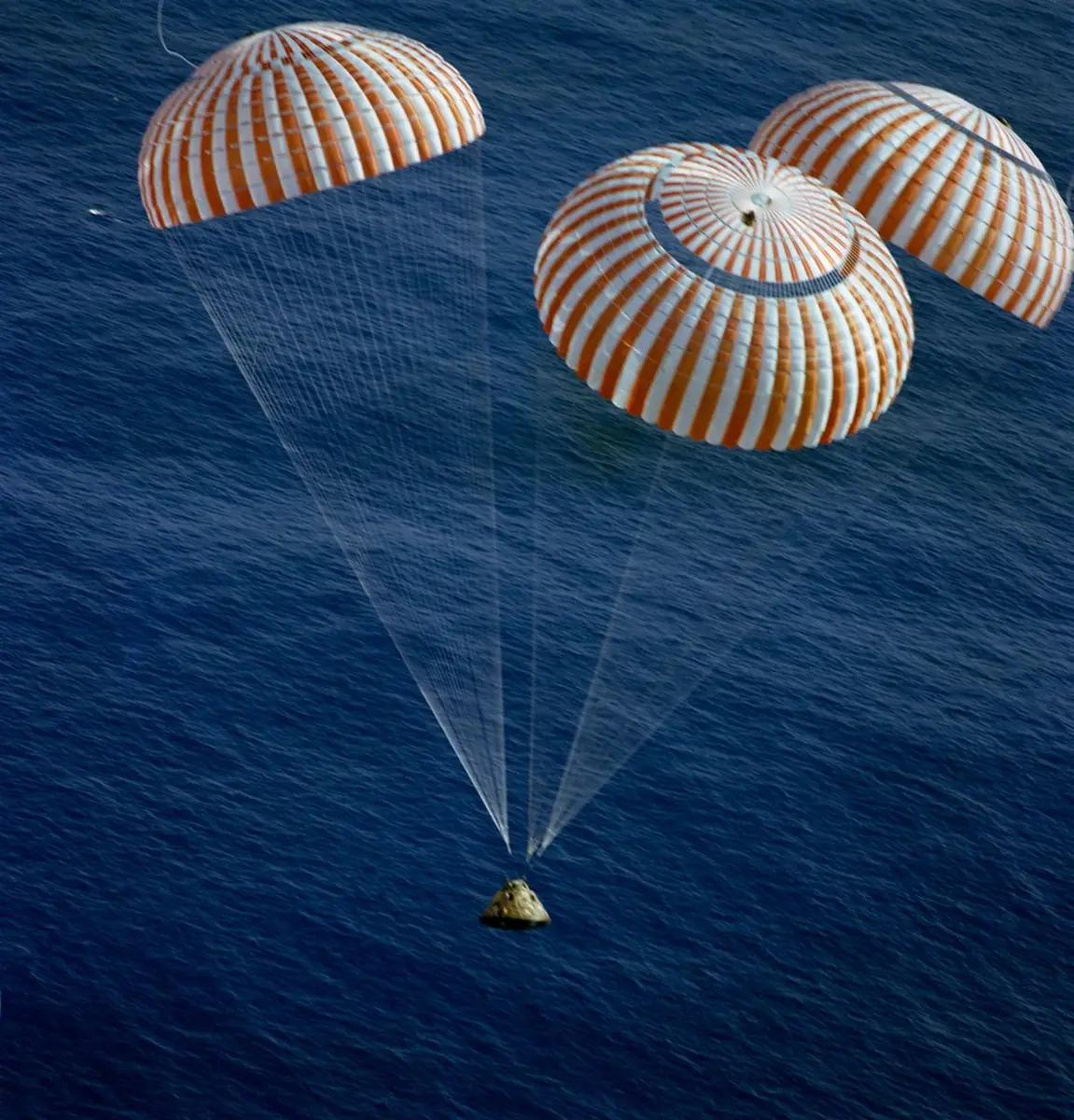
-
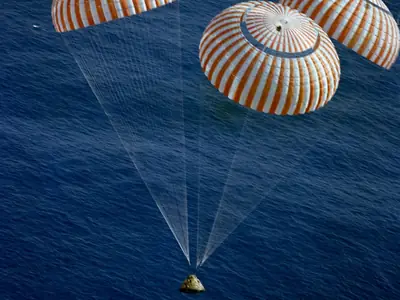 America descends to the Pacific, the last Apollo lunar splashdown.
At a glance 12
-
Mission type
Type J-3: the third extended science mission and the last crewed Moon landing of the Apollo program.
-
Dates
Launched 7 December 1972, landed 11 December, splashed down 19 December 1972.
-
Mission duration
301 h 51 min 59 s (12 days 13 h 52 min), the longest Apollo flight.
-
Call signs
Command module America (CM-114) and lunar module Challenger (LM-12).
-
Landing site
The Taurus–Littrow valley on the south-eastern rim of Mare Serenitatis, walled in by the North and South Massifs.
-
Coordinates
20.19080° N, 30.77168° E, the easternmost Apollo landing.
-
Records
Longest surface stay (74 h 59 min 40 s), longest total moonwalk time (22 h 03 min 57 s), most samples (110.52 kg), longest rover drives (35.7 km22.2 miles) and most lunar orbits (75).
-
Moonwalks
Three EVAs of more than 7 hours each.
-
Samples
110.52 kg (243.7 lb).
-
Designations
AS-512, Eastern Test Range #1701; international IDs 1972-096A to -096D.
-
Distance flown
1,291,299 n mi (about 2.39 million km1.49 million miles).
-
The last so far
No one has walked on the Moon since. The next people to travel to the Moon were the Artemis II crew, who flew around it in April 2026.
Crew & team 11
-
Gene Cernan, commander
Capt., USN, born 14 March 1934 in Chicago; 38 at launch. Purdue electrical engineering (1956), M.S. Naval Postgraduate School (1963). Pilot of Gemini 9A and lunar module pilot of Apollo 10; this was his third flight.
-
Twice to the Moon
Cernan flew to the Moon twice: to within 15 km9 miles of it on Apollo 10, then to the surface on Apollo 17. He died in January 2017.
-
Ron Evans, command module pilot
Cdr., USN, born 10 November 1933 in St. Francis, Kansas; 39 at launch. University of Kansas electrical engineering (1956), M.S. NPS (1964), selected 1966. First flight. He died in 1990.
-
Jack Schmitt, lunar module pilot
Civilian, born 3 July 1935 in Santa Rita, New Mexico; 37 at launch. Caltech B.S. (1957), Harvard Ph.D. in geology (1964), selected in 1965 with the first scientist-astronauts.
-
A geologist on the Moon
Schmitt was the first professional scientist on the Moon and the only geologist. He replaced Joe Engle when Apollo 18 was cancelled.
-
Senator Schmitt
Schmitt later served one term as a U.S. Senator for New Mexico (1977–1983). He is one of the four living moonwalkers.
-
Backup crew
John Young, Stu Roosa and Charlie Duke.
-
Support crew
Bob Overmyer, Bob Parker and Gordon Fullerton.
-
Capsule communicators
Gordon Fullerton, Bob Overmyer, Bob Parker (moonwalk CAPCOM), Joe Allen, Alan Shepard, Ken Mattingly, Charlie Duke, Stu Roosa and John Young.
-
Flight directors
Gerry Griffin; Gene Kranz and Neil Hutchinson; Pete Frank and Charles Lewis.
-
Weights
Launch-day weights 80.3 kg (Cernan), 75.7 kg (Evans) and 74.8 kg (Schmitt).
Launch & Saturn V 10
-
First night launch
05:33:00 GMT on 7 December (12:33 a.m. EST), the only night launch of a crewed Saturn V. Its glow was seen hundreds of kilometres away.
-
Delay
At T−30 s the terminal countdown sequencer failed to command S-IVB oxygen tank pressurization. Holds added up to 2 h 40 min.
-
Weather
21.1 °C70.0 °F, 93% humidity, light north-westerly wind, stratocumulus 20% and cirrus above.
-
Weight at ignition
6,529,784 lb for SA-512.
-
Flight azimuth
91.504°, the only Apollo Saturn V to fly south of due east.
-
Parking orbit
90.3 × 90.0 n mi (167 × 167 km104 × 104 miles) at 28.526°. Translunar injection came after two full Earth orbits.
-
Translunar injection
A 351.04-s burn from 3:12:37. Controllers then trimmed the coast so that America arrived on the original schedule.
-
Max Q
701.75 lb/ft² at 82.5 s.
-
S-IVB impact
Steered into the Moon at 86:59:41 near 4.2° S, 12.3° W. All four working seismometers recorded it.
-
Upper winds
Strongest winds on the way up: 87.6 knots (162 km/h101 mph) at 11.9 km38,945 feet.
Spacecraft 8
-
Command & service module
CSM-114, 66,942 lb at launch, with a SIM bay carrying new instruments.
-
SIM bay
A lunar sounder radar, an infrared scanning radiometer and a far-ultraviolet spectrometer, alongside the panoramic and mapping cameras and the laser altimeter.
-
Challenger
LM-12, 36,262 lb at launch, the heaviest lunar module.
-
Descent propellant
19,564 lb loaded, 18,249 lb burned; about 117 s of hover time left, the largest margin of any landing.
-
LRV-3
The third and last rover, which also carried the transmitter for the surface electrical properties experiment.
-
Software
Colossus 3 (command module) and Luminary 1G (lunar module).
-
Docking latches
Three docking latches failed to lock at first; the crew set them by hand. Latch 4 also gave trouble.
-
The last plaque
“Here man completed his first explorations of the Moon, December 1972, A.D. May the spirit of peace in which we came be reflected in the lives of all mankind.”
Flight & orbit 11
-
Docking
Separated from the S-IVB at 3:42:28 and docked at 3:57:11.
-
The Blue Marble
About five hours after launch the crew photographed a fully lit Earth, from Africa to the Antarctic ice cap, the only Apollo flight with a view of the south polar cap.
-
Light flashes
The crew observed bright and dim cosmic-ray flashes for an hour at 68:19.
-
Lunar orbit insertion
SIM door off at 81:33; a 393.16-s burn at 86:14:23 into 170.0 × 52.6 n mi (315 × 97 km196 × 61 miles) after an 83 h 2 min coast.
-
Low orbit
The CSM's engine lowered both craft to 59.0 × 14.5 n mi (109 × 27 km68 × 17 miles); they stayed there 17 h before undocking at 107:48.
-
Powered descent
From 8.7 n mi (16 km10 miles) altitude at 110:09:53, lasting about 12 min.
-
Lunar liftoff
22:54:37 GMT on 14 December, televised from the rover; a 441-s burn into 48.5 × 9.1 n mi (90 × 17 km56 × 10 miles).
-
Rendezvous
Docked at 187:37:15 after 79 h 49 min apart.
-
Ascent stage impact
Crashed at 193:17:21 about 9.9 km6.2 miles south-west of the landing site; the Apollo 12, 14, 15 and 16 seismometers recorded it.
-
An extra day
The crew spent an extra day in lunar orbit on science before a 143.69-s trans-Earth burn at 234:02:09 after 75 orbits.
-
Science on the way out
Heat flow and convection demonstrations ran from 42:55 to 46:00, once in attitude hold and once in the barbecue roll.
Landing site 8
-
Touchdown
19:54:58 GMT (2:54:58 p.m. EST) on 11 December 1972.
-
Accuracy
Within about 200 m656 feet of the planned point.
-
Sun angle
About 13° above the eastern horizon.
-
Attitude
Challenger settled pitched 4–5° up with no roll.
-
Why Taurus-Littrow
It promised old highland rock from the massifs, dark volcanic deposits on the valley floor and good use of the rover.
-
Light mantle
A bright avalanche deposit from the South Massif spreads across the valley floor.
-
Named stops
Steno, Camelot, Nansen, Lara, Shorty, Henry and Van Serg craters; Tracy's Rock at Station 6.
-
A basin rim
The valley cuts into mountains raised by the impact that formed the Serenitatis basin.
Moonwalks 10
-
EVA-1
7 h 11 min 53 s. Rover unloaded, ALSEP set up 185 m610 feet west-northwest of the LM, deep drill core, and a drive to Station 1: 3.3 km2.1 miles, 14.3 kg.
-
The fender
Cernan knocked off the rover's right rear fender extension; duct tape failed and dust sprayed over the crew.
-
Map-and-clamp repair
For EVA-2, on a suggestion from John Young, they made a new fender from four taped laminated maps held by two clamps from the LM's lights.
-
EVA-2
7 h 36 min 56 s, the longest drive: to Nansen at the foot of the South Massif, about 7.6 km4.7 miles from the LM, then to Shorty crater: 20.3 km12.6 miles, 34.1 kg.
-
“Orange soil!”
At Shorty crater Schmitt scuffed the ground and found bright orange soil, later shown to be volcanic glass.
-
EVA-3
7 h 15 min 8 s to the North Massif, Tracy's Rock at Station 6, Station 7 and Van Serg crater: 12.1 km7.5 miles, 62.0 kg.
-
Tracy's Rock
A huge split boulder at Station 6, named for Cernan's daughter. Cernan later said he traced her initials in the dust.
-
Fastest rover
Cernan reached about 18 km/h11 mph driving downhill, an unofficial lunar speed record.
-
Last words
Cernan, last up the ladder: “...we leave as we came and, God willing, as we shall return, with peace and hope for all mankind.”
-
Totals
22 h 03 min 57 s outside, 35.7 km22.2 miles by rover, farthest point about 7.6 km4.7 miles from Challenger.
Surface science 11
-
ALSEP
Heat flow, lunar ejecta and meteorites, lunar seismic profiling, lunar atmospheric composition and a surface gravimeter.
-
Seismic profiling
Eight explosive packages of 0.1–6.5 lb were placed up to a few kilometres away and set off by timer after the crew left, probing the valley down to about 2.7 km1.7 miles.
-
Blast on TV
Two charges went off before trans-Earth injection; the flash and dust from the second were seen on the rover's camera.
-
Gravimeter flaw
The surface gravimeter, built to detect gravitational waves, could not be balanced because of a design error. It returned only seismic and free-oscillation data.
-
Thin atmosphere
The mass spectrometer measured the Moon's tenuous atmosphere, including helium and argon.
-
Heat flow
Probes 2.5 m8 feet deep gave about 16 mW/m², revised to about 14 mW/m² as the regional value.
-
Traverse gravimeter
Gravity readings at the stops mapped the dense basalt filling the valley.
-
Surface electrical properties
A transmitter on the LM site and a receiver on the rover sounded the subsurface by radio, until the receiver overheated.
-
Neutron probe
A probe in the deep drill hole measured how neutrons build up isotopes in the regolith.
-
Too hot to work
The lunar ejecta and meteorites experiment overheated in lunar daylight and was run mainly at night.
-
Cosmic ray sheets
Detector sheets recorded cosmic-ray and solar particle tracks and were brought home.
Rocks & discoveries 9
-
What came home
110.52 kg, the most of any mission, with 7xxxx sample numbers (second digit = station).
-
Orange soil 74220
Tiny orange and black volcanic glass beads, sprayed in fire fountains about 3.6 billion years ago.
-
Water inside
Later studies found water in the glass beads and in crystal inclusions from 74220, evidence for water in the Moon's interior.
-
Troctolite 76535
A coarse rock from Station 6, about 4.2 billion years old. Its magnetism points to an ancient lunar dynamo.
-
Station 6 boulder
Tracy's Rock is impact-melt breccia that rolled down the North Massif, preserving ancient basin debris.
-
Valley basalts
High-titanium basalts such as 70017 filled the valley about 3.7 billion years ago.
-
Goodwill rocks
Fragments of basalt 70017 were set in goodwill displays and given to nations around the world and all U.S. states.
-
Deep core
Cernan drilled a core nearly 3 m10 feet long near the ALSEP.
-
Station 2 boulders
At Nansen the crew sampled boulders that had rolled from the South Massif, including breccia 72255.
Alone in orbit 8
-
Evans solo
Ron Evans flew America alone for nearly 80 hours (79 h 49 min undocked).
-
Radar under the surface
The lunar sounder radar probed layers beneath the maria.
-
Heat map
The infrared radiometer mapped surface temperatures and found cold spots and hot spots tied to rocky craters.
-
Mice in orbit
Five pocket mice with radiation detectors under their scalps (the BIOCORE experiment) rode in America. Four survived.
-
Orbit trim
The CSM's orbit did not decay as predicted, so a 37.5-s trim burn lowered it to 67.3 × 62.5 n mi (125 × 116 km77 × 72 miles).
-
Deep-space EVA
On the way home Evans spent 1 h 5 min 44 s outside retrieving sounder, panoramic and mapping film, the last deep-space EVA to date.
-
Ultraviolet spectrometer
Measured the density and composition of the Moon's thin atmosphere from orbit.
-
Biostack
A sealed stack of seeds, spores and eggs (Biostack IIA) recorded cosmic-ray hits on living matter.
Return & recovery 7
-
Entry
Entry at 36,090 ft/s; peak 6.49 g.
-
Splashdown
19:24:59 GMT on 19 December 1972 at 17.88° S, 166.11° W, about 1 n mi (1.9 km1.2 miles) from target and 3.5 n mi (6.5 km4.0 miles) from USS Ticonderoga (CVS-14).
-
Upright
America floated apex-up; the crew was aboard ship in 52 minutes.
-
Same ship again
Ticonderoga also recovered Apollo 16 eight months earlier.
-
Recovery force
3 ships and 15 aircraft, the smallest of the program.
-
Where America is
Displayed at Space Center Houston, the visitor centre of NASA's Johnson Space Center.
-
Last deactivation
America was made safe at North Island Naval Air Station in San Diego before going to Downey for analysis.
Moments & legacy 7
-
The Blue Marble
Photo AS17-148-22727, taken on the way out, became one of the most reproduced images in history.
-
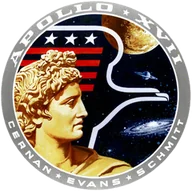
The patch
The Greek god Apollo with an American eagle, Saturn and a galaxy, a hint that people would someday go farther.
-
Flag for Mission Control
On the first anniversary, Cernan and Schmitt gave Mission Control a flag that had flown to the Moon with them.
-
Most productive
NASA called it the most productive and trouble-free crewed mission of Apollo.
-
Training scientists
It showed a scientist could be trained as an astronaut while keeping a scientist's eye.
-
Night launch lesson
Stars and horizon were invisible during the night launch, so window-based alignment checks could not be used.
-
From orbit today
LRO images show Challenger's descent stage, the rover and the tracks to the massifs.
Seven missions side by side
Figures from NASA's Apollo by the Numbers. Select a mission to open its dossier.
| Measure | Apollo 11 | Apollo 12 | Apollo 13 | Apollo 14 | Apollo 15 | Apollo 16 | Apollo 17 |
|---|---|---|---|---|---|---|---|
| Landing (UTC) | 20 July 1969 | 19 November 1969 | did not land | 5 February 1971 | 30 July 1971 | 21 April 1972 | 11 December 1972 |
| Landing site | Mare Tranquillitatis | Oceanus Procellarum | Fra Mauro highlands (planned) | Fra Mauro highlands | Hadley–Apennine | Descartes Highlands | Taurus–Littrow valley |
| Lunar module | Eagle (LM-5) | Intrepid (LM-6) | Aquarius (LM-7) | Antares (LM-8) | Falcon (LM-10) | Orion (LM-11) | Challenger (LM-12) |
| Command module | Columbia (CM-107) | Yankee Clipper (CM-108) | Odyssey (CM-109) | Kitty Hawk (CM-110) | Endeavour (CM-112) | Casper (CM-113) | America (CM-114) |
| Commander | Neil Armstrong | Pete Conrad | Jim Lovell | Alan Shepard | David Scott | John Young | Gene Cernan |
| Lunar module pilot | Buzz Aldrin | Alan Bean | Fred Haise | Edgar Mitchell | Jim Irwin | Charlie Duke | Harrison Schmitt |
| Command module pilot | Michael Collins | Dick Gordon | Jack Swigert | Stuart Roosa | Al Worden | Ken Mattingly | Ron Evans |
| Mission type | G | H-1 | H-2 | H-3 | J-1 | J-2 | J-3 |
| Time on the Moon | 21 h 36 min | 31 h 31 min | none | 33 h 30 min | 66 h 54 min | 71 h 2 min | 74 h 59 min |
| Moonwalks | 1 · 2 h 31 min | 2 · 7 h 45 min | none | 2 · 9 h 22 min | 3 · 18 h 34 min | 3 · 20 h 14 min | 3 · 22 h 3 min |
| Samples | 21.55 kg | 34.35 kg | none | 42.28 kg | 77.31 kg | 95.71 kg | 110.52 kg |
| Farthest from the lunar module | 60 m200 feet | ≈ 410 m1,350 feet | none | ≈ 1.45 km0.9 miles | ≈ 5.0 km3.1 miles | ≈ 4.6 km2.9 miles | ≈ 7.6 km4.7 miles |
| Rover distance | none | none | none | none | 27.9 km17.3 miles | 26.9 km16.7 miles | 35.7 km22.2 miles |
| Sun at landing | 10.8° | 5.1° | none | 10.3° | 12.2° | 14.8° | 13.0° |
| Lunar orbits | 30 | 45 | none (flyby) | 34 | 74 | 64 | 75 |
| Mission length | 8 d 3 h 18 min | 10 d 4 h 36 min | 5 d 22 h 54 min | 9 d 0 h 1 min | 12 d 7 h 11 min | 11 d 1 h 51 min | 12 d 13 h 51 min |
| Recovery ship | USS Hornet | USS Hornet | USS Iwo Jima | USS New Orleans | USS Okinawa | USS Ticonderoga | USS Ticonderoga |
| Sourced facts | 130 | 113 | 134 | 112 | 110 | 111 | 112 |
Sources and method
27 sources, how the Moon is drawn, and photo credits
Mission facts
- R. W. Orloff, Apollo by the Numbers: A Statistical Reference, NASA SP-2000-4029
- E. M. Jones & K. Glover, Apollo Lunar Surface Journal (NASA History)
- Apollo Preliminary Science Reports, NASA SP-214, SP-235, SP-272, SP-289, SP-315, SP-330
- C. Meyer, Lunar Sample Compendium, NASA Astromaterials Curation
- NASA NSSDCA, Apollo: Where are they now?
- NASA Science, Moonwalkers (living status checked Nov 2026)
- NASA Science, Apollo 11 Seismic Experiment
- H. Lindsay, ALSEP essay, Apollo Lunar Surface Journal
- Active Seismic Experiment (Apollo 14 and 16 results)
- A. Saunders, The Mystery Behind Alan Shepard's 'Moon Shot' Revealed, USGA, Feb 2021
- K. Cartier, Apollo may have found an Earth meteorite on the Moon, Eos (on Bellucci et al. 2019, EPSL)
- Langseth, Keihm & Peters, Revised lunar heat-flow values (1976)
- Apollo 16 Preliminary Science Report, Lunar Portable Magnetometer
- LROC, Orion, Up Close (Apollo 16 site), NASA/GSFC/ASU
- Haymaker et al., The Apollo 17 Pocket Mouse Experiment (BIOCORE), NASA SP-368
- NASA/JPL, First Confirmed Capture into Earth Orbit Is Likely Apollo Rocket (2002)
- NASA Science, Genesis Rock
- NASA History, Apollo 13: Mission Details
- NASA History, 50 Years Ago: Apollo 13 Preps for 3rd Moon Landing
- NASA History, 50 Years Ago: Apollo 13 Review Board Report (on the Cortright report, June 1970)
- NASA, Apollo 13: The Successful Failure
- LROC, Rocket impacts recorded by the Apollo seismic network, NASA/GSFC/ASU
- NASA, Acting NASA Administrator Reflects on Legacy of Astronaut Jim Lovell, Aug 2025
- Associated Press, Artemis II makes trip around the Moon after breaking Apollo 13's distance record, Apr 2026
- collectSPACE, NASA's SpaceX Crew-13 pays homage to Apollo 13 on mission patch, Apr 2026
- NASA Image and Video Library (photo captions)
- General Apollo reference (mission reports, press kits, crew biographies)
How the Moon is drawn
Positions of the Moon and Sun come from Astronomy Engine (Don Cross, MIT license). The Moon's orientation uses the IAU/WGCCRE 2009 rotation model, giving the libration seen from your location. Spot checks against NASA's Dial-a-Moon agree to within 0.02° for the sub-Earth and sub-solar points.
Surface map: NASA Scientific Visualization Studio CGI Moon Kit (Ernie Wright), from Lunar Reconnaissance Orbiter camera data. Shading follows the Lommel-Seeliger law with faint earthshine.
Landing coordinates are in the IAU mean Earth/polar axis frame, as tabulated in Apollo by the Numbers; Apollo 13's is its planned target. Feature-name positions are approximate.
Photographs
All photographs and mission emblems are NASA images from the NASA Image and Video Library; each photo links to its original record. NASA does not endorse this site.
Crew living status was checked in November 2026. Mission times are UTC.
Source
Apollo Preliminary Science Reports, NASA SP-214, SP-235, SP-272, SP-289, SP-315, SP-330
All sourcesSource
A. Saunders, The Mystery Behind Alan Shepard's 'Moon Shot' Revealed, USGA, Feb 2021
All sourcesSource
All sourcesSource
NASA/JPL, First Confirmed Capture into Earth Orbit Is Likely Apollo Rocket (2002)
All sourcesSource
NASA History, 50 Years Ago: Apollo 13 Review Board Report (on the Cortright report, June 1970)
All sourcesSource
NASA, Acting NASA Administrator Reflects on Legacy of Astronaut Jim Lovell, Aug 2025
All sourcesSource
All sources