
Apollo landing sites
Apollo on tonight's Moon Apollo on the Moon of
The six landing sites, and Apollo 13's planned one, placed on the Moon as it looks from where you are. Each pin is in sunlight or lunar night the way the site is right now. Pick a site for its mission dossier.
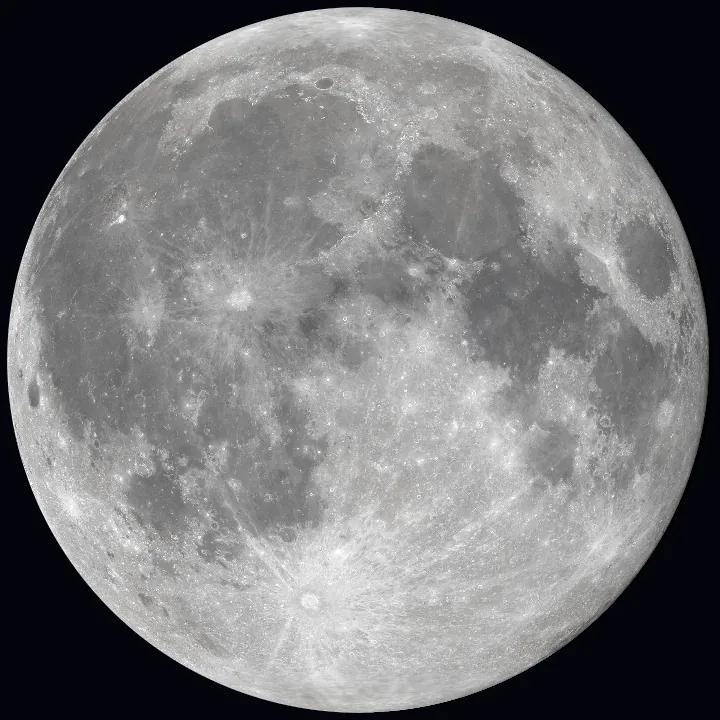
Site in sunlightSite in lunar nightPlanned, never reached
Clear-sky view: clouds and weather are not shown. Rendered from NASA Lunar Reconnaissance Orbiter maps.
The near side face on, north up, as at full Moon. With JavaScript on, this shows the Moon as it looks from your location right now.
Apollo 11
Apollo 11
Tranquility Base, Mare Tranquillitatis · 0.674° N, 23.473° E
- Commander
- Neil A. Armstrong
- Command module pilot
- Michael Collins
- Lunar module pilot
- Edwin E. “Buzz” Aldrin Jr.
- Command module
- Columbia
- Lunar module
- Eagle
The first crewed landing: one moonwalk, a seismometer, a laser mirror and 21.55 kg of Moon brought home.
- Landed
- 20 July 196920:17 UTC
- Time on the Moon
- 21 h 36 minliftoff 21 July 1969
- Moonwalks
- 2 h 31 min1 moonwalk · ≈ 1 km0.6 miles on foot
- Samples
- 21.55 kg47.5 lb
- Farthest from the lunar module
- 60 m200 feeton foot
- Mission
- 8 d 3 h 18 min30 lunar orbits · USS Hornet
-
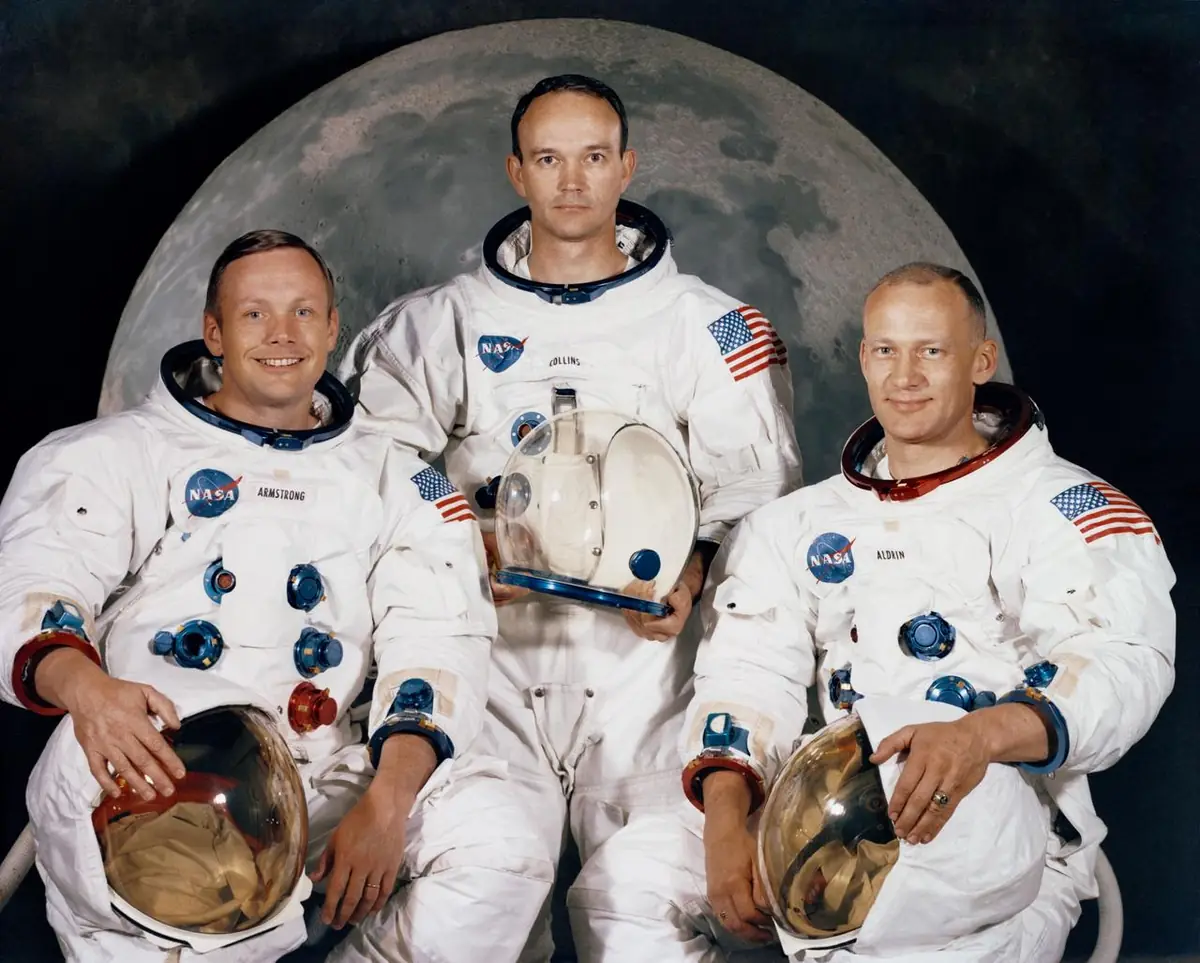
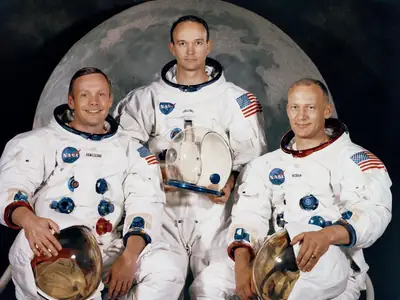 Prime crew portrait, May 1969: Neil Armstrong, Michael Collins and Buzz Aldrin.
-
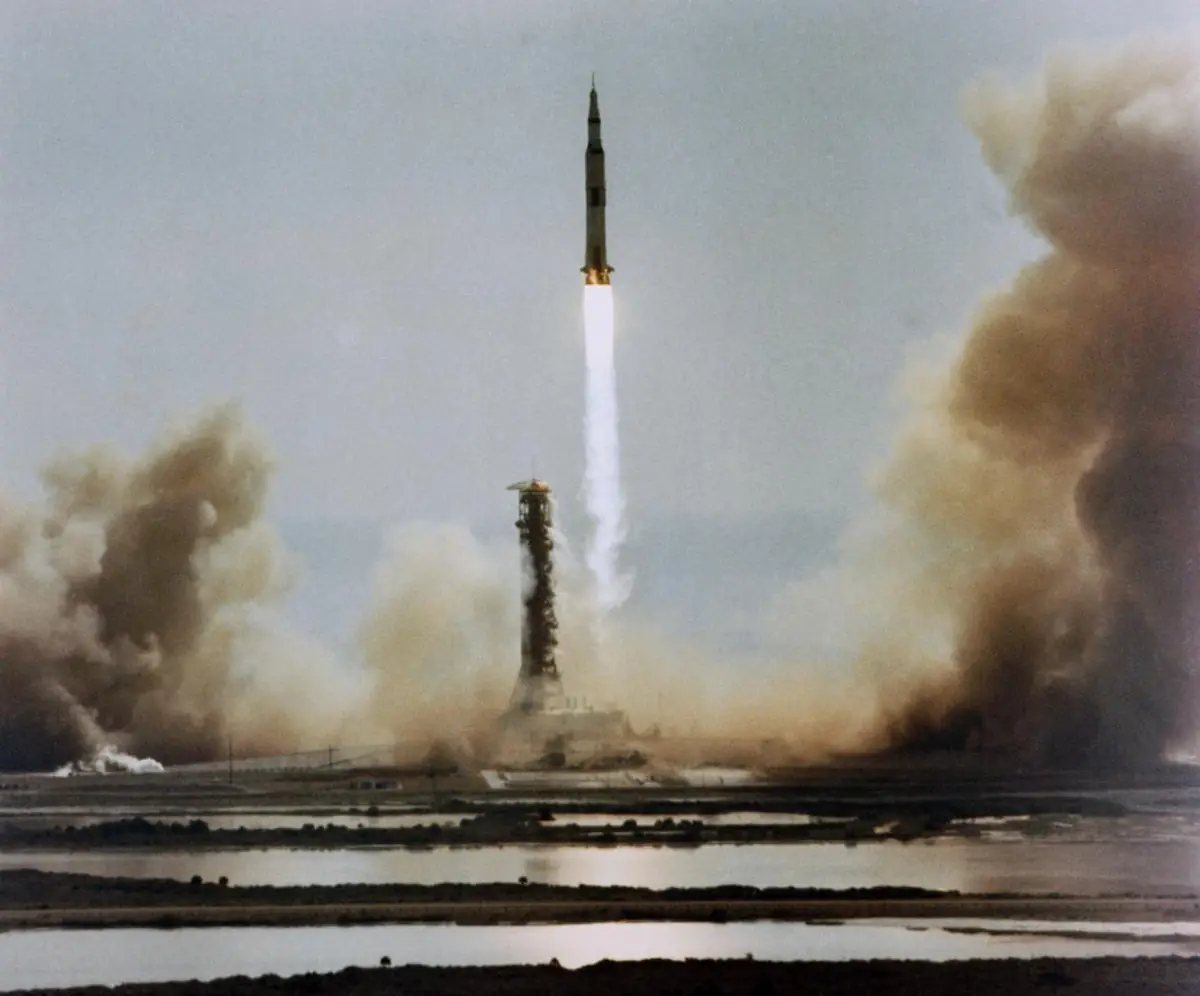
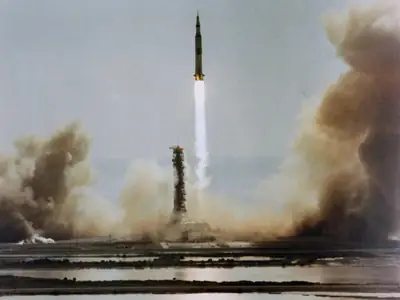 Saturn V SA-506 lifts off from Pad 39A at 9:32 a.m. EDT, 16 July 1969.
-
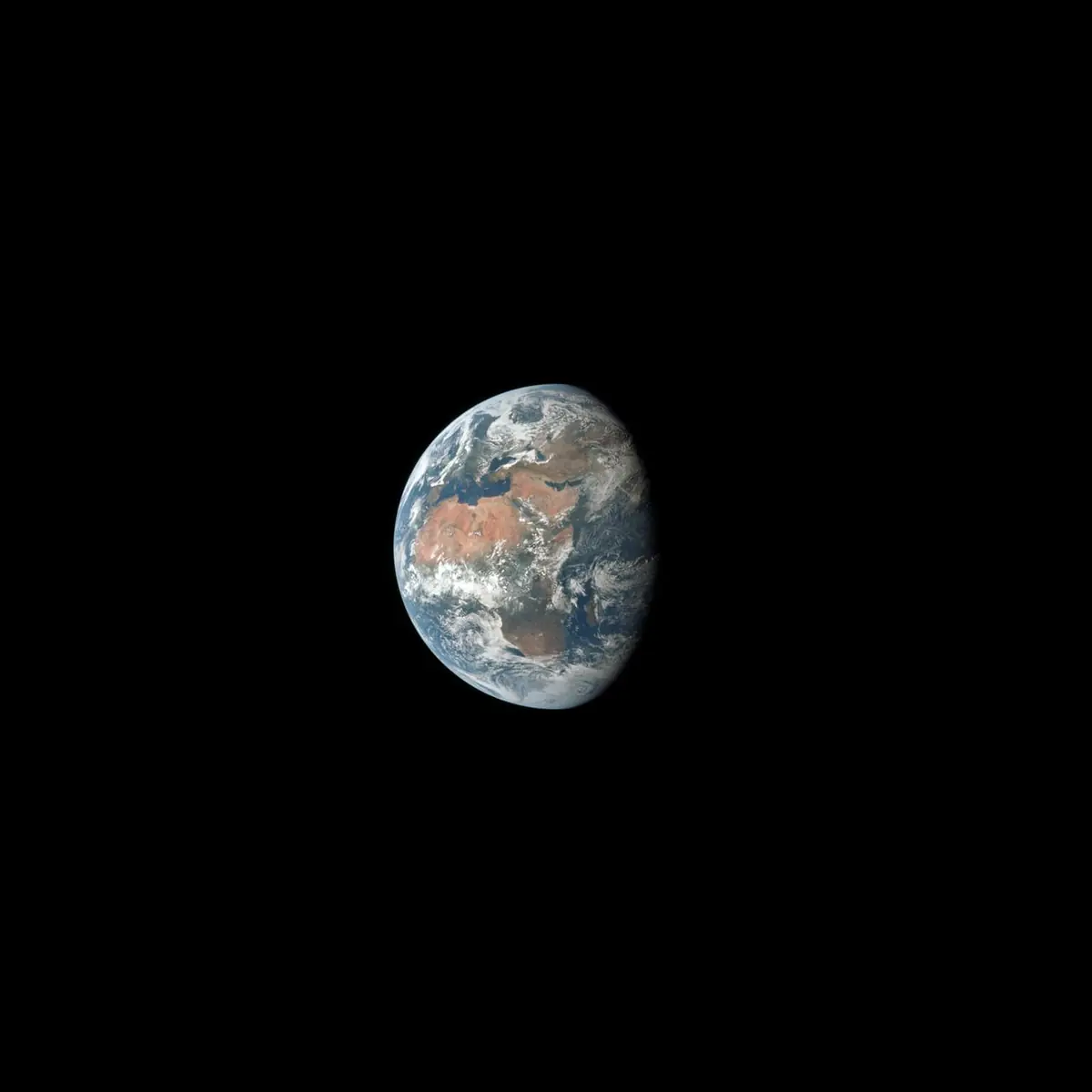
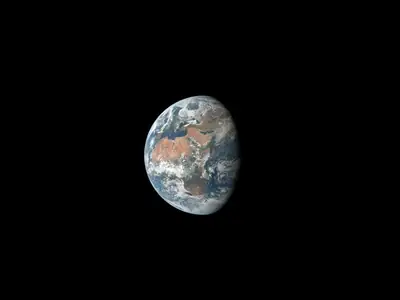 Earth from about 98,000 n mi (181,000 km113,000 miles) after translunar injection: Africa, Europe and Asia.
-
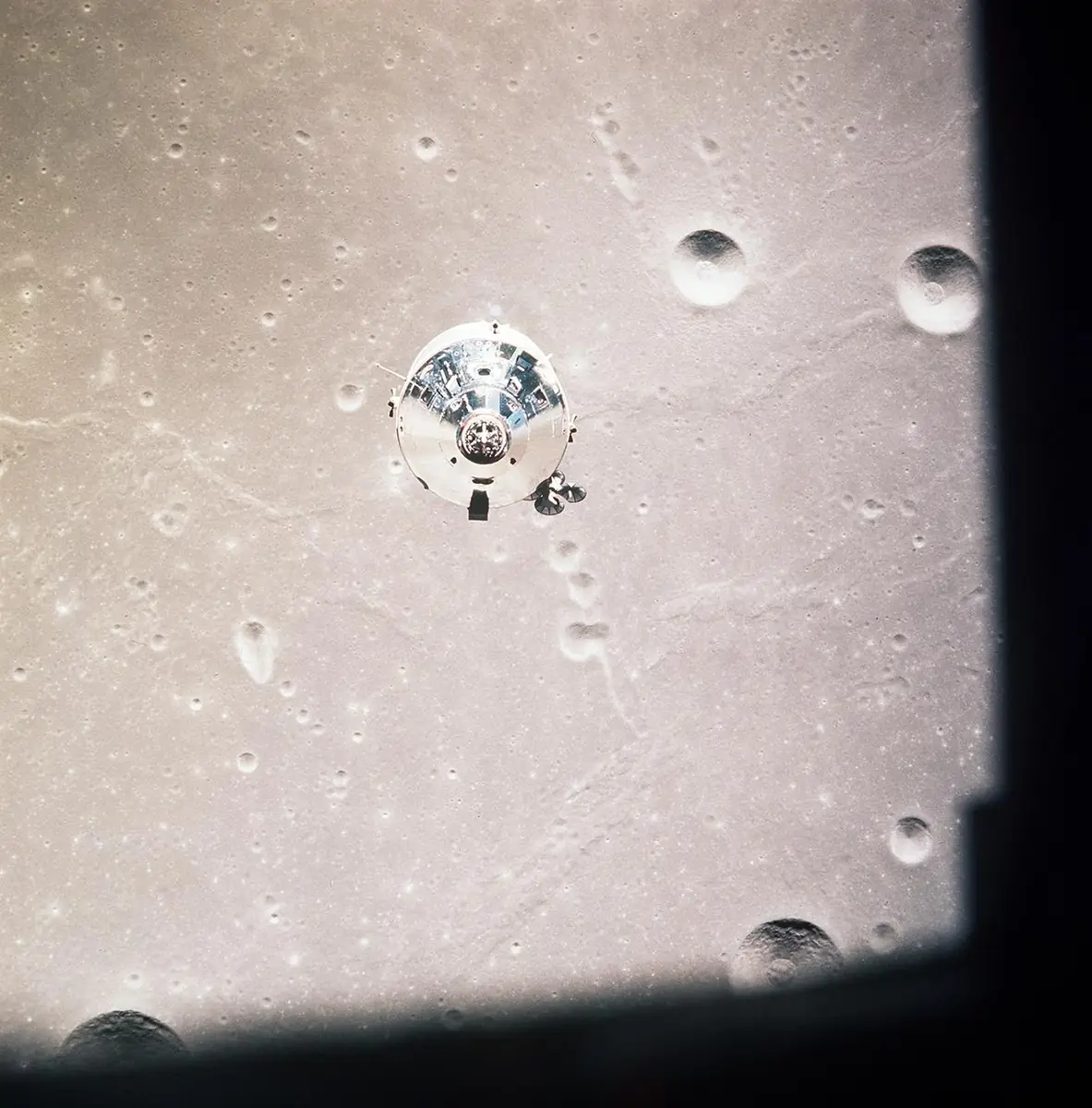
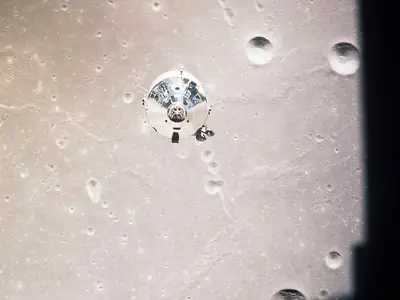 Columbia seen from Eagle in lunar orbit over the Sea of Fertility.
-
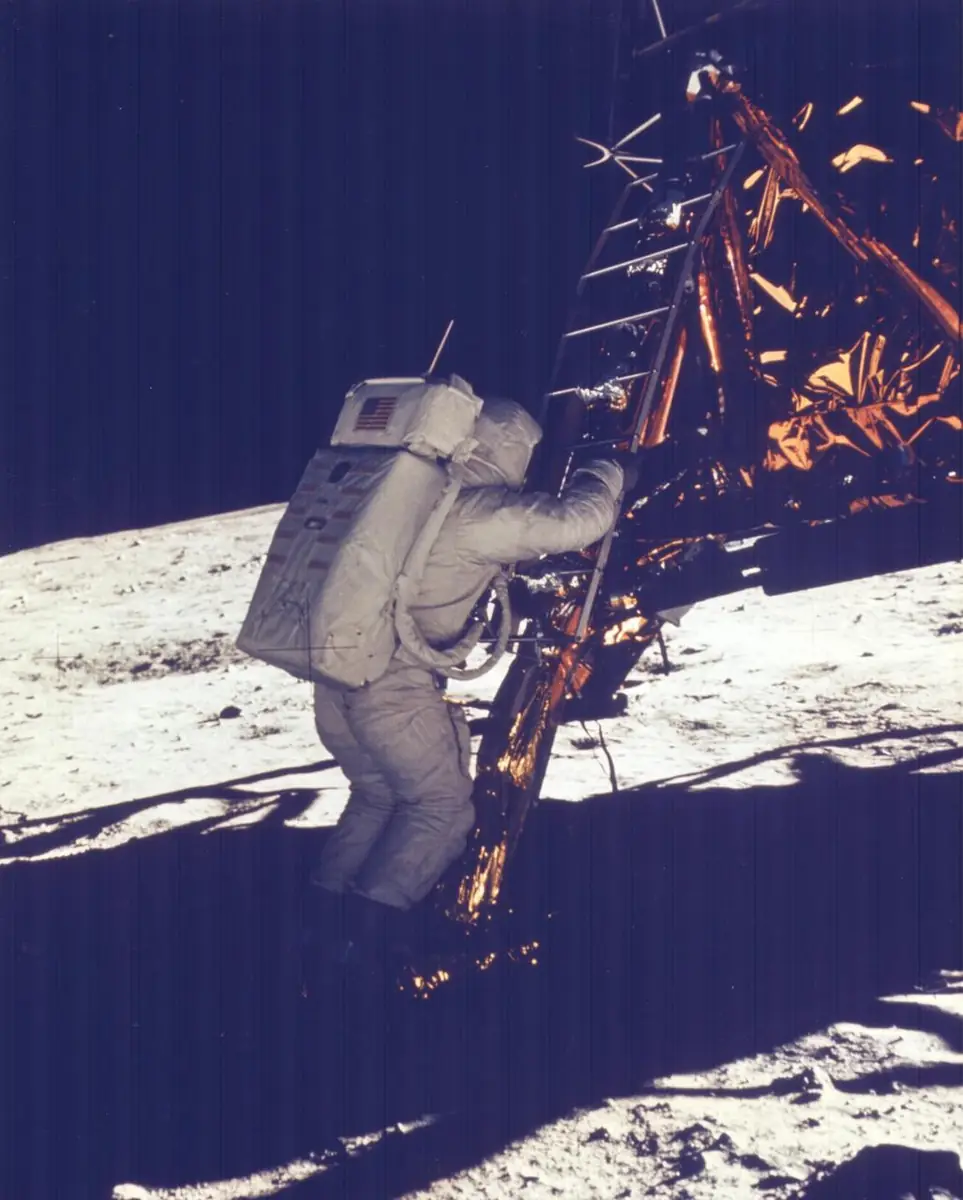
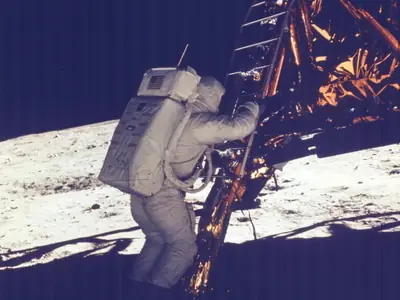 Aldrin climbs down Eagle's ladder.
-
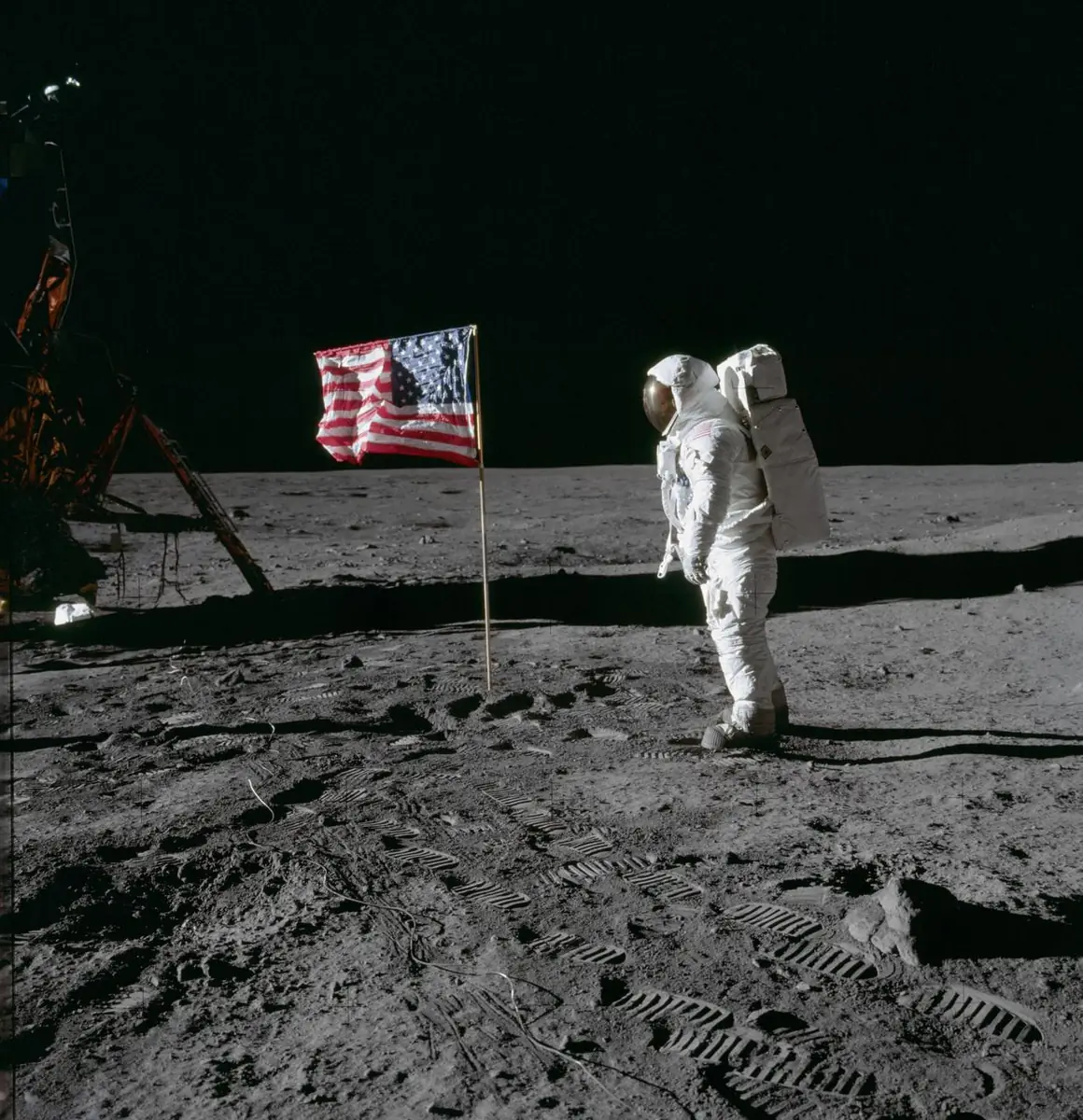
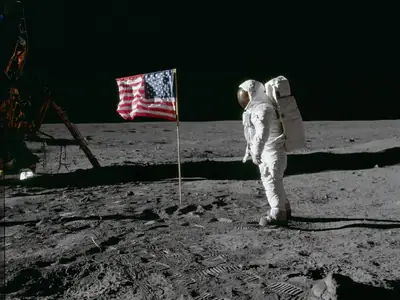 Aldrin beside the flag; Eagle on the left.
-
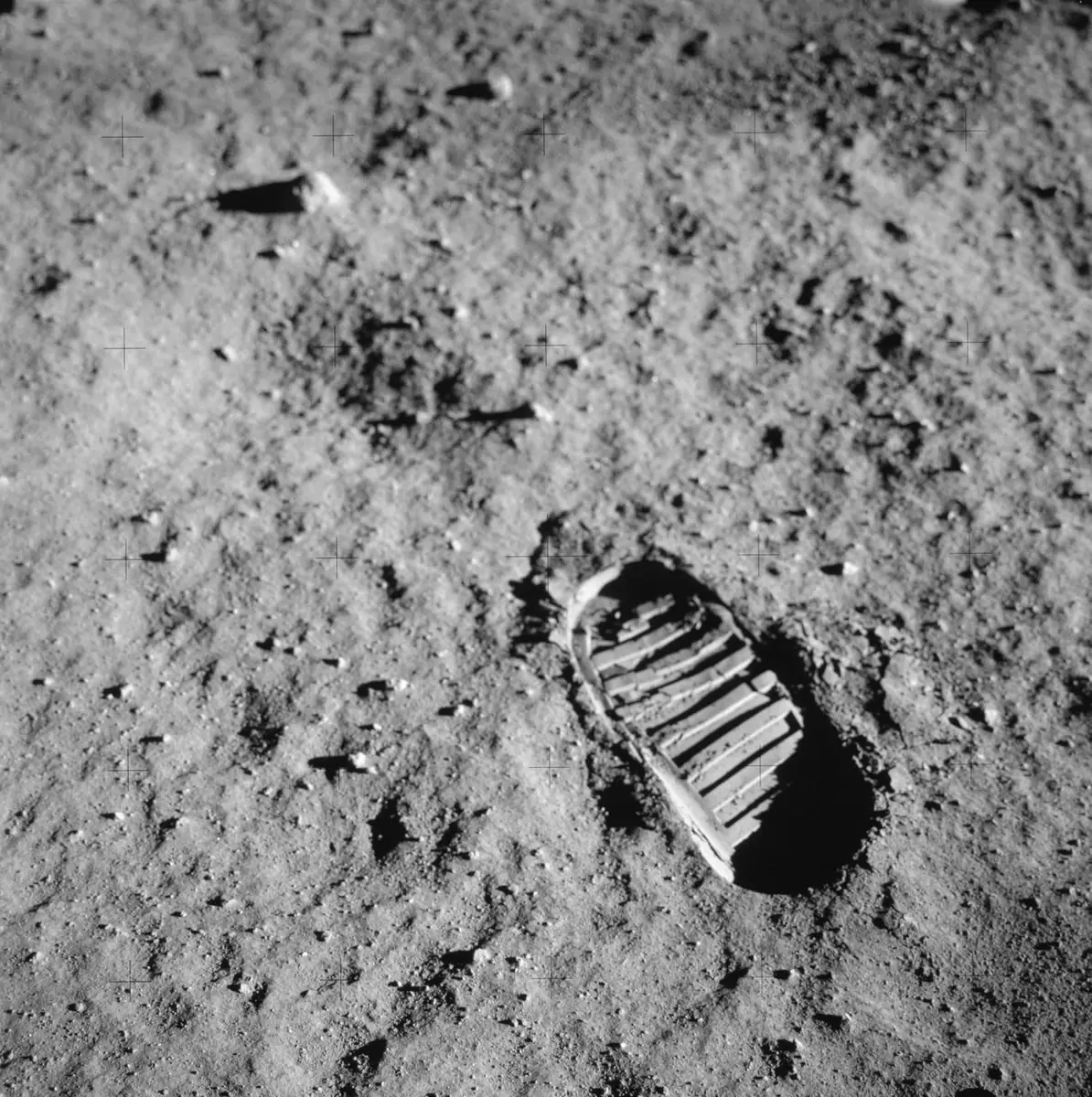
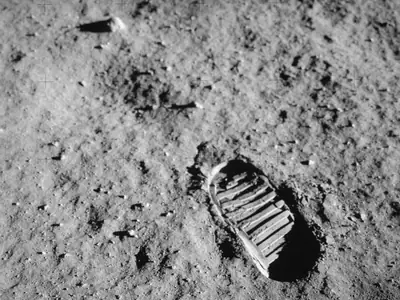 Close-up of a bootprint in the lunar soil.
-
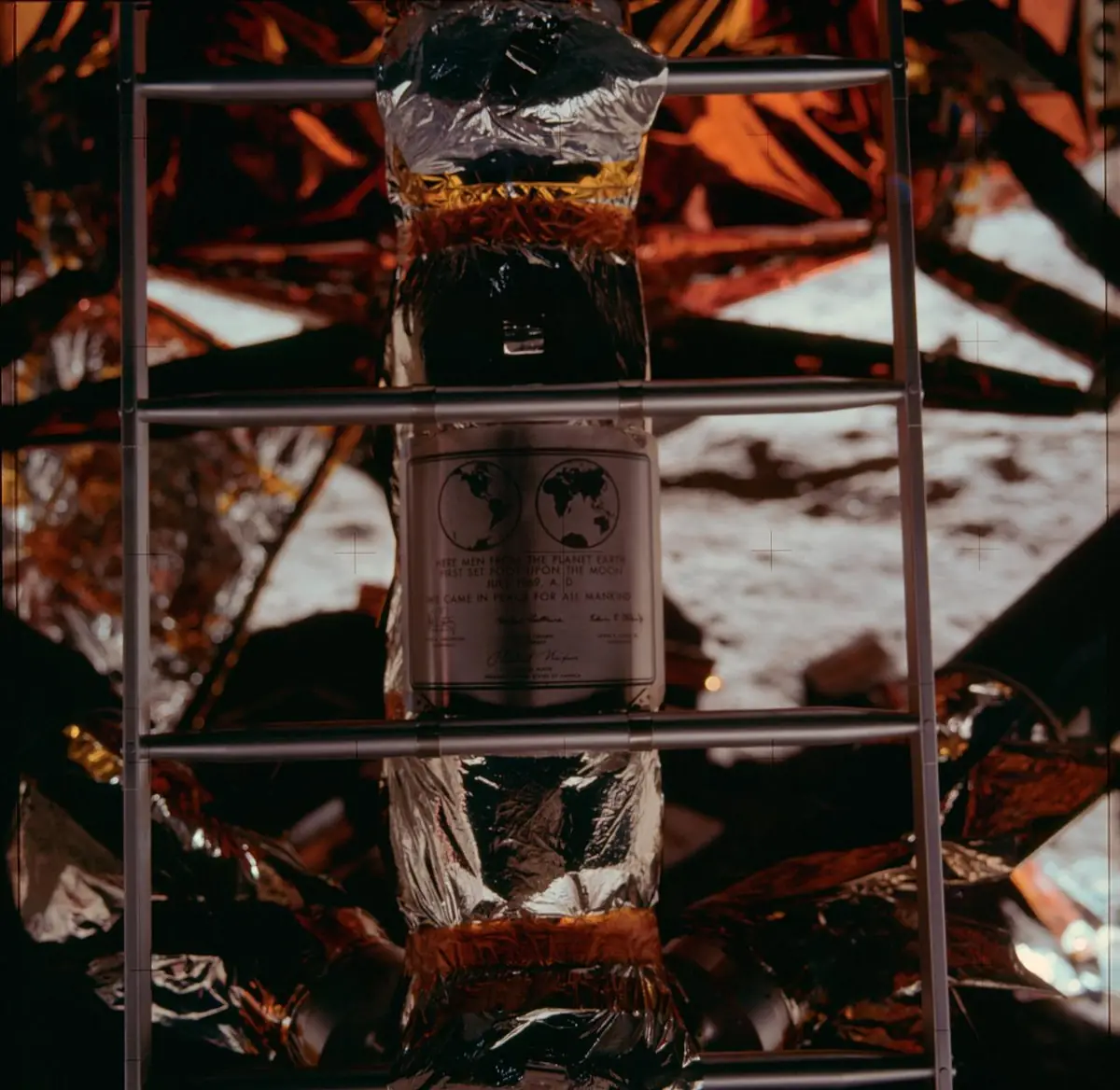
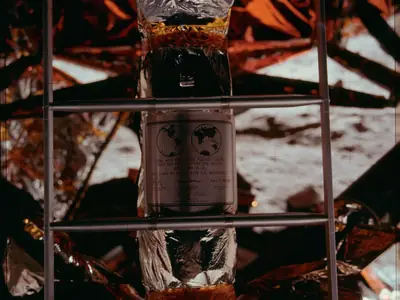 The plaque on Eagle's forward leg.
-
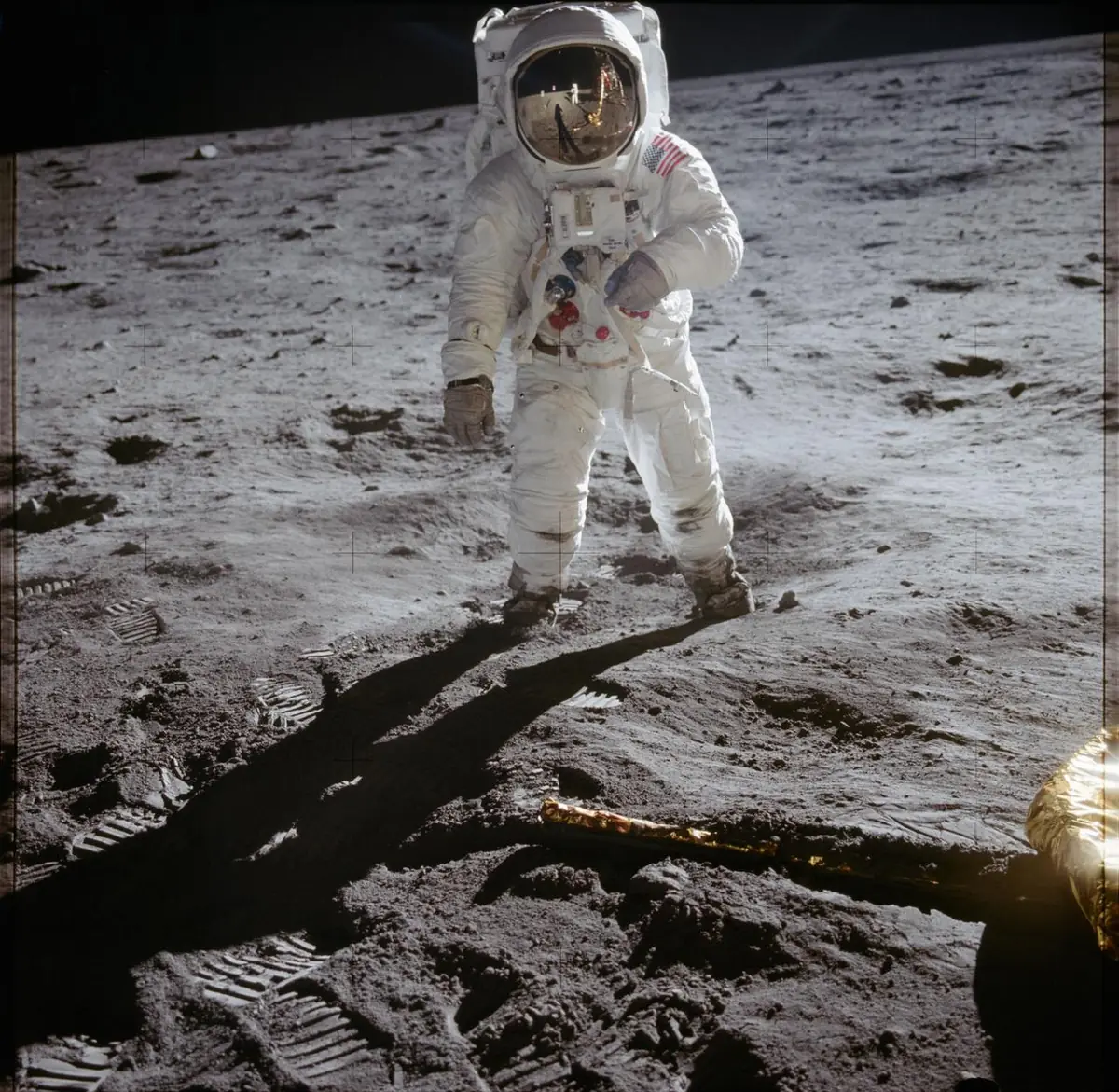
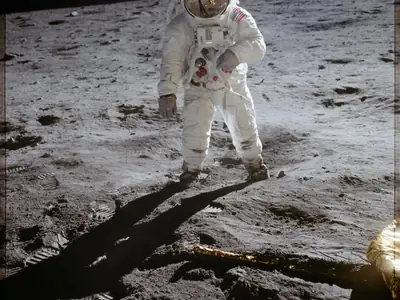 The best-known Apollo 11 photo: Aldrin, with Armstrong and Eagle reflected in his visor.
-
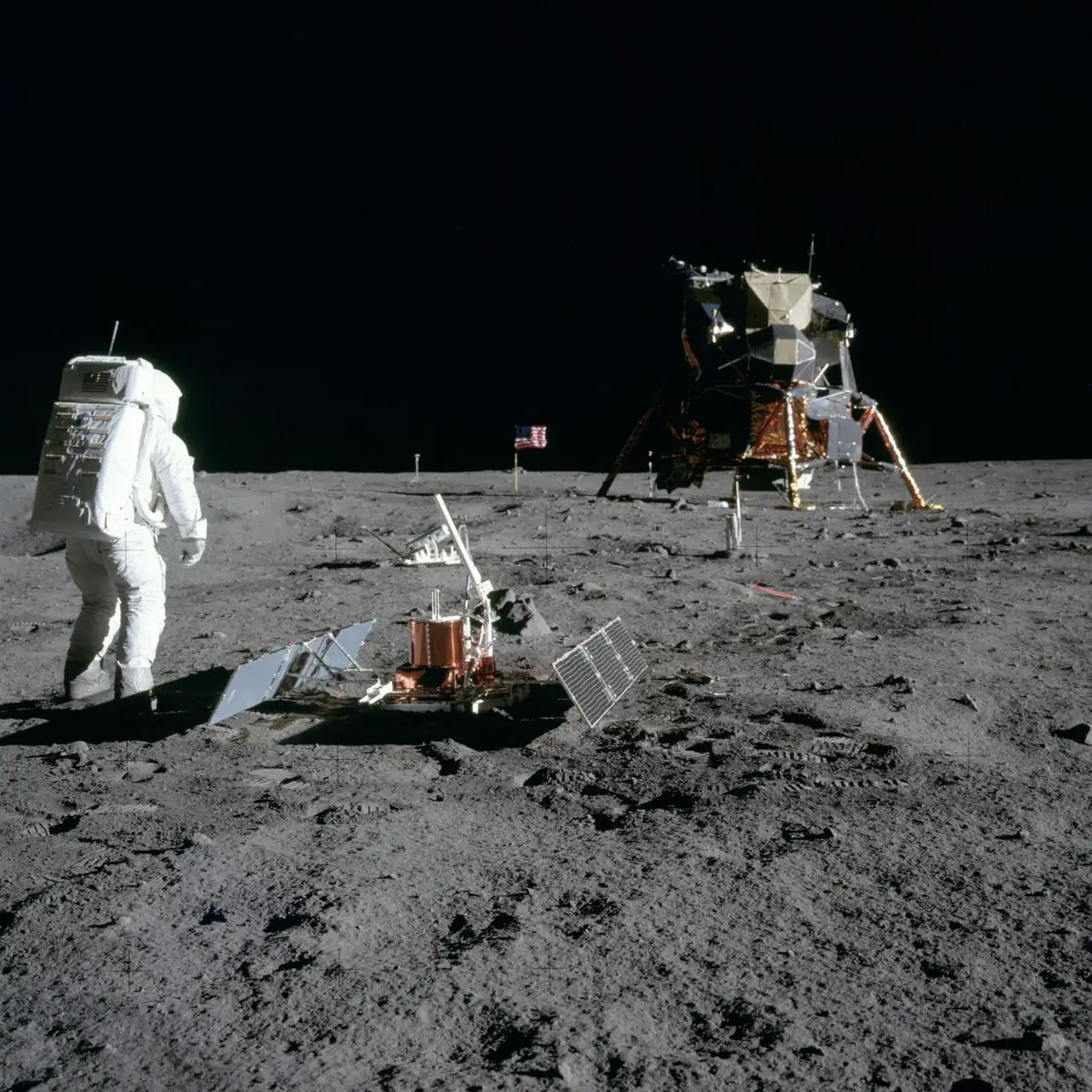
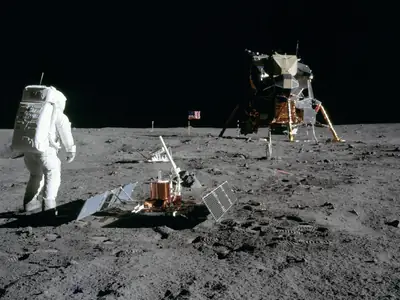 Aldrin after deploying the seismometer; the laser reflector and flag beyond.
-
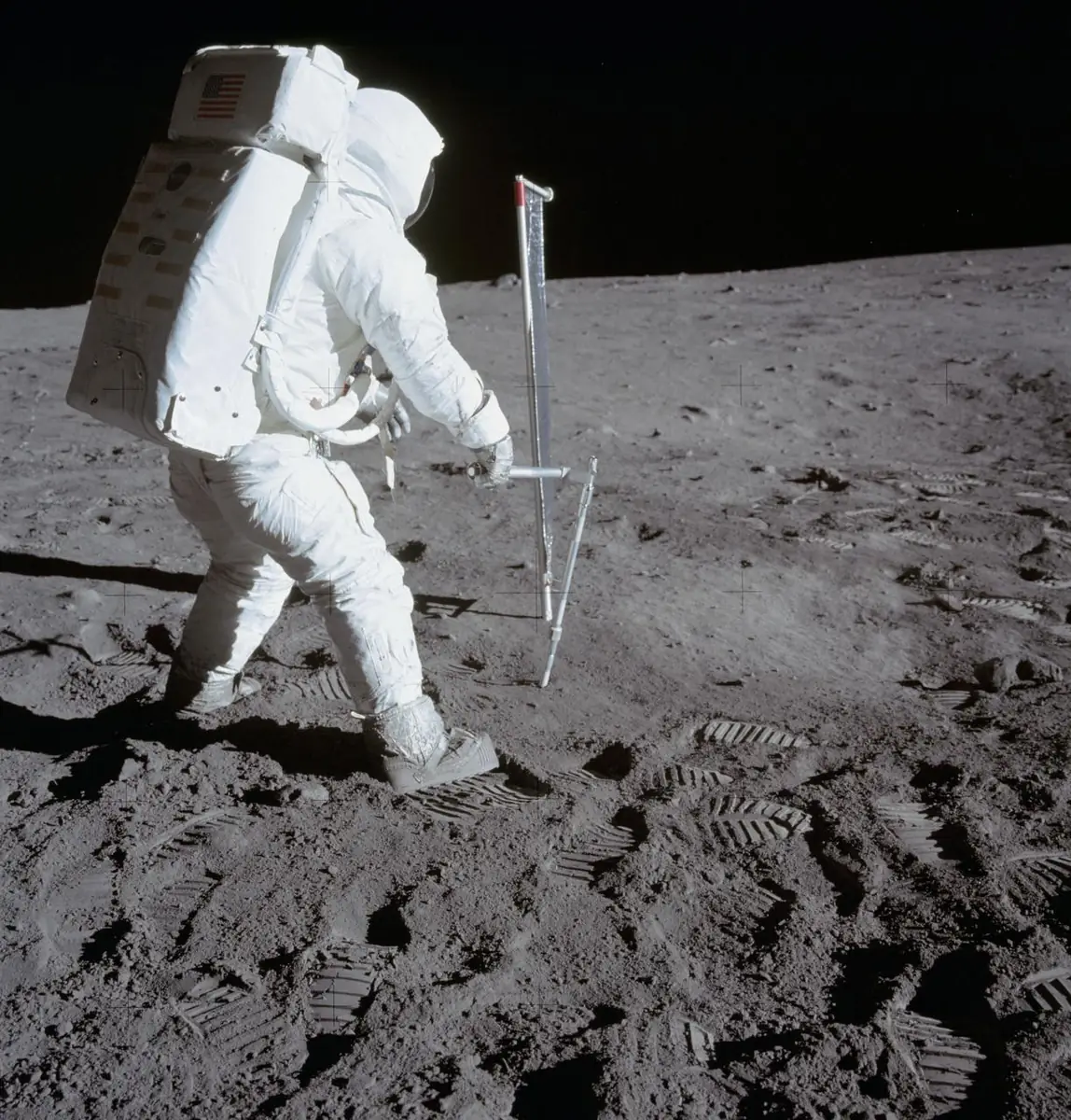
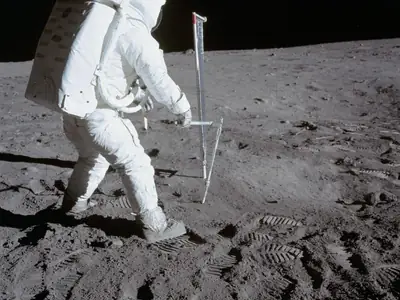 Aldrin drives a core tube; the solar wind sail stands behind him.
-
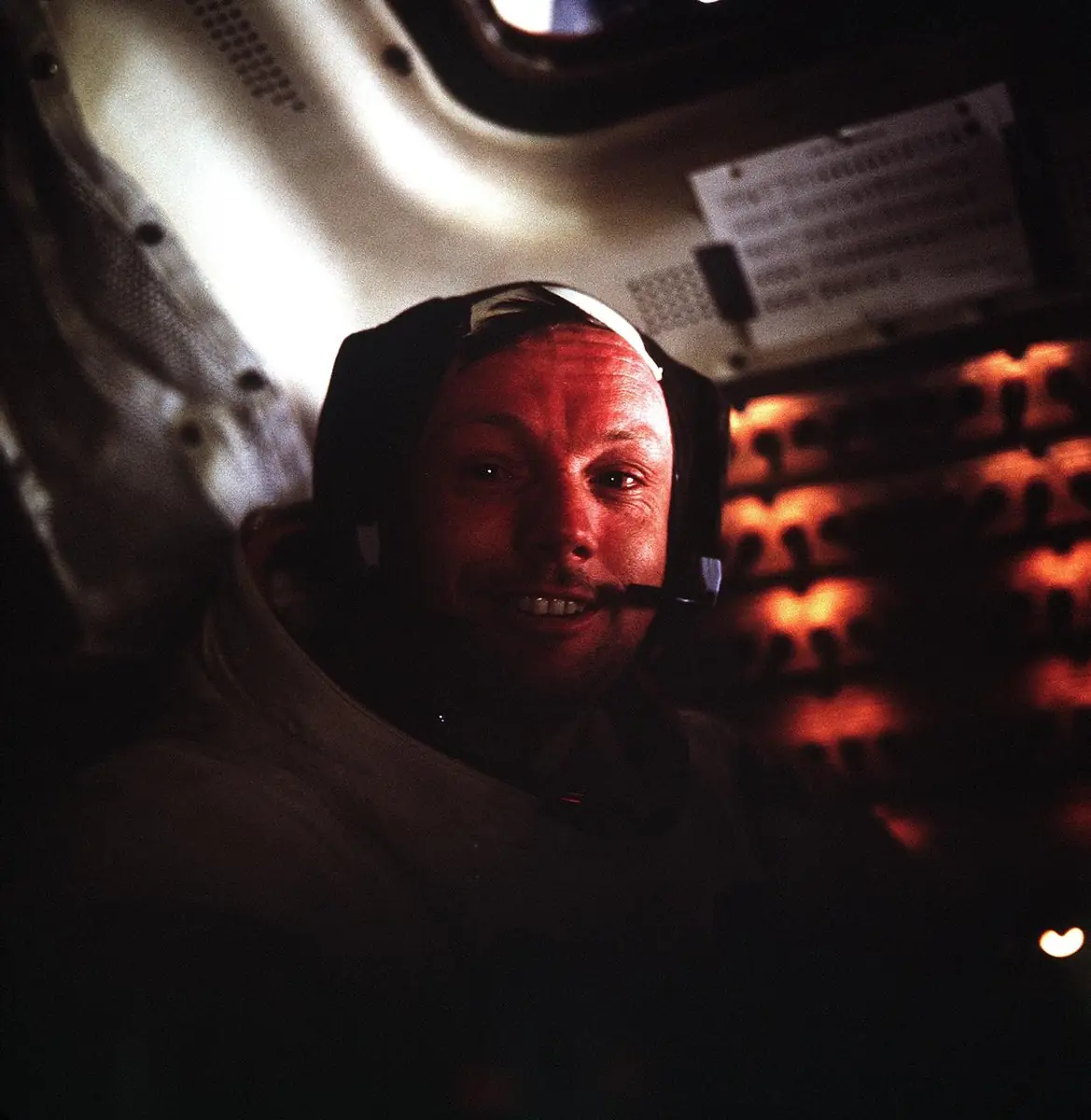
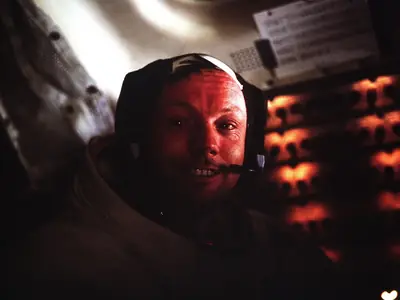 Armstrong inside Eagle after the moonwalk.
-
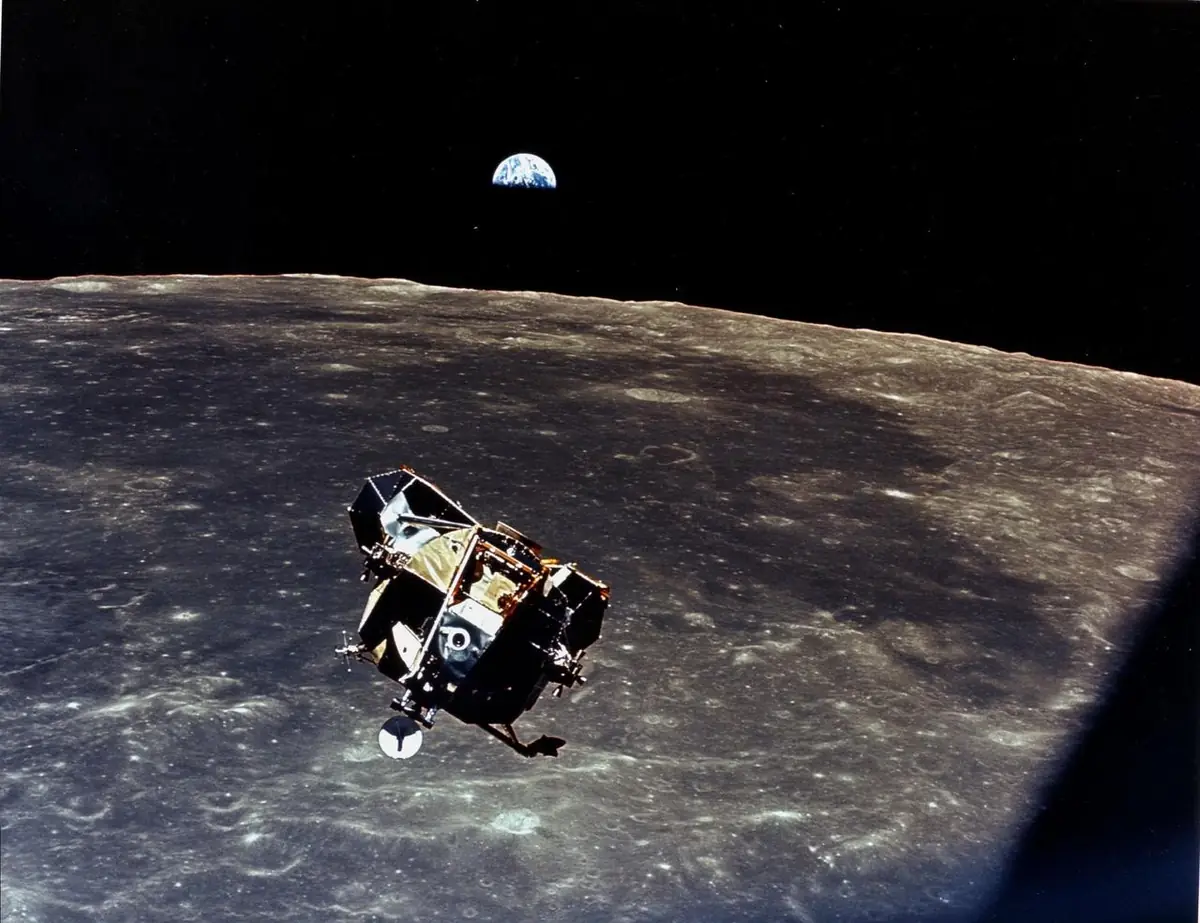
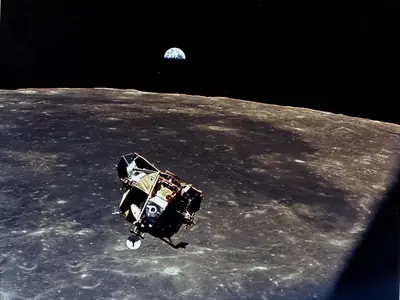 Eagle's ascent stage rises to meet Columbia, with Earth above the horizon.
-
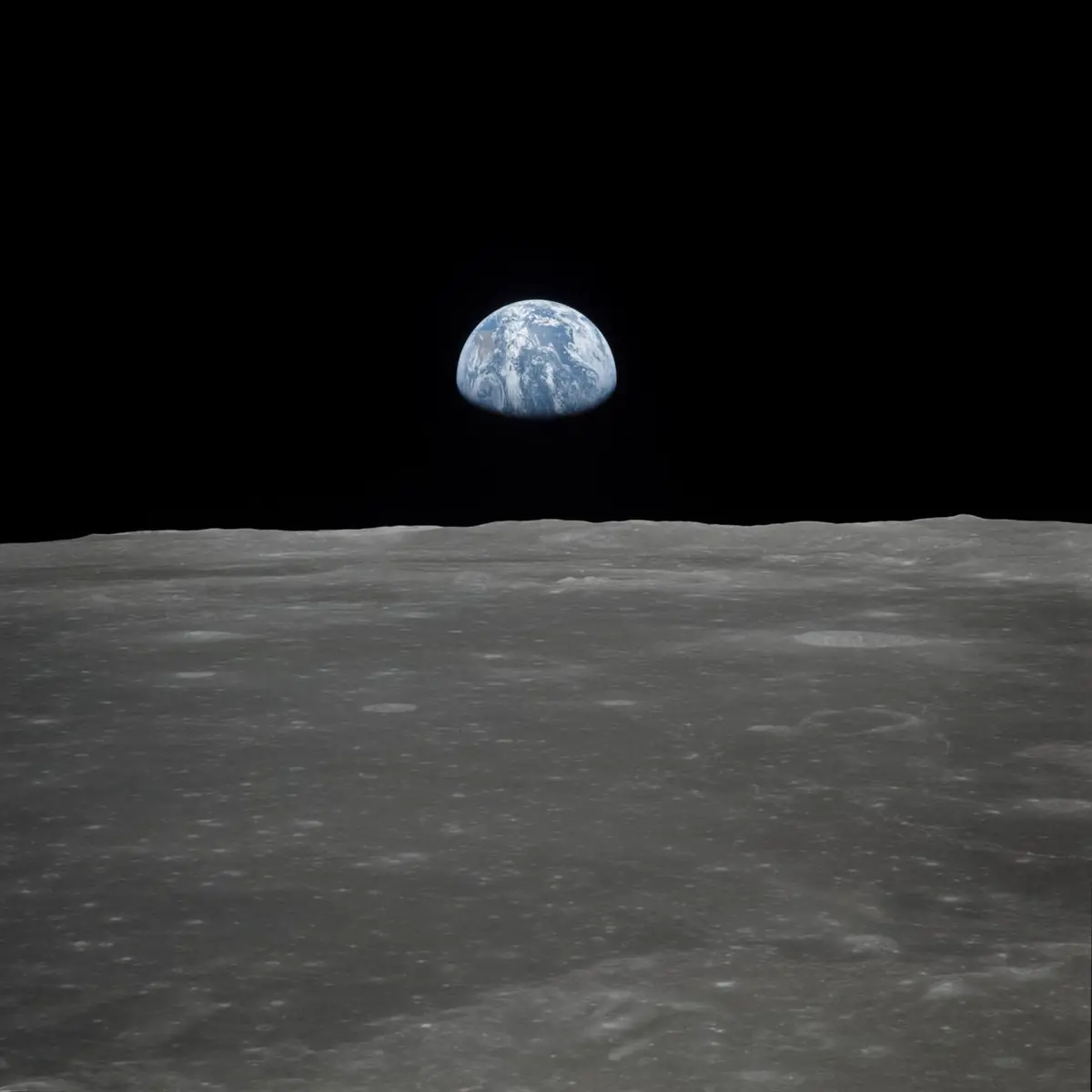
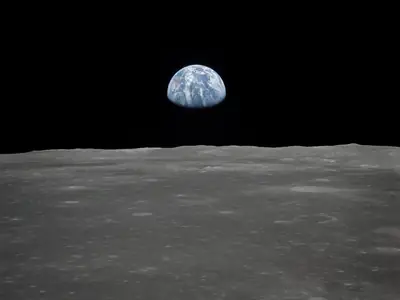 Earthrise over Smyth's Sea, seen from lunar orbit.
-
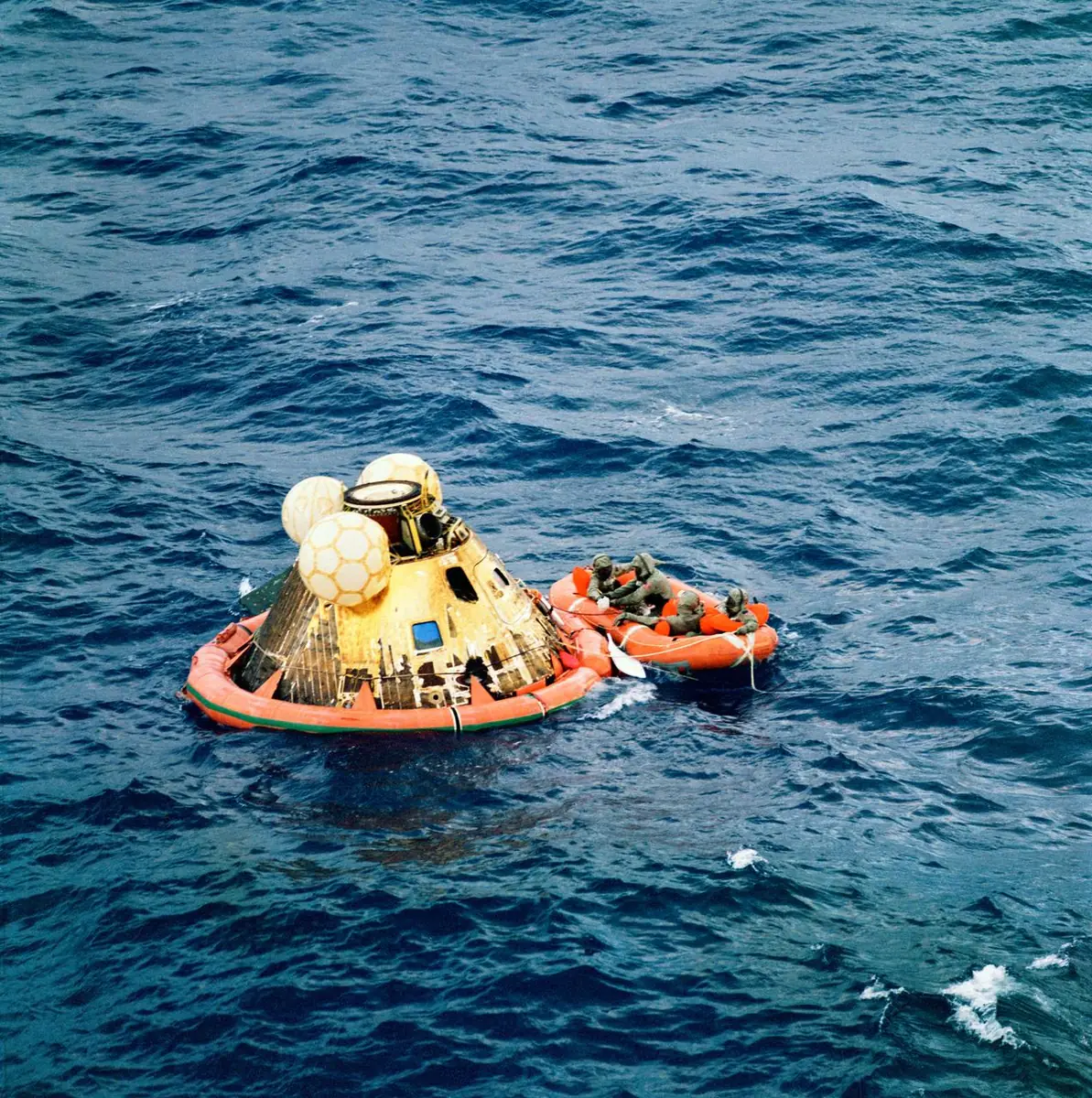
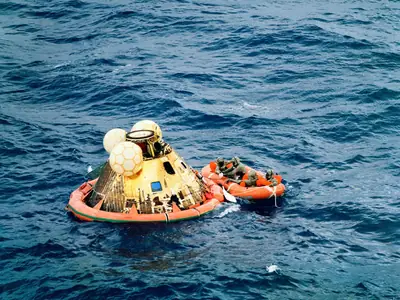 The crew in biological isolation garments in the raft beside Columbia.
-
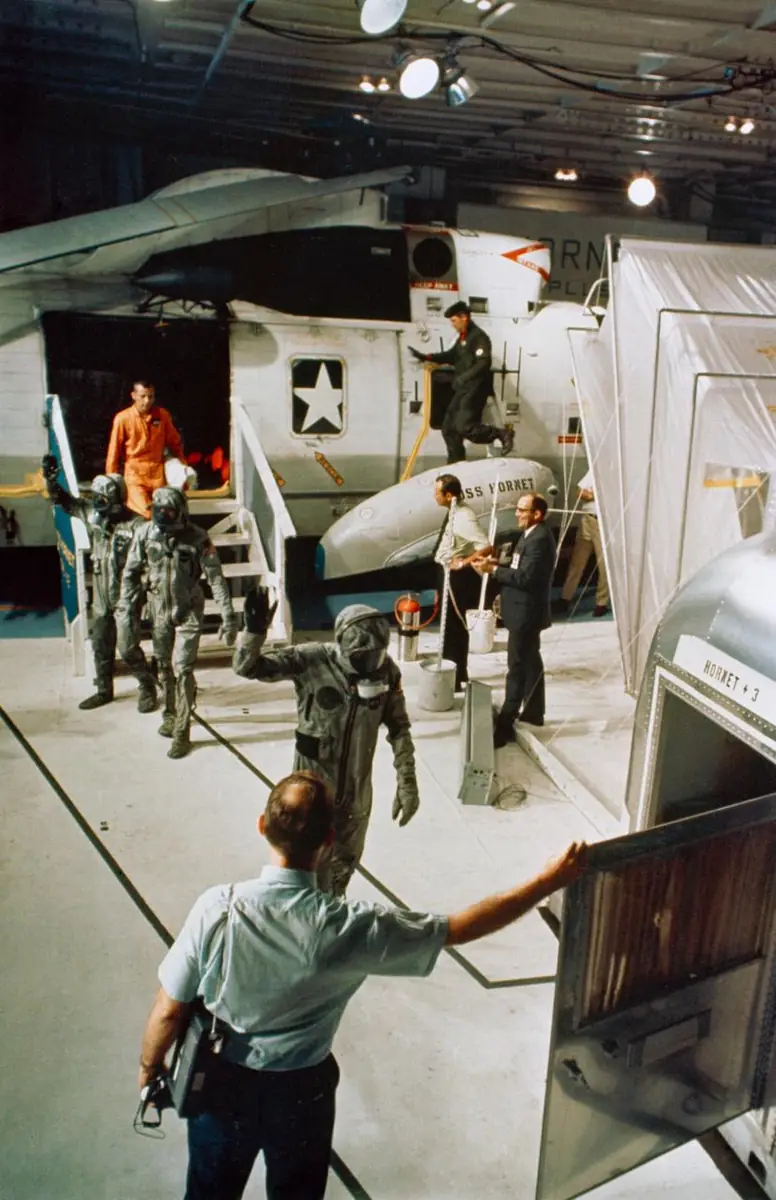
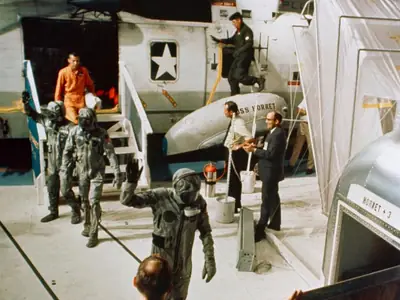 The crew walks from the helicopter to the Mobile Quarantine Facility on USS Hornet.
At a glance 13
-
Mission type
Type G: the first crewed lunar landing demonstration. Land, walk, collect samples, leave a minimal science package and come home.
-
Dates
Launched 16 July 1969, landed 20 July, splashed down 24 July 1969.
-
Mission duration
195 h 18 min 35 s from liftoff to splashdown (8 days 3 h 18 min).
-
Call signs
Command module Columbia (CM-107) and lunar module Eagle (LM-5).
-
Landing site
Southwestern Mare Tranquillitatis (Sea of Tranquility), planning site ALS-2. Armstrong named it Tranquility Base on touchdown.
-
Coordinates
0.67408° N, 23.47297° E in the IAU mean Earth/polar axis frame.
-
Time on the Moon
Eagle stood on the surface for 21 h 36 min 21 s.
-
Moonwalk
One EVA of 2 h 31 min 40 s, the shortest of the six landings.
-
Samples
21.55 kg (47.5 lb) of rock and soil, the official Lunar Receiving Laboratory total.
-
Lunar orbits
30 orbits of the Moon by Columbia, totalling 59 h 30 min in lunar orbit.
-
Designations
Space vehicle AS-506, Eastern Test Range #5307. International IDs: 1969-059A (CSM), -059B (S-IVB), -059C (ascent stage), -059D (descent stage).
-
Distance flown
828,743 n mi round trip (about 1.53 million km0.95 million miles).
-
The goal
It met President Kennedy's 1961 objective of landing a man on the Moon and returning him safely to Earth before the decade was out.
Crew & team 12
-
Neil A. Armstrong, commander
Civilian, born 5 Aug 1930 in Wapakoneta, Ohio; 38 at launch. Selected in 1962. As command pilot of Gemini 8 he flew the first docking of two spacecraft.
-
Armstrong's background
Purdue B.S. in aeronautical engineering (1955); former X-15 research pilot. Apollo 11 made him the first civilian to command two U.S. missions.
-
Michael Collins, command module pilot
Lt. Col., USAF, born 31 Oct 1930 in Rome, Italy; 38 at launch. West Point 1952, selected 1963, pilot of Gemini 10.
-
Buzz Aldrin, lunar module pilot
Col., USAF, born 20 Jan 1930 in Montclair, New Jersey; 39 at launch. West Point 1951; Sc.D. in astronautics from MIT (1963) on orbital rendezvous.
-
First doctorate in space
Aldrin was the first astronaut with a doctorate to fly. On Gemini 12 he had shown that long spacewalks were workable with handholds, restraints and rest periods.
-
Backup crew
Jim Lovell (commander), Bill Anders (command module pilot) and Fred Haise (lunar module pilot).
-
Support crew
Ken Mattingly, Ron Evans, Bill Pogue and Jack Swigert.
-
Capsule communicators
Charlie Duke (voice of the landing), Ron Evans, Bruce McCandless (moonwalk CAPCOM), Jim Lovell, Bill Anders, Ken Mattingly, Fred Haise, Don Lind, Owen Garriott and Jack Schmitt.
-
Flight directors
Cliff Charlesworth and Gerry Griffin (first shift), Gene Kranz (second shift, the landing) and Glynn Lunney (third shift).
-
A veteran crew
Only the second all-experienced American crew; the next would not fly until Space Shuttle mission STS-26 nearly two decades later.
-
Weight lost
Launch-day weights 78.0 kg (Armstrong), 75.3 kg (Collins) and 75.7 kg (Aldrin); at recovery 74.4, 72.1 and 75.3 kg.
-
Where they are now
Armstrong died in 2012 and Collins in 2021. Aldrin is one of the four moonwalkers still alive in November 2026.
Launch & Saturn V 13
-
Liftoff
13:32:00 GMT (9:32 a.m. EDT) on 16 July 1969 from Launch Complex 39A, Kennedy Space Center.
-
Launch vehicle
Saturn V SA-506: first stage S-IC-6, second stage S-II-6, third stage S-IVB-506, instrument unit S-IU-506.
-
Weight at ignition
6,477,875 lb (2,938 t) at first-stage ignition, 6.4 s before liftoff.
-
Height
110.6 m363 feet from the base of the S-IC to the tip of the launch escape tower.
-
Thrust
Five F-1 engines rated 7.61 million lbf; measured thrust 35–38 s after liftoff was 7.552 million lbf.
-
Launch weather
29.4 °C84.9 °F, 73% humidity, cumulus 10% at 730 m2,400 feet under high cirrostratus; surface wind 6.4 kn from 175°.
-
Launch window
Opened 13:32 GMT and would have closed at 17:54 GMT (4 h 22 min), timed for a 10.8° Sun elevation at the landing site.
-
Ascent
Rolled to a 72.058° flight azimuth. S-IC cutoff at 2 min 41.6 s, S-II cutoff at 9 min 08.2 s, first S-IVB cutoff at 11 min 39.3 s.
-
Max Q
Maximum dynamic pressure of 735.17 lb/ft² at 83.0 s and 13.6 km44,512 feet.
-
Parking orbit
100.4 × 98.9 n mi (186 × 183 km116 × 114 miles), inclined 32.521°, period 88.18 min.
-
Translunar injection
The S-IVB relit at 2 h 44 min 16 s for 346.87 s; injection came at 2:50:13 after 1.5 Earth orbits, at about 10.8 km/s6.7 miles per second.
-
Spent stages
The S-IC fell into the Atlantic 357 n mi (661 km411 miles) downrange, the S-II 2,372 n mi (4,393 km2,730 miles) downrange.
-
S-IVB fate
Vented to swing past the Moon (closest approach 1,825 n mi, 3,380 km2,100 miles) into solar orbit.
Spacecraft 11
-
Command & service module
CSM-107 by North American Rockwell, 63,507 lb (28.8 t) at launch. The service module alone weighed 51,243 lb with propellant.
-
Columbia
3.9 m12.8 feet wide, 3.5 m11.4 feet tall, 210 cubic feet (5.9 cubic meters) of habitable volume; 12,250 lb dry and 10,873 lb at splashdown.
-
Service propulsion
One SPS engine rated 20,500 lbf, used for lunar orbit insertion and the trip home.
-
Eagle
LM-5 by Grumman, 33,278 lb (15.1 t) at launch, 7.0 m22.9 feet tall and 9.4 m31 feet across the landing legs.
-
Descent propellant
18,184 lb of Aerozine 50 and nitrogen tetroxide loaded; 17,414 lb burned getting down.
-
Fuel at touchdown
Postflight analysis found about 45 s of firing time left at touchdown, not the far smaller figures often quoted.
-
Cabin
235 cu ft (160 habitable). The crew flew standing at the controls, held by restraint harnesses.
-
Software
MIT Instrumentation Laboratory programs Colossus 2A in the command module and Luminary 1A in the lunar module.
-
Ascent stage
4,804 lb dry, with a single fixed 3,500-lbf engine and a crew compartment 2.3 m7.7 feet high. It carried the crew and samples back to orbit.
-
Launch escape system
A tower 10.2 m33.5 feet tall with a 147,000-lbf solid motor, jettisoned during second-stage flight.
-
Science package
EASEP: a solar-powered passive seismometer and a 100-corner-cube laser reflector, a stripped-down set for a first landing.
Flight & orbit 13
-
Transposition & docking
Columbia separated from the S-IVB at 3:15:23, turned around and docked with Eagle at 3:24:04; the pair pulled free at 4:17:03.
-
One midcourse correction
A 3.13-s, 20.9 ft/s burn at 26:44:58 was the only correction needed on the way out.
-
Barbecue roll
Passive thermal control, a slow roll, kept the spacecraft evenly warmed during the coast.
-
Lunar orbit insertion
A 357.53-s SPS burn behind the Moon at 75:49:50 put the stack into a 169.7 × 60.0 n mi (314 × 111 km195 × 69 miles) orbit; the coast out had lasted 73 h 05 min.
-
Circularization
A 16.88-s burn at 80:11:37 trimmed the orbit to 66.1 × 54.5 n mi (122 × 101 km76 × 63 miles).
-
Undocking
Eagle and Columbia parted at 100:12:00, 62.9 n mi (116 km72 miles) above the Moon.
-
Descent orbit insertion
A 30-s descent-engine burn at 101:36:14 dropped Eagle into a 58.5 × 7.8 n mi (108 × 14 km67 × 9.0 miles) orbit.
-
Powered descent
Began at 102:33:05 and lasted about 12.6 min. Eagle started about 4 n mi (7.4 km4.6 miles) farther downrange than planned.
-
Lunar liftoff
Ascent engine ignition at 17:54:00 GMT on 21 July (124:22:01); a 434.88-s burn reached a 48.0 × 9.4 n mi (89 × 17 km55 × 11 miles) orbit.
-
Rendezvous
Coelliptic rendezvous ended in docking at 128:03:00. The two craft had been apart exactly 27 h 51 min.
-
Gimbal lock
Manoeuvring for docking, Eagle's guidance platform hit gimbal lock; the crew finished on the abort guidance system.
-
Trans-Earth injection
A 151.41-s SPS burn at 135:23:42 after 30 lunar orbits, leaving at 8,589 ft/s relative to the Moon.
-
Coming home
A single 4.8 ft/s correction at 150:30 was the only one needed on the 59 h 37 min trip home.
Landing site 11
-
Touchdown
20:17:39 GMT (4:17:39 p.m. EDT) on 20 July 1969, 102:45:40 into the flight.
-
Off target
About 6.9 km4.3 miles west of the target ellipse's centre, after the late downrange start.
-
Manual flying
The guidance was taking Eagle into a large crater strewn with car-sized boulders (now called West crater). Armstrong took semi-manual control and flew past it.
-
Program alarms
Five computer alarms (1202 and 1201, executive overflows) from 102:38:22. Guidance officer Steve Bales and Jack Garman judged them safe and called go.
-
Low fuel
The low-level light came on at 102:44:28, 72 s before landing, prompting Duke's “60 seconds” and “30 seconds” calls.
-
Attitude
Eagle settled tilted 4.5° to the east and yawed 13° south of the planned heading.
-
Sun angle
The Sun stood 10.8° above the eastern horizon, early lunar morning, so shadows outlined every crater.
-
Why here
Chosen from 30 candidate sites, cut to three, using Lunar Orbiter photos and Surveyor data: smooth mare, gentle approach, slopes under 2°, free-return reachable.
-
Lighting rule
Landings needed the Sun 5–14° high in the east. Because lunar sunlight changes about 0.5° an hour, each site gave a ~16-hour chance every 29.5 days.
-
No blast crater
Footpads sank only 8–10 cm3–4 inches, the engine bell had about 30 cma foot of clearance, and there was no crater under the engine.
-
Mare geology
Flat, dark basalt plains, peppered with small craters and a fine regolith a few metres thick.
Moonwalks 13
-
Hatch open
The forward hatch opened at 109:07:35; Armstrong squeezed out at 109:19:16 and deployed the MESA, switching on the TV camera.
-
First step
Left boot on the Moon at 02:56:15 GMT on 21 July (10:56:15 p.m. EDT, 20 July), 109:24:15 into the flight.
-
First words
“That's one small step for man, one giant leap for mankind.” Armstrong always said he meant “a man”.
-
First task
A contingency sample near the ladder. The soil was soft on top but very hard 6–8 in down.
-
Aldrin steps down
Aldrin left the hatch at 109:39:00 and reached the surface at 109:43:15. His description: “Magnificent desolation.”
-
The plaque
They read the plaque on the ladder strut: “Here men from the planet Earth first set foot upon the Moon, July 1969, A.D. We came in peace for all mankind.”
-
Flag
A 0.9 × 1.5 m3 × 5 feet nylon flag on a 2.4 m8 feet aluminium staff went up at 110:09:43. Aldrin saw it fall when the ascent stage lifted off.
-
Call from the White House
President Nixon spoke to the crew at 110:16:30 by radio-telephone.
-
Moving around
Both found mobility far better than expected and metabolic rates well below predictions; Aldrin tried kangaroo hops and a loping gait.
-
Little West crater
Near the end Armstrong jogged about 60 m200 feet east to look into a crater 33 m110 feet wide, the farthest anyone went from Eagle.
-
Photographs
Armstrong carried the Hasselblad most of the time, so nearly all surface photos show Aldrin. Only a few show Armstrong.
-
Back inside
Hatch closed at 111:39:13. About 1 km0.6 miles walked in total.
-
A felt-tip fix
In the cabin Aldrin found the ascent engine arm circuit breaker snapped off and pushed it in with a felt-tip pen.
Surface science 11
-
Passive seismometer
The Passive Seismic Experiment Package, the first seismometer on the Moon, was set 16.8 m55 feet from Eagle. It ran on solar panels and was warmed through the night by radioisotope heaters.
-
Footsteps and moonquakes
It picked up the astronauts walking and, later, natural signals interpreted as meteoroid impacts and shallow moonquakes.
-
Three weeks of data
It returned about 21 days of data and stopped responding to commands on 25 August 1969, probably from midday overheating.
-
Laser Ranging Retro-Reflector
100 fused-silica corner cubes in a panel about 46 cm18 inches square (principal investigator J. E. Faller).
-
First laser echo
Lick Observatory caught the first laser returns from the reflector on 1 August 1969.
-
Still working
Observatories still range to it. Decades of data show the Moon receding about 3.8 cm1.5 inches a year.
-
Solar Wind Composition
A Swiss aluminium-foil sail (Johannes Geiss, University of Bern) trapped solar-wind noble gases. It was exposed for 1 h 17 min, then rolled up and brought home.
-
Only foreign experiment
The solar wind sail was the only non-U.S. experiment on Apollo 11.
-
Core tubes
Two core tubes went only 6–8 in deep; Aldrin had to hammer hard to drive them.
-
Soil mechanics
Footprints, the cores and the sinking footpads gave the first direct measurements of how lunar soil bears weight.
-
Less documentation
Time ran short, so most material was a bulk scoop. Only about 15 lb of extra samples were picked individually, with less documentation than planned.
Rocks & discoveries 9
-
What came home
21.55 kg in two aluminium sample return containers, catalogued with numbers starting 10xxx.
-
Old lava
The rocks were titanium-rich basalts, full of the mineral ilmenite, that crystallized from lava roughly 3.6–3.9 billion years ago.
-
New minerals
Three minerals new to science were found: armalcolite (named for ARMstrong, ALdrin and COLlins), tranquillityite and pyroxferroite.
-
Bone dry
No water-bearing minerals, no organic material and no sign of life. Native iron grains showed the lavas formed with very little oxygen.
-
Highland chips
Small white fragments of anorthosite, thrown in from distant highlands, led scientists to propose that the young Moon was covered by a magma ocean.
-
Glassy soil
The soil was full of glass beads and agglutinates welded by micrometeorite impacts.
-
Solar wind in the dirt
The fine soil held implanted solar-wind gases such as hydrogen and helium, including helium-3.
-
Quarantine tests
Samples were opened in vacuum cabinets at the Lunar Receiving Laboratory and tested on plants and animals; nothing harmful was found.
-
A Moon-named mineral on Earth
Tranquillityite was later identified in rocks in Western Australia.
Alone in orbit 6
-
Columbia solo
Collins flew Columbia alone for 27 h 51 min while Eagle was away.
-
Out of contact
Each pass behind the Moon cut him off from Earth for about 48 minutes.
-
Looking for Eagle
Collins searched the landing area through the sextant but never found Eagle. Its position was fixed from rendezvous radar data and later from descent photography.
-
Rescue ready
He was trained to fly Columbia down to a lower orbit to pick up the ascent stage if it could not reach the planned orbit.
-
Orbital photography
Long-distance photography from Columbia, plus mapping photos and landmark tracking for later missions.
-
After Apollo
Collins wrote Carrying the Fire (1974) and was director of the National Air and Space Museum when its Mall building opened in 1976.
Return & recovery 10
-
Weather diversion
Bad weather in the planned area moved the splashdown point 215 n mi (398 km247 miles) farther downrange.
-
Entry
Entry interface at 195:03:06, travelling 11.03 km/s36,194 feet per second; peak load 6.56 g.
-
Splashdown
16:50:35 GMT on 24 July 1969 at 13.30° N, 169.15° W in the Pacific, 1.7 n mi (3.1 km2.0 miles) from target and 13 n mi (24 km15 miles) from the recovery ship.
-
Upside down
Columbia came to rest apex-down and was righted by its inflatable bags in 7 min 40 s.
-
Germ-proof suits
The crew put on biological isolation garments, climbed into a raft and were scrubbed with iodine solution.
-
USS Hornet
Aboard the carrier USS Hornet (CVS-12), Capt. Carl J. Seiberlich, 63 minutes after splashdown. Columbia was hoisted aboard later.
-
Quarantine
They rode the Mobile Quarantine Facility to Hawaii and then Houston, entering the Lunar Receiving Laboratory on 28 July. They were released on 10 August 1969.
-
Recovery force
5 Navy ships and 31 aircraft were deployed for the recovery.
-
Where Columbia is
Columbia is displayed at the Smithsonian National Air and Space Museum in Washington, D.C.
-
Where Eagle is
The ascent stage was jettisoned in lunar orbit on 21 July; its impact site is unknown.
Moments & legacy 8
-
“The Eagle has landed”
“Houston, Tranquility Base here. The Eagle has landed.” Duke: “You got a bunch of guys about to turn blue. We're breathing again.”
-
Live television
Slow-scan pictures came first through Goldstone, then Honeysuckle Creek and Parkes in Australia, which carried most of the moonwalk.
-
Audience
Estimates put the worldwide audience at about 600 million people.
-
Left behind
An Apollo 1 patch, medals honouring cosmonauts Gagarin and Komarov, a gold olive branch and a silicon disc of goodwill messages from world leaders.
-
The patch
An eagle landing with an olive branch. With Apollo 13's, it is one of only two Apollo crew patches without the crew's names.
-
Collins at undocking
“You cats take it easy on the lunar surface.”
-
Seen from orbit
Lunar Reconnaissance Orbiter images show Eagle's descent stage, the experiments and the dark tracks of the moonwalk.
-
Crater names
Three small craters north of the site are named Aldrin, Collins and Armstrong.
Seven missions side by side
Figures from NASA's Apollo by the Numbers. Select a mission to open its dossier.
| Measure | Apollo 11 | Apollo 12 | Apollo 13 | Apollo 14 | Apollo 15 | Apollo 16 | Apollo 17 |
|---|---|---|---|---|---|---|---|
| Landing (UTC) | 20 July 1969 | 19 November 1969 | did not land | 5 February 1971 | 30 July 1971 | 21 April 1972 | 11 December 1972 |
| Landing site | Mare Tranquillitatis | Oceanus Procellarum | Fra Mauro highlands (planned) | Fra Mauro highlands | Hadley–Apennine | Descartes Highlands | Taurus–Littrow valley |
| Lunar module | Eagle (LM-5) | Intrepid (LM-6) | Aquarius (LM-7) | Antares (LM-8) | Falcon (LM-10) | Orion (LM-11) | Challenger (LM-12) |
| Command module | Columbia (CM-107) | Yankee Clipper (CM-108) | Odyssey (CM-109) | Kitty Hawk (CM-110) | Endeavour (CM-112) | Casper (CM-113) | America (CM-114) |
| Commander | Neil Armstrong | Pete Conrad | Jim Lovell | Alan Shepard | David Scott | John Young | Gene Cernan |
| Lunar module pilot | Buzz Aldrin | Alan Bean | Fred Haise | Edgar Mitchell | Jim Irwin | Charlie Duke | Harrison Schmitt |
| Command module pilot | Michael Collins | Dick Gordon | Jack Swigert | Stuart Roosa | Al Worden | Ken Mattingly | Ron Evans |
| Mission type | G | H-1 | H-2 | H-3 | J-1 | J-2 | J-3 |
| Time on the Moon | 21 h 36 min | 31 h 31 min | none | 33 h 30 min | 66 h 54 min | 71 h 2 min | 74 h 59 min |
| Moonwalks | 1 · 2 h 31 min | 2 · 7 h 45 min | none | 2 · 9 h 22 min | 3 · 18 h 34 min | 3 · 20 h 14 min | 3 · 22 h 3 min |
| Samples | 21.55 kg | 34.35 kg | none | 42.28 kg | 77.31 kg | 95.71 kg | 110.52 kg |
| Farthest from the lunar module | 60 m200 feet | ≈ 410 m1,350 feet | none | ≈ 1.45 km0.9 miles | ≈ 5.0 km3.1 miles | ≈ 4.6 km2.9 miles | ≈ 7.6 km4.7 miles |
| Rover distance | none | none | none | none | 27.9 km17.3 miles | 26.9 km16.7 miles | 35.7 km22.2 miles |
| Sun at landing | 10.8° | 5.1° | none | 10.3° | 12.2° | 14.8° | 13.0° |
| Lunar orbits | 30 | 45 | none (flyby) | 34 | 74 | 64 | 75 |
| Mission length | 8 d 3 h 18 min | 10 d 4 h 36 min | 5 d 22 h 54 min | 9 d 0 h 1 min | 12 d 7 h 11 min | 11 d 1 h 51 min | 12 d 13 h 51 min |
| Recovery ship | USS Hornet | USS Hornet | USS Iwo Jima | USS New Orleans | USS Okinawa | USS Ticonderoga | USS Ticonderoga |
| Sourced facts | 130 | 113 | 134 | 112 | 110 | 111 | 112 |
Sources and method
27 sources, how the Moon is drawn, and photo credits
Mission facts
- R. W. Orloff, Apollo by the Numbers: A Statistical Reference, NASA SP-2000-4029
- E. M. Jones & K. Glover, Apollo Lunar Surface Journal (NASA History)
- Apollo Preliminary Science Reports, NASA SP-214, SP-235, SP-272, SP-289, SP-315, SP-330
- C. Meyer, Lunar Sample Compendium, NASA Astromaterials Curation
- NASA NSSDCA, Apollo: Where are they now?
- NASA Science, Moonwalkers (living status checked Nov 2026)
- NASA Science, Apollo 11 Seismic Experiment
- H. Lindsay, ALSEP essay, Apollo Lunar Surface Journal
- Active Seismic Experiment (Apollo 14 and 16 results)
- A. Saunders, The Mystery Behind Alan Shepard's 'Moon Shot' Revealed, USGA, Feb 2021
- K. Cartier, Apollo may have found an Earth meteorite on the Moon, Eos (on Bellucci et al. 2019, EPSL)
- Langseth, Keihm & Peters, Revised lunar heat-flow values (1976)
- Apollo 16 Preliminary Science Report, Lunar Portable Magnetometer
- LROC, Orion, Up Close (Apollo 16 site), NASA/GSFC/ASU
- Haymaker et al., The Apollo 17 Pocket Mouse Experiment (BIOCORE), NASA SP-368
- NASA/JPL, First Confirmed Capture into Earth Orbit Is Likely Apollo Rocket (2002)
- NASA Science, Genesis Rock
- NASA History, Apollo 13: Mission Details
- NASA History, 50 Years Ago: Apollo 13 Preps for 3rd Moon Landing
- NASA History, 50 Years Ago: Apollo 13 Review Board Report (on the Cortright report, June 1970)
- NASA, Apollo 13: The Successful Failure
- LROC, Rocket impacts recorded by the Apollo seismic network, NASA/GSFC/ASU
- NASA, Acting NASA Administrator Reflects on Legacy of Astronaut Jim Lovell, Aug 2025
- Associated Press, Artemis II makes trip around the Moon after breaking Apollo 13's distance record, Apr 2026
- collectSPACE, NASA's SpaceX Crew-13 pays homage to Apollo 13 on mission patch, Apr 2026
- NASA Image and Video Library (photo captions)
- General Apollo reference (mission reports, press kits, crew biographies)
How the Moon is drawn
Positions of the Moon and Sun come from Astronomy Engine (Don Cross, MIT license). The Moon's orientation uses the IAU/WGCCRE 2009 rotation model, giving the libration seen from your location. Spot checks against NASA's Dial-a-Moon agree to within 0.02° for the sub-Earth and sub-solar points.
Surface map: NASA Scientific Visualization Studio CGI Moon Kit (Ernie Wright), from Lunar Reconnaissance Orbiter camera data. Shading follows the Lommel-Seeliger law with faint earthshine.
Landing coordinates are in the IAU mean Earth/polar axis frame, as tabulated in Apollo by the Numbers; Apollo 13's is its planned target. Feature-name positions are approximate.
Photographs
All photographs and mission emblems are NASA images from the NASA Image and Video Library; each photo links to its original record. NASA does not endorse this site.
Crew living status was checked in November 2026. Mission times are UTC.
Source
Apollo Preliminary Science Reports, NASA SP-214, SP-235, SP-272, SP-289, SP-315, SP-330
All sourcesSource
A. Saunders, The Mystery Behind Alan Shepard's 'Moon Shot' Revealed, USGA, Feb 2021
All sourcesSource
All sourcesSource
NASA/JPL, First Confirmed Capture into Earth Orbit Is Likely Apollo Rocket (2002)
All sourcesSource
NASA History, 50 Years Ago: Apollo 13 Review Board Report (on the Cortright report, June 1970)
All sourcesSource
NASA, Acting NASA Administrator Reflects on Legacy of Astronaut Jim Lovell, Aug 2025
All sourcesSource
All sources