
Nature calendar · Fish
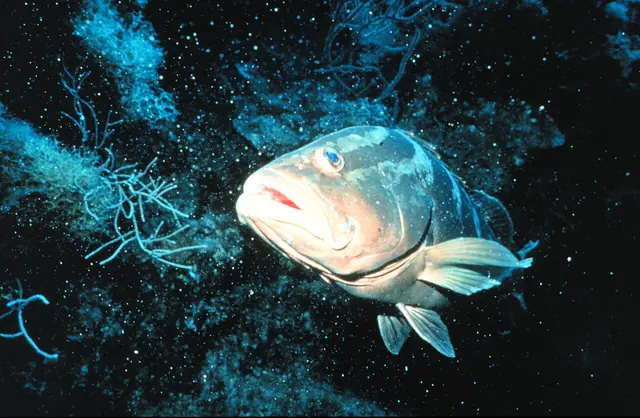
Nassau grouper spawning, Little Cayman
West End, Little Cayman, Cayman Islands · January or February · Times in Cayman Islands time
Nassau grouper live alone most of the year, but each winter thousands meet at the west end of Little Cayman, one of the largest of the few spawning aggregations of this endangered fish still known.
REEF: the Grouper Moon Project, with the Cayman Islands Department of the Environment since 2001; Little Cayman holds one of the largest of the few remaining aggregations of this endangered species. Source · All sources
Predicted nights in 2041
Times are Cayman Islands time.
After the 17 January full moon
Fri 18 to Fri 25 Jan 2041
Possible
The rule expects the main spawning in the other month.
| Night | Watch | Rating |
|---|---|---|
| Fri 18 Jan | 5:04 PM to 6:24 PM | Possible |
| Sat 19 Jan | 5:05 PM to 6:25 PM | Possible |
| Sun 20 Jan | 5:06 PM to 6:26 PM | Possible |
| Mon 21 Jan | 5:06 PM to 6:26 PM | Possible |
| Tue 22 Jan | 5:07 PM to 6:27 PM | Possible |
| Wed 23 Jan | 5:08 PM to 6:28 PM | Possible |
| Thu 24 Jan | 5:08 PM to 6:28 PM | Possible |
| Fri 25 Jan | 5:09 PM to 6:29 PM | Possible |
After the 15 February full moon
Sat 16 to Sat 23 Feb 2041
Likely
The rule expects the main spawning this month.
| Night | Watch | Rating |
|---|---|---|
| Sat 16 Feb | 5:21 PM to 6:41 PM | Likely |
| Sun 17 Feb | 5:21 PM to 6:41 PM | Likely |
| Mon 18 Feb | 5:22 PM to 6:42 PM | Likely |
| Tue 19 Feb | 5:22 PM to 6:42 PM | Likely |
| Wed 20 Feb | 5:22 PM to 6:42 PM | Likely |
| Thu 21 Feb | 5:23 PM to 6:43 PM | Possible |
| Fri 22 Feb | 5:23 PM to 6:43 PM | Possible |
| Sat 23 Feb | 5:24 PM to 6:44 PM | Possible |
Where it happens
West End, Little Cayman, Cayman Islands · 19.7° N, 80.1° W

Drag or scroll to move around the map; hover or tap a dot for another spectacle.
How we predict it
Every spawning burst in five years of monitoring came in January or February, one to eight days after the full moon; the most fish were present one to five days after.
Whaylen et al. (2006), Aggregation dynamics and lessons learned from five years of monitoring at a Nassau grouper spawning aggregation in Little Cayman, Proceedings of the Gulf and Caribbean Fisheries Institute 59. Spawning in January or February, 1 to 8 days after the full moon; the month set by January's full moon against the winter solstice; bursts from 21 minutes before to 11 minutes after sunset on average. Source · All sources
The month depends on January's full moon: one 30 days or more after the winter solstice brought the main spawning in January; an earlier one moved it to February.
Whaylen et al. (2006), Aggregation dynamics and lessons learned from five years of monitoring at a Nassau grouper spawning aggregation in Little Cayman, Proceedings of the Gulf and Caribbean Fisheries Institute 59. Spawning in January or February, 1 to 8 days after the full moon; the month set by January's full moon against the winter solstice; bursts from 21 minutes before to 11 minutes after sunset on average. Source · All sources
We apply that rule each year, rate days 1 to 5 of the expected month Likely and days 6 to 8 Possible, and the other month Possible.
Whaylen et al. (2006), Aggregation dynamics and lessons learned from five years of monitoring at a Nassau grouper spawning aggregation in Little Cayman, Proceedings of the Gulf and Caribbean Fisheries Institute 59. Spawning in January or February, 1 to 8 days after the full moon; the month set by January's full moon against the winter solstice; bursts from 21 minutes before to 11 minutes after sunset on average. Source · All sources
Spawning bursts came on average from 21 minutes before to 11 minutes after sunset, as early as an hour before; we show an hour before sunset to 20 minutes after.
Whaylen et al. (2006), Aggregation dynamics and lessons learned from five years of monitoring at a Nassau grouper spawning aggregation in Little Cayman, Proceedings of the Gulf and Caribbean Fisheries Institute 59. Spawning in January or February, 1 to 8 days after the full moon; the month set by January's full moon against the winter solstice; bursts from 21 minutes before to 11 minutes after sunset on average. Source · All sources
Ratings: Best is what the source names as the peak; Likely and Possible follow the source's main and side months or nights; Unlikely is a month the rule expects nothing. Moon phases, sunset and dawn come from NASA JPL's DE440 ephemeris.
Watching it
The Grouper Moon Project of REEF and the Cayman Islands Department of Environment has studied the aggregation every winter since 2001.
REEF: the Grouper Moon Project, with the Cayman Islands Department of the Environment since 2001; Little Cayman holds one of the largest of the few remaining aggregations of this endangered species. Source · All sources
Rules and respect
The Cayman Islands halted fishing at the aggregations in 2003 and made the protection permanent in 2016.
Phys.org (Scripps Institution of Oceanography, 2023): the Cayman Islands halted fishing at the aggregations in 2003 and made the protections permanent in 2016. Source · All sources
What the dates cannot promise
In a split year the fish may gather in January and spawn only in February.
REEF: in a split moon year thousands of Nassau grouper came in January without spawning, then spawned after the February full moon. Source · All sources
More on the nature calendar
- California grunion runsCabrillo Beach, San Pedro · March to August
- Whale sharks at Gladden SpitGladden Spit, off Placencia · March to June, after the full moon
- Horseshoe crab spawning, Delaware BayDuPont Nature Center, Mispillion Harbor, Delaware · May and June
- Christmas Island red crab spawningFlying Fish Cove, Christmas Island · November to January
- Great Barrier Reef coral spawningGreat Barrier Reef, off Cairns · October to December
- Ningaloo coral spawningCoral Bay, Ningaloo Reef · March and April
- Florida Keys coral spawningKey Largo, Florida Keys · August and September
- Flower Garden Banks coral spawningFlower Garden Banks, Gulf of Mexico · August, sometimes September
- Coral spawning at Sesoko, OkinawaSesoko Island, Motobu · May or June
- Rice coral spawning, Kāneʻohe BayKāneʻohe Bay, Oʻahu, Hawaii · June and July, after the new moon
- Palolo rising, SamoaTutuila · October or November
- Olive ridley arribadas at OstionalOstional National Wildlife Refuge, Guanacaste · All year, biggest July to November
- Box jellyfish at WaikīkīWaikīkī Beach, Oʻahu, Hawaii · Every month, 8 to 10 days after the full moon
- Bermuda firewormsFerry Reach · Summer and autumn
- Puerto Rico's bioluminescent baysMosquito Bay, Vieques · All year, best near new moon
- Firefly squid of Toyama BayNamerikawa, Toyama Bay · March to May, near new moon
- Blue tears of the Matsu IslandsBeihai Tunnel, Nangan · April to September, best April to June
- Lunar rainbow at Victoria FallsVictoria Falls rainforest · Three nights at every full moon
- Moonbow at Cumberland FallsCumberland Falls State Resort Park, Kentucky · Five nights around every full moon
- Moonbows at Yosemite FallsYosemite Falls, Yosemite National Park, California · April to June, around the full moon
- Kasanka bat migrationKasanka National Park · Mid-October to December, peak November
- Congress Avenue Bridge batsCongress Avenue Bridge, Austin, Texas · Every evening, March to October
- Penguin Parade, Phillip IslandSummerland Beach, Phillip Island · Every evening, all year
- Sort Sol, the black sunTønder Marsh · Early March to mid-April, mid-August to October
- The Severn BoreMinsterworth, Gloucestershire · Spring tides all year
- Great tides at Mont-Saint-MichelMont-Saint-Michel, Normandy · Spring tides all year, biggest near the equinoxes
- The Qiantang River tidal boreYanguan, Haining, Zhejiang · Big tides every lunar month; biggest in the eighth (September or October)
- Horsetail Fall firefall, YosemiteHorsetail Fall, El Capitan, Yosemite · Mid to late February, at sunset
- Diamond Fuji and Pearl Fuji, Lake YamanakaLake Yamanaka, Yamanashi · Mid-October to late February at sunset; Pearl Fuji at some full moons
- The Sun's return to LongyearbyenLongyearbyen, Svalbard · 8 March, around noon
- Midnight sun at NordkappNorth Cape plateau, Magerøya · Mid-May to late July
- Bau Nyale sea worms, LombokSeger Beach, Kuta, Central Lombok · February or March, before dawn
- Sandhill cranes on the Platte RiverRowe Sanctuary, Gibbon, Nebraska · March to early April, at sunset
- Silver eels on dark autumn nightsBurrishoole, County Mayo · September to December, on dark nights
- Kapenta rig lights on Lake KaribaKariba, Lake Kariba · All year, between full moons
- Gulf grunion by day, Puerto PeñascoPuerto Peñasco, Sonora · February to May, after new and full moons