
Solar observer
Today's Sun from SDO
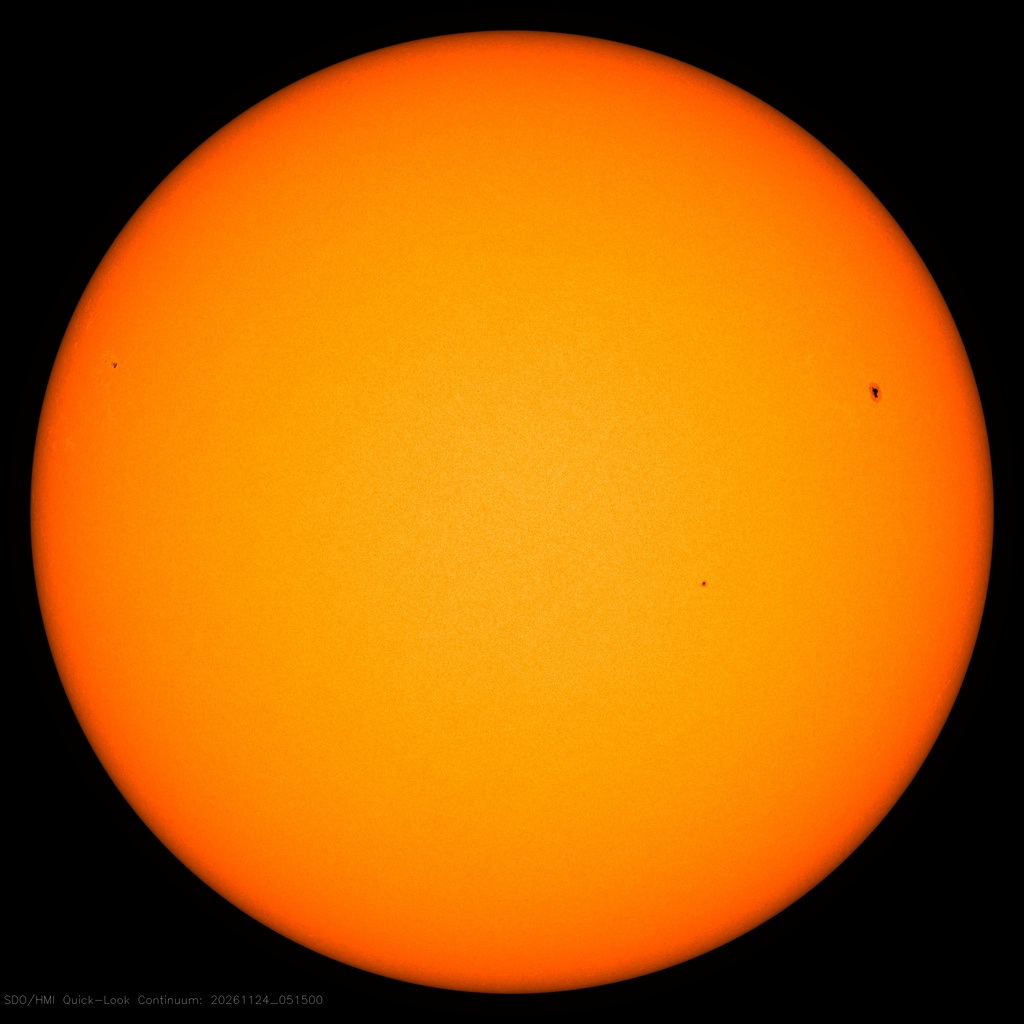
Visible light · HMI continuum near 617 nm. The photosphere in white light, colored orange: sunspots, their umbrae and penumbrae, and the darkening toward the limb, as a white-light solar filter shows them.
Courtesy of NASA/SDO and the AIA, EVE, and HMI science teams.
The Sun's orientation
(20 Jan 10:54 UTC)From Columbus, Ohio, US
The Sun is below the horizon (-21.9°).
Pick a time of day in the bar above to see how the disk sits in a telescope from here.
Day by day at 0h UT
| Date | P | B0 | L0 | Rotation |
|---|---|---|---|---|
| −6.91° | −5.03° | 189.52° | 1985.474 | |
| −7.36° | −5.12° | 176.35° | 1985.510 | |
| −7.81° | −5.21° | 163.18° | 1985.547 | |
| −8.26° | −5.30° | 150.02° | 1985.583 | |
| −8.70° | −5.39° | 136.85° | 1985.620 | |
| −9.14° | −5.47° | 123.68° | 1985.656 | |
| −9.58° | −5.55° | 110.52° | 1985.693 | |
| −10.01° | −5.64° | 97.35° | 1985.730 | |
| −10.44° | −5.72° | 84.18° | 1985.766 | |
| −10.86° | −5.79° | 71.02° | 1985.803 | |
| −11.28° | −5.87° | 57.85° | 1985.839 | |
| −11.69° | −5.95° | 44.68° | 1985.876 | |
| −12.11° | −6.02° | 31.52° | 1985.912 | |
| −12.51° | −6.09° | 18.35° | 1985.949 | |
| −12.91° | −6.16° | 5.18° | 1985.986 | |
| −13.31° | −6.22° | 352.02° | 1986.022 | |
| −13.70° | −6.29° | 338.85° | 1986.059 | |
| −14.09° | −6.35° | 325.68° | 1986.095 | |
| −14.47° | −6.41° | 312.52° | 1986.132 | |
| −14.85° | −6.47° | 299.35° | 1986.168 | |
| −15.22° | −6.53° | 286.18° | 1986.205 | |
| −15.59° | −6.58° | 273.02° | 1986.242 | |
| −15.95° | −6.64° | 259.85° | 1986.278 | |
| −16.31° | −6.69° | 246.68° | 1986.315 | |
| −16.66° | −6.74° | 233.52° | 1986.351 | |
| −17.00° | −6.78° | 220.35° | 1986.388 | |
| −17.34° | −6.83° | 207.18° | 1986.424 | |
| −17.68° | −6.87° | 194.01° | 1986.461 |
A line marks the last 0h UT before a new Carrington rotation begins. A year of it as data
Sunspot numbers
The last two weeks
| Date | Number | Area | Flux |
|---|---|---|---|
| Sun 29 Nov | 49 | – | – |
| Sat 28 Nov | 48 | 200 | 101 |
| Fri 27 Nov | 30 | 70 | 91 |
| Thu 26 Nov | 22 | 70 | 87 |
| Wed 25 Nov | 33 | 90 | 87 |
| Tue 24 Nov | 36 | 170 | 88 |
| Mon 23 Nov | 23 | 150 | 90 |
| Sun 22 Nov | 23 | 160 | 94 |
| Sat 21 Nov | 39 | 230 | 99 |
| Fri 20 Nov | 62 | 260 | 103 |
| Thu 19 Nov | 80 | 320 | 107 |
| Wed 18 Nov | 148 | 590 | 118 |
| Tue 17 Nov | 145 | 510 | 121 |
| Mon 16 Nov | 111 | 390 | 123 |
Numbered regions on the disk
| Region | Location | Carrington | Area | Spots | McIntosh | Magnetic | Flares C/M/X |
|---|---|---|---|---|---|---|---|
| AR 4584 | S10E41 | 182° | 90 | 5 | Cao | B | 0/0/0% |
| AR 4583 | N05E03 | 219° | 20 | 6 | – | – | 0/0/0% |
| AR 4582 | N18W20 | 243° | – | – | – | – | 0/0/0% |
| AR 4585 | N09W25 | 247° | 50 | 8 | – | – | 0/0/0% |
3 groups with 19 spots and 160 MSH of area in this report.
Sources and method
P, B0 and L0 come from the site's own astronomy core: the Earth's and the Sun's positions from NASA JPL's DE440 ephemeris, the IAU's rotation elements for the Sun, and the light-time correction The Astronomical Almanac applies. They agree with sunpy to 0.002° and with the printed tables to their last digit.
Sources
Flares and the regions that made them: Solar flares. The next eclipse of the Sun from here: Eclipses.