
Solar observer
Today's Sun from SDO
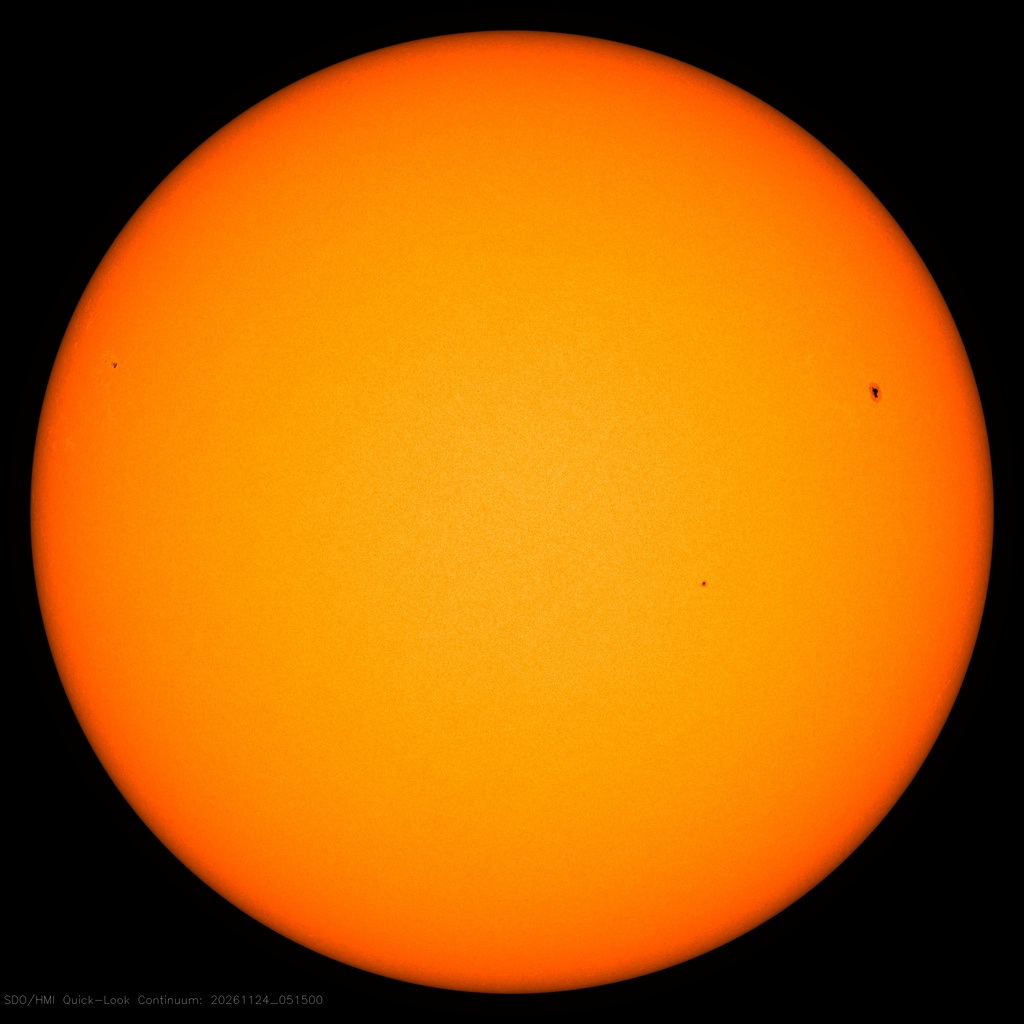
Visible light · HMI continuum near 617 nm. The photosphere in white light, colored orange: sunspots, their umbrae and penumbrae, and the darkening toward the limb, as a white-light solar filter shows them.
Courtesy of NASA/SDO and the AIA, EVE, and HMI science teams.
The Sun's orientation
(7 Sep 10:51 UTC)From Columbus, Ohio, US
The Sun is below the horizon (-3.5°).
Pick a time of day in the bar above to see how the disk sits in a telescope from here.
Day by day at 0h UT
| Date | P | B0 | L0 | Rotation |
|---|---|---|---|---|
| +22.56° | +7.25° | 260.03° | 2074.278 | |
| +22.77° | +7.25° | 246.82° | 2074.314 | |
| +22.98° | +7.25° | 233.61° | 2074.351 | |
| +23.18° | +7.25° | 220.41° | 2074.388 | |
| +23.38° | +7.24° | 207.20° | 2074.424 | |
| +23.57° | +7.24° | 194.00° | 2074.461 | |
| +23.75° | +7.23° | 180.80° | 2074.498 | |
| +23.93° | +7.22° | 167.59° | 2074.534 | |
| +24.11° | +7.20° | 154.39° | 2074.571 | |
| +24.27° | +7.19° | 141.19° | 2074.608 | |
| +24.43° | +7.17° | 127.99° | 2074.644 | |
| +24.59° | +7.15° | 114.78° | 2074.681 | |
| +24.73° | +7.13° | 101.58° | 2074.718 | |
| +24.87° | +7.10° | 88.38° | 2074.754 | |
| +25.01° | +7.08° | 75.18° | 2074.791 | |
| +25.14° | +7.05° | 61.98° | 2074.828 | |
| +25.26° | +7.02° | 48.78° | 2074.864 | |
| +25.37° | +6.99° | 35.59° | 2074.901 | |
| +25.48° | +6.95° | 22.39° | 2074.938 | |
| +25.58° | +6.92° | 9.19° | 2074.974 | |
| +25.68° | +6.88° | 355.99° | 2075.011 | |
| +25.77° | +6.84° | 342.80° | 2075.048 | |
| +25.85° | +6.80° | 329.60° | 2075.084 | |
| +25.92° | +6.75° | 316.40° | 2075.121 | |
| +25.99° | +6.71° | 303.21° | 2075.158 | |
| +26.05° | +6.66° | 290.01° | 2075.194 | |
| +26.11° | +6.61° | 276.82° | 2075.231 | |
| +26.15° | +6.56° | 263.62° | 2075.268 |
A line marks the last 0h UT before a new Carrington rotation begins. A year of it as data
Sunspot numbers
The last two weeks
| Date | Number | Area | Flux |
|---|---|---|---|
| Sun 29 Nov | 50 | – | – |
| Sat 28 Nov | 48 | 200 | 101 |
| Fri 27 Nov | 30 | 70 | 91 |
| Thu 26 Nov | 22 | 70 | 87 |
| Wed 25 Nov | 33 | 90 | 87 |
| Tue 24 Nov | 36 | 170 | 88 |
| Mon 23 Nov | 23 | 150 | 90 |
| Sun 22 Nov | 23 | 160 | 94 |
| Sat 21 Nov | 39 | 230 | 99 |
| Fri 20 Nov | 62 | 260 | 103 |
| Thu 19 Nov | 80 | 320 | 107 |
| Wed 18 Nov | 148 | 590 | 118 |
| Tue 17 Nov | 145 | 510 | 121 |
| Mon 16 Nov | 111 | 390 | 123 |
Numbered regions on the disk
| Region | Location | Carrington | Area | Spots | McIntosh | Magnetic | Flares C/M/X |
|---|---|---|---|---|---|---|---|
| AR 4584 | S10E41 | 182° | 70 | 6 | Cao | B | 20/5/1% |
| AR 4583 | N05E03 | 219° | 20 | 6 | Dro | B | 15/1/1% |
| AR 4582 | N18W20 | 243° | – | – | – | – | 0/0/0% |
| AR 4585 | N10W36 | 258° | 50 | 8 | Dso | B | 20/5/1% |
3 groups with 20 spots and 140 MSH of area in this report.
Sources and method
P, B0 and L0 come from the site's own astronomy core: the Earth's and the Sun's positions from NASA JPL's DE440 ephemeris, the IAU's rotation elements for the Sun, and the light-time correction The Astronomical Almanac applies. They agree with sunpy to 0.002° and with the printed tables to their last digit.
Sources
Flares and the regions that made them: Solar flares. The next eclipse of the Sun from here: Eclipses.